20 IEP Goals for Students with Autism (With Examples)
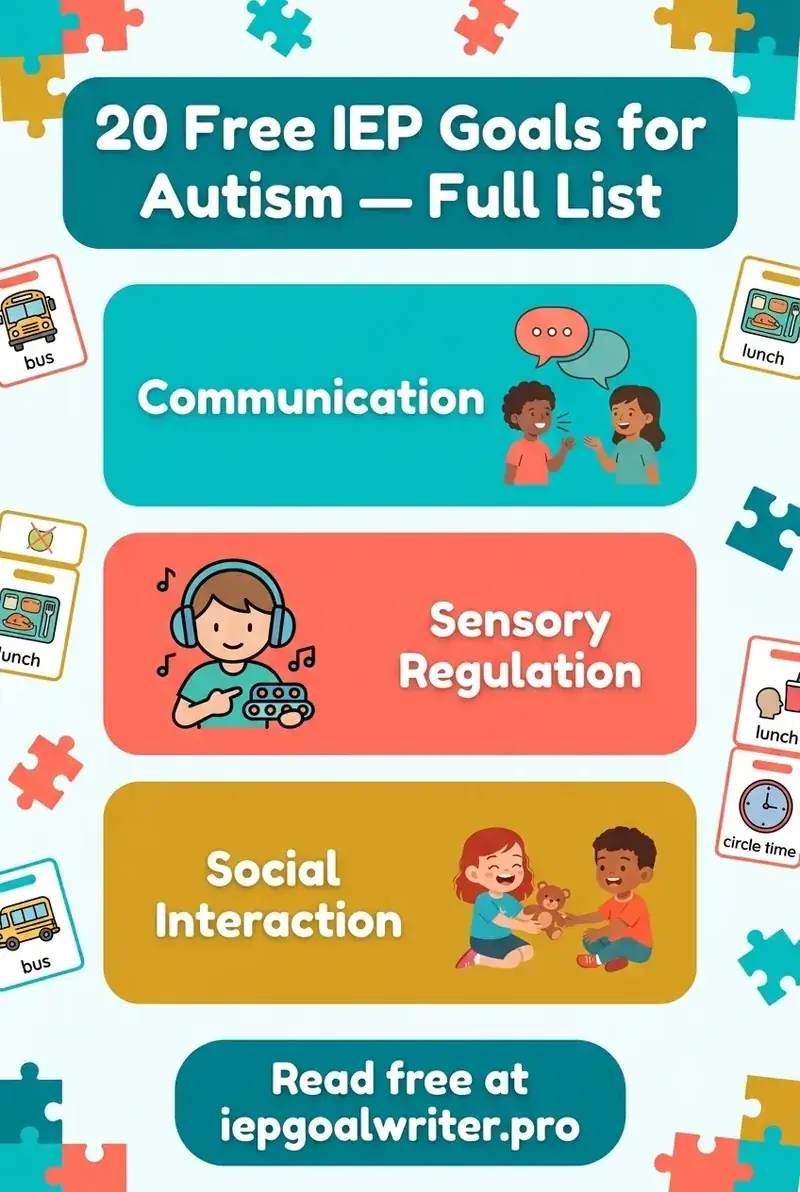
Good IEP goals for autism target communication, sensory regulation, social interaction, and flexibility with routines. Each goal should be observable, measurable, and tied to the student's specific present levels — for example, initiating a request using words or AAC in 4 of 5 opportunities, rather than a vague goal like 'improve communication.'
Autism affects each student differently, so IEP goals need to be built from the student's actual present levels rather than copied generically. Below are 20 goals organized into four common target areas for students on the autism spectrum — use them as a starting structure, then adjust the accuracy percentage, trial count, and support level to match your student's baseline data.
Communication
- 1.By [date], [student] will initiate a request for a preferred item or activity using a complete sentence or AAC device in 4 of 5 observed opportunities, as measured by teacher and SLP data collection.
- 2.By [date], [student] will respond to a peer's greeting with an appropriate verbal or gestural response in 4 of 5 opportunities across 3 settings, as measured by observation data.
- 3.By [date], [student] will use 2-3 word phrases to comment on an activity during structured play in 4 of 5 opportunities, as measured by SLP session data.
- 4.By [date], [student] will answer simple 'wh-' questions about a familiar routine with 80% accuracy across 4 of 5 trials, as measured by teacher-administered probes.
- 5.By [date], [student] will use a visual schedule to independently transition between 3 activities with no more than 1 verbal prompt in 4 of 5 opportunities.
Sensory Regulation
- 1.By [date], [student] will independently use a sensory break card to request a break when overwhelmed in 4 of 5 observed opportunities, as measured by behavior log data.
- 2.By [date], [student] will tolerate a non-preferred sensory input (e.g., fire drill, loud cafeteria) for 10 consecutive minutes with no more than 1 self-regulation prompt in 3 of 4 occurrences.
- 3.By [date], [student] will identify their own sensory state (calm, overwhelmed, seeking) using a visual scale with 80% accuracy in 4 of 5 check-ins.
Social Interaction
- 1.By [date], [student] will engage in parallel play alongside a peer for 5 consecutive minutes without adult prompting in 4 of 5 observed opportunities.
- 2.By [date], [student] will take a turn in a structured game with 1 peer, waiting appropriately, in 4 of 5 opportunities across 3 sessions.
- 3.By [date], [student] will identify a peer's basic emotion (happy, sad, frustrated) from a photo or video with 80% accuracy in 4 of 5 trials.
- 4.By [date], [student] will independently join an ongoing peer activity using a taught script (e.g., 'Can I play too?') in 3 of 4 observed opportunities.
Flexibility & Transitions
- 1.By [date], [student] will transition between 2 non-preferred activities within 2 minutes of a visual or verbal cue, with no more than 1 prompt, in 4 of 5 observed transitions.
- 2.By [date], [student] will tolerate an unexpected change to the daily schedule (with advance visual warning) without a behavioral escalation in 3 of 4 occurrences.
- 3.By [date], [student] will accept 'not now' or 'no' from an adult regarding a preferred activity, using a taught coping strategy, in 4 of 5 observed opportunities.
Why Goals Should Come from the FBA, Not a Template
The goals above are a starting structure, not a checklist to copy wholesale. For a student with autism, the IEP team should pull directly from evaluation data and, where behavior is involved, the Functional Behavior Assessment — a goal only works if it targets a skill this specific student is missing, at a support level they can actually reach from their current baseline.
FAQ
Paste your assessment data and generate an IDEA-compliant, individualized goal in seconds.
Try it free →