14 IEP Behavior & Self-Regulation Goals
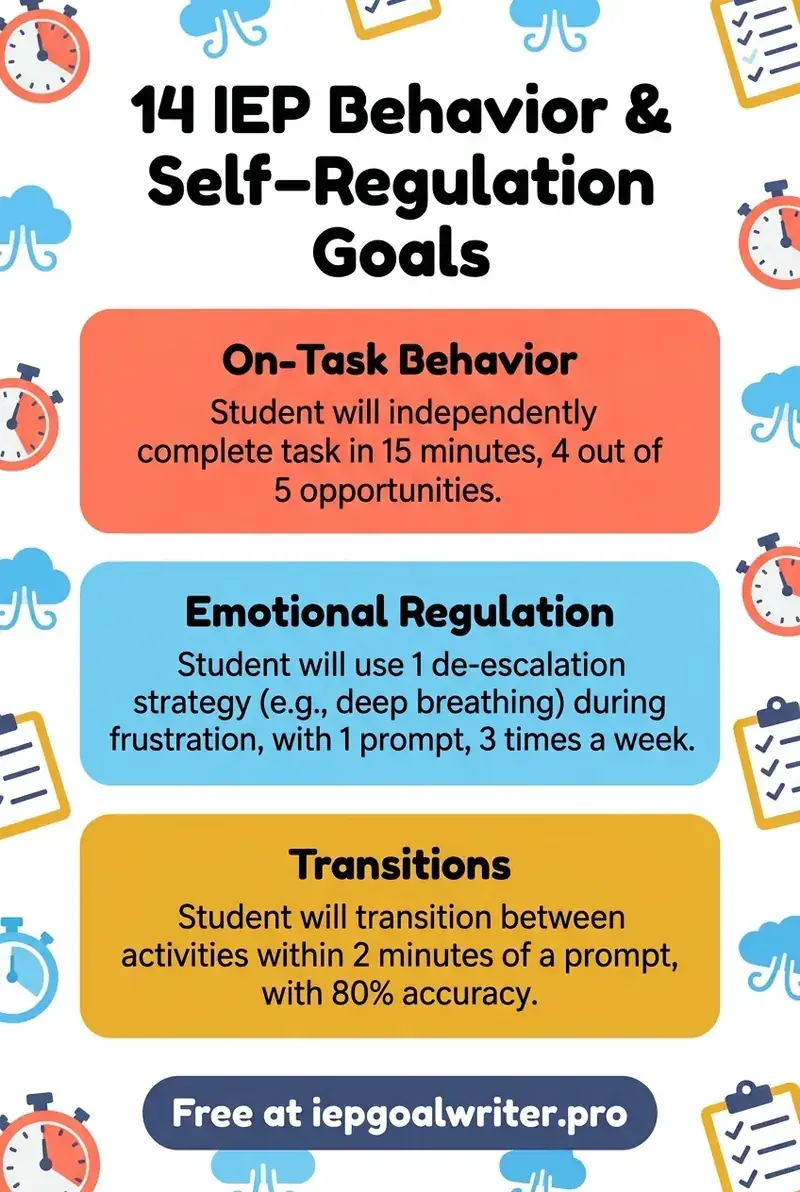
IEP behavior and self-regulation goals should target a replacement skill identified through an FBA — staying on-task, using a coping strategy, or transitioning smoothly — with clear observable criteria, such as remaining on-task for 15 consecutive minutes with no more than 1 redirect.
The strongest behavior goals target a specific, teachable replacement skill rather than just trying to reduce a problem behavior. These 14 goals cover the most common self-regulation targets across on-task behavior, emotional regulation, and transitions.
On-Task Behavior
- 1.By [date], [student] will remain on-task during independent work for 15 consecutive minutes with no more than 1 teacher redirect in 4 of 5 observed sessions.
- 2.By [date], [student] will use a self-monitoring checklist to track on-task behavior, matching teacher ratings within 1 point, in 4 of 5 sessions.
- 3.By [date], [student] will return to task independently after a self-identified distraction in 4 of 5 observed opportunities.
- 4.By [date], [student] will follow classroom expectations during whole-group instruction with no more than 2 redirects in 4 of 5 sessions.
Emotional Regulation
- 1.By [date], [student] will independently use a coping strategy (deep breathing, movement break, fidget tool) when frustrated in 4 of 5 observed opportunities.
- 2.By [date], [student] will identify their emotional state using a visual scale with 80% accuracy in 4 of 5 check-ins.
- 3.By [date], [student] will request a break using an appropriate signal before escalating in 4 of 5 observed opportunities.
- 4.By [date], [student] will accept corrective feedback from an adult without arguing or shutting down in 4 of 5 observed instances.
Transitions
- 1.By [date], [student] will transition between classroom activities within 2 minutes of the signal with no more than 1 verbal prompt in 4 of 5 observed transitions.
- 2.By [date], [student] will use a visual schedule to anticipate and prepare for an upcoming transition in 4 of 5 opportunities.
- 3.By [date], [student] will tolerate an unexpected schedule change (with advance notice) without a behavioral escalation in 3 of 4 occurrences.
- 4.By [date], [student] will line up and walk in the hallway following classroom expectations in 4 of 5 observed transitions.
Following Directions
- 1.By [date], [student] will follow a 2-step direction from an adult without needing repetition in 4 of 5 observed opportunities across 3 settings.
- 2.By [date], [student] will comply with a non-preferred adult request within 1 minute with no more than 1 prompt in 4 of 5 opportunities.
Pairing Goals with Data Collection
Behavior and self-regulation goals are only as useful as the data behind them. Before finalizing a goal, confirm exactly how it will be tracked — a frequency count, an interval observation, or a self-monitoring checklist — since vague plans to keep an eye on it rarely produce data a team can use to judge progress at the next review.
Paste your assessment data and generate an IDEA-compliant, individualized goal in seconds.
Try it free →