12 IEP Fine Motor Goals (With Examples)
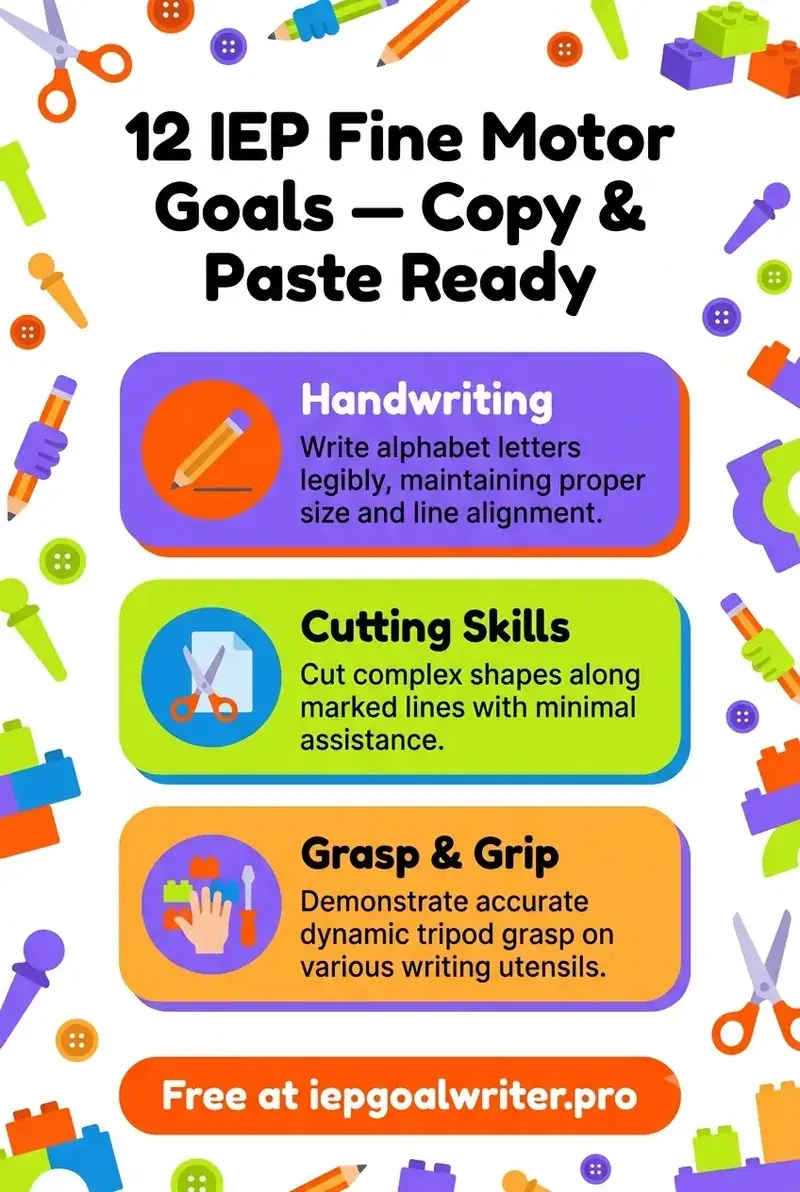
IEP fine motor goals should target the specific skill an OT evaluation identified as delayed — handwriting legibility, scissor use, or grasp pattern — with clear accuracy criteria, such as writing legibly using a tripod grasp with 80% accuracy across 4 of 5 writing samples.
Fine motor goals are usually developed in coordination with an occupational therapist and should target functional classroom tasks — writing, cutting, and manipulating materials — not isolated motor exercises disconnected from schoolwork.
Handwriting
- 1.By [date], [student] will write their first and last name legibly using a functional grasp with 80% accuracy in 4 of 5 writing samples.
- 2.By [date], [student] will write letters within the lines of ruled paper with 80% accuracy across 4 of 5 writing samples.
- 3.By [date], [student] will copy a sentence from the board legibly within a reasonable time frame in 4 of 5 opportunities.
- 4.By [date], [student] will use appropriate spacing between words in independent writing with 80% accuracy in 4 of 5 samples.
Cutting & Manipulation
- 1.By [date], [student] will use scissors to cut along a straight line with 80% accuracy in 4 of 5 trials.
- 2.By [date], [student] will use scissors to cut along a curved line with 75% accuracy in 4 of 5 trials.
- 3.By [date], [student] will manipulate small classroom materials (paperclips, coins, buttons) using a pincer grasp in 4 of 5 observed opportunities.
Grasp & Grip
- 1.By [date], [student] will demonstrate a functional tripod grasp on a pencil during a 5-minute writing task in 4 of 5 observed opportunities.
- 2.By [date], [student] will maintain appropriate pencil grip and pressure for the duration of a writing assignment in 4 of 5 samples.
- 3.By [date], [student] will use an adaptive grip tool independently during writing tasks in 4 of 5 observed opportunities.
- 4.By [date], [student] will complete a 10-piece puzzle independently within 5 minutes in 4 of 5 trials.
- 5.By [date], [student] will fasten buttons or a zipper independently in 4 of 5 observed opportunities.
When to Loop in Occupational Therapy
If a student is not progressing on a fine motor goal despite consistent practice, that is a signal to request an OT consultation rather than simply extending the same goal for another year. An OT can identify whether the barrier is grip strength, visual-motor integration, or something else entirely — information that changes what the goal and the intervention should actually look like.
Paste your assessment data and generate an IDEA-compliant, individualized goal in seconds.
Try it free →