12 IEP Goals for Deaf & Hard-of-Hearing Students
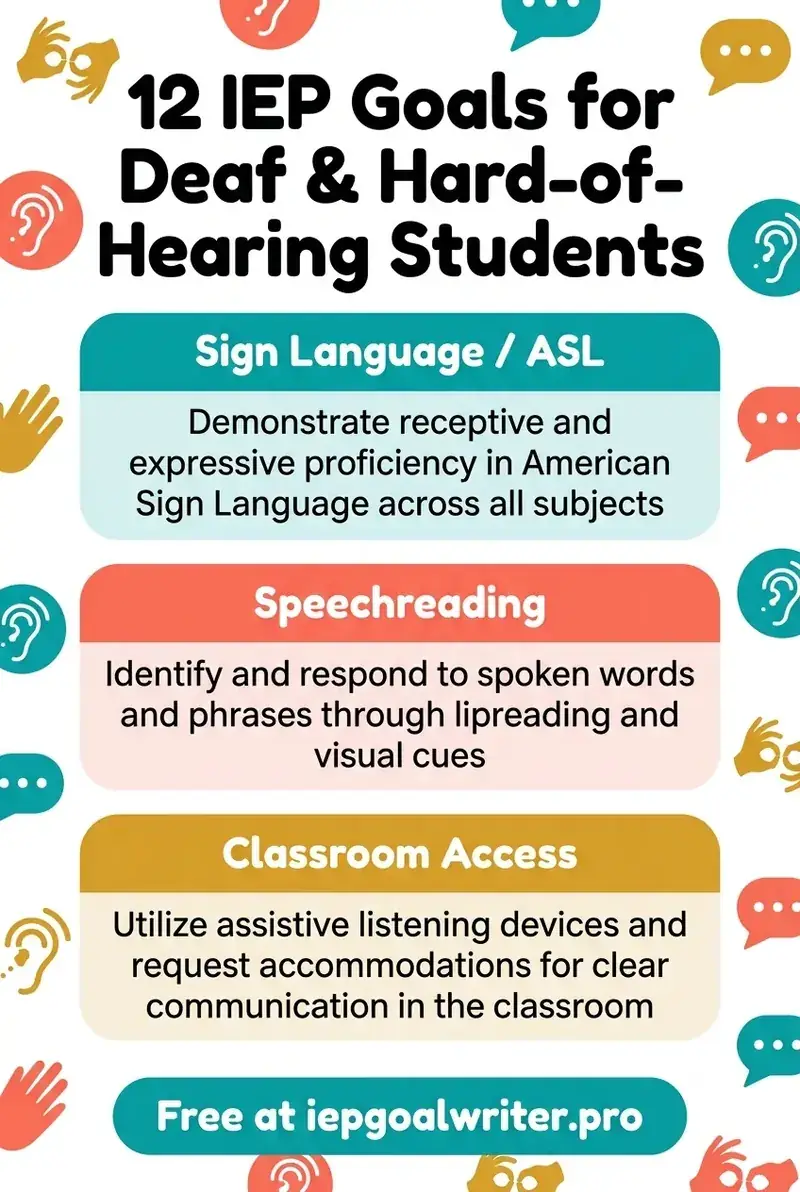
IEP goals for deaf and hard-of-hearing students should target the student's primary communication mode — sign language, spoken language with amplification, or a combined approach — plus classroom access skills like requesting repetition or using assistive listening devices independently.
Deaf and hard-of-hearing students have widely different communication profiles depending on hearing level, amplification, and family communication mode, so goals should reflect the IEP team's documented communication plan rather than assuming one approach fits all students.
Language Development
- 1.By [date], [student] will expressively use 25 new ASL signs or vocabulary words in structured activities with 80% accuracy across 4 of 5 trials.
- 2.By [date], [student] will answer comprehension questions about a story presented in their primary communication mode with 80% accuracy in 4 of 5 trials.
- 3.By [date], [student] will use complete sentences (in sign or spoken language) to describe a daily event in 4 of 5 observed opportunities.
Speechreading & Listening
- 1.By [date], [student] will identify key words in a teacher's instruction using speechreading and residual hearing with 75% accuracy across 4 of 5 trials.
- 2.By [date], [student] will independently check and report if their hearing aid or cochlear implant is functioning properly each morning in 4 of 5 school days.
- 3.By [date], [student] will use an FM/assistive listening system independently during instruction in 4 of 5 observed opportunities.
Classroom Access & Self-Advocacy
- 1.By [date], [student] will request repetition or clarification when a message is missed in 4 of 5 observed opportunities, rather than guessing or disengaging.
- 2.By [date], [student] will independently position themselves for optimal visual/auditory access during group instruction in 4 of 5 observed opportunities.
- 3.By [date], [student] will explain their hearing loss and needed accommodations to a new teacher or peer with 80% accuracy in a role-play scenario.
- 4.By [date], [student] will use visual classroom cues (lights, captions) to stay informed of transitions in 4 of 5 observed opportunities.
- 5.By [date], [student] will follow a captioned or interpreted video lesson and answer comprehension questions with 80% accuracy in 4 of 5 trials.
Aligning Goals with the Communication Plan
Every IEP for a deaf or hard-of-hearing student should reference a documented communication plan — the family and team's agreed-upon primary language and mode. Goals should support that plan rather than default to whichever approach is easiest for staff; if the communication plan says ASL is primary, spoken-language goals should not quietly take over the IEP.
Paste your assessment data and generate an IDEA-compliant, individualized goal in seconds.
Try it free →