12 IEP Goals for Emotional & Behavioral Disorders (EBD)
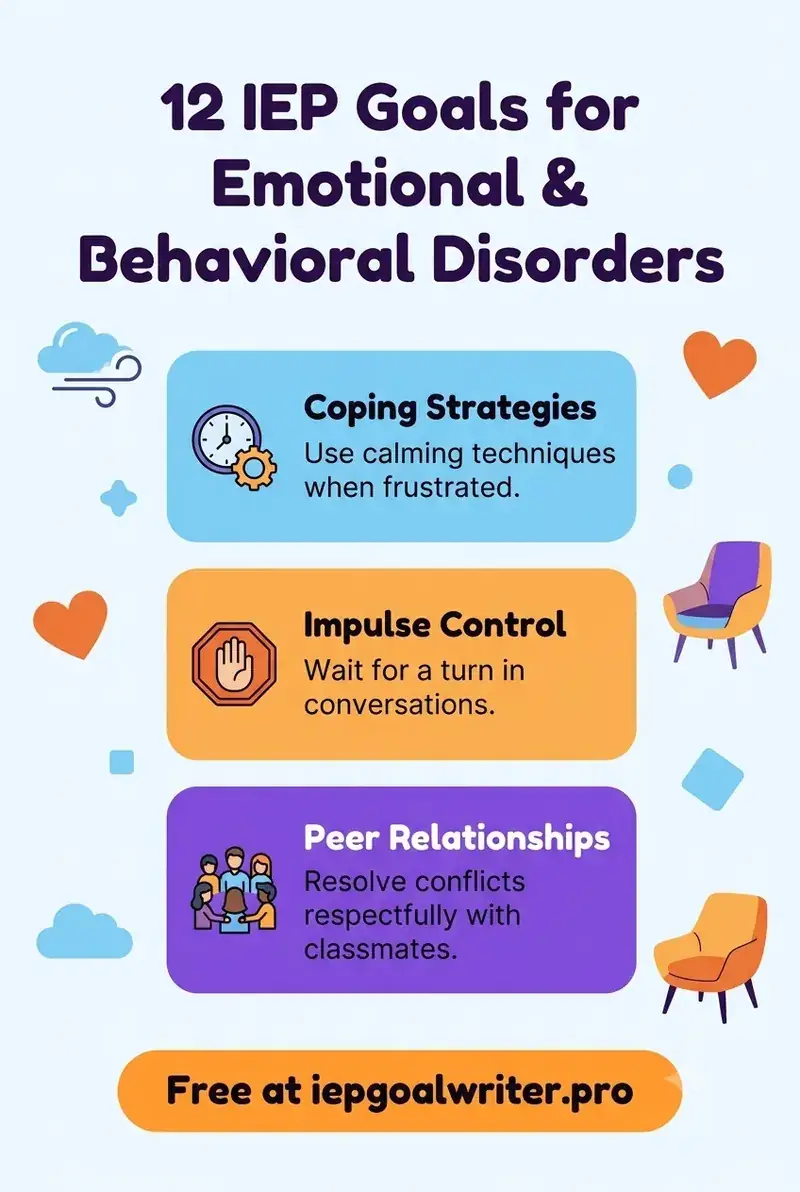
IEP goals for emotional/behavioral disorders should target the specific replacement behavior identified through an FBA — coping strategy use, impulse control, or peer interaction — with clear, observable criteria, such as using a coping strategy instead of escalating in 4 of 5 opportunities.
For students with an emotional or behavioral disorder (EBD), the strongest goals are built directly from FBA data and connect to the student's BIP. A goal that only says 'reduce outbursts' isn't measurable — instead, target the replacement skill the student is learning to use.
Coping Strategies
- 1.By [date], [student] will independently use a taught coping strategy (deep breathing, break card) when frustrated in 4 of 5 observed opportunities, as measured by behavior log data.
- 2.By [date], [student] will identify their emotional state on a 1-5 scale and request support before escalating in 4 of 5 opportunities.
- 3.By [date], [student] will use a designated calm-down space independently when signaled in 4 of 5 observed opportunities.
Impulse Control
- 1.By [date], [student] will respond to adult redirection calmly, without arguing or shutting down, in 4 of 5 observed instances.
- 2.By [date], [student] will wait for an adult's attention using an appropriate signal (raised hand, wait card) in 4 of 5 opportunities.
- 3.By [date], [student] will remain in the assigned area during a non-preferred activity without elopement in 4 of 5 observed opportunities.
Peer Relationships
- 1.By [date], [student] will resolve a peer conflict using a taught strategy (e.g., stop-think-talk) without adult intervention in 3 of 4 occurrences.
- 2.By [date], [student] will tolerate a peer declining to share or changing plans without a behavioral escalation in 4 of 5 observed opportunities.
- 3.By [date], [student] will engage in a cooperative activity with a peer for 10 minutes without incident in 4 of 5 sessions.
Connecting These Goals to the BIP
Behavior goals for emotional and behavioral disorders should never stand alone — they need to connect directly to the replacement behaviors identified in the student's Behavior Intervention Plan. If the BIP and the IEP goals describe different target behaviors, staff will end up tracking two different things, which makes it hard to tell whether the intervention is actually working.
Paste your assessment data and generate an IDEA-compliant, individualized goal in seconds.
Try it free →