16 IEP Social Skills Goals (With Examples)
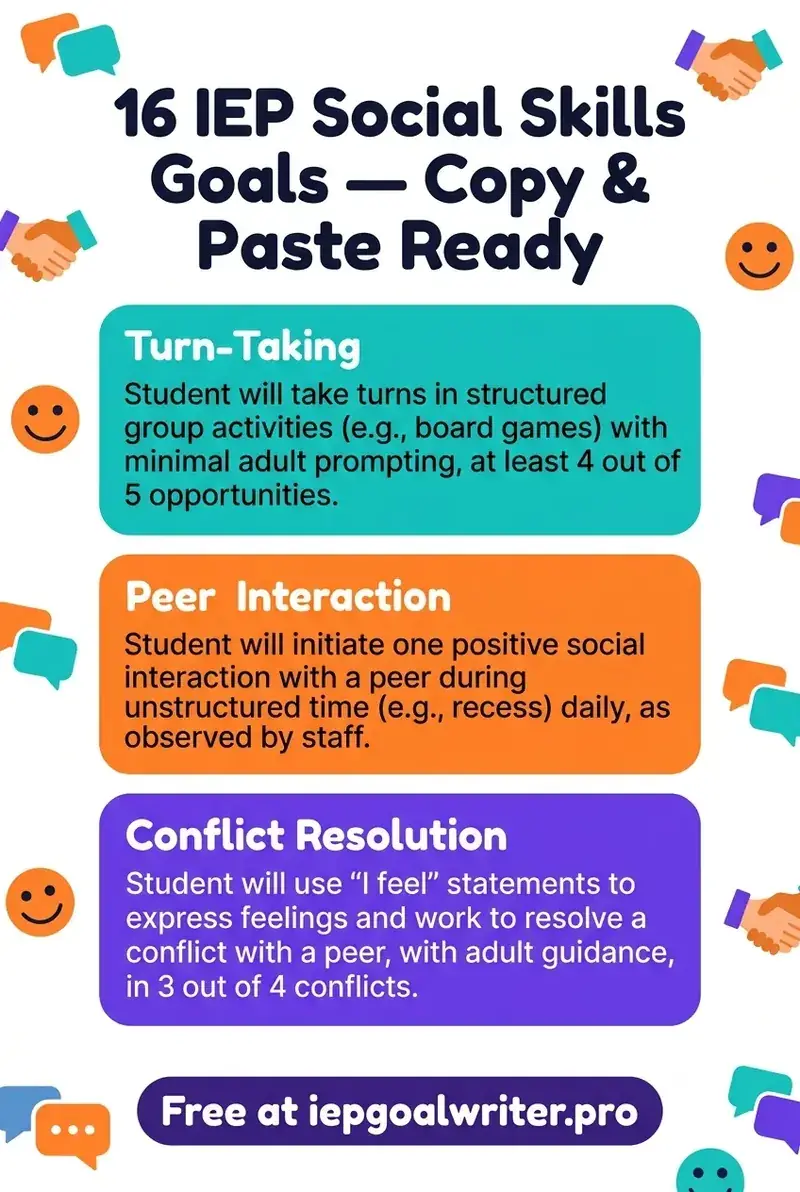
IEP social skills goals should target a specific, observable social behavior — initiating interaction, taking turns, or resolving conflict — measured across real settings like recess or group work, not just a general 'improve social skills' statement that can't be tracked with data.
Social skills goals work best when they target one concrete behavior at a time and are measured in the settings where the student actually struggles — structured class time, recess, or unstructured transitions. These 16 goals cover the most commonly targeted social skill areas.
Turn-Taking & Cooperation
- 1.By [date], [student] will take turns during a structured group activity, waiting appropriately, in 4 of 5 opportunities across 3 sessions.
- 2.By [date], [student] will share materials with a peer during a cooperative task with no more than 1 prompt in 4 of 5 observed opportunities.
- 3.By [date], [student] will follow the rules of a group game without adult intervention in 4 of 5 observed opportunities.
- 4.By [date], [student] will complete an assigned role in a small group project in 4 of 5 opportunities.
Peer Interaction
- 1.By [date], [student] will initiate a positive interaction with a peer using an appropriate greeting or conversation starter in 4 of 5 observed opportunities.
- 2.By [date], [student] will independently join an ongoing peer activity using a taught entry strategy in 3 of 4 observed opportunities.
- 3.By [date], [student] will maintain a peer interaction for 5 consecutive minutes without adult prompting in 4 of 5 observed opportunities.
- 4.By [date], [student] will give and receive a compliment appropriately with a peer in 4 of 5 observed opportunities.
Conflict Resolution
- 1.By [date], [student] will use a taught conflict-resolution strategy (stop-think-talk) to resolve a peer disagreement without adult intervention in 3 of 4 occurrences.
- 2.By [date], [student] will accept 'no' or a change in plans from a peer without a behavioral escalation in 4 of 5 observed opportunities.
- 3.By [date], [student] will identify 2 possible solutions to a peer conflict scenario with 80% accuracy in 4 of 5 trials.
- 4.By [date], [student] will apologize and problem-solve after a conflict with adult support in 4 of 5 observed opportunities.
Reading Social Cues
- 1.By [date], [student] will identify a peer's emotion from facial expression or tone of voice with 80% accuracy in 4 of 5 trials.
- 2.By [date], [student] will adjust their behavior appropriately after recognizing a peer is upset or disengaged in 3 of 4 observed opportunities.
- 3.By [date], [student] will recognize when a conversation topic should change based on a peer's reaction with 75% accuracy in 4 of 5 observed opportunities.
- 4.By [date], [student] will maintain appropriate physical space during a peer interaction in 4 of 5 observed opportunities.
Generalizing Social Skills Across Settings
A social skill practiced only in a small-group pull-out session often does not show up on the playground. Whenever possible, measure social goals in at least one natural setting — recess, lunch, or a general education class — in addition to structured instruction, so the data reflects whether the skill actually transfers.
Paste your assessment data and generate an IDEA-compliant, individualized goal in seconds.
Try it free →