11 IEP Goals for Blind & Low-Vision Students
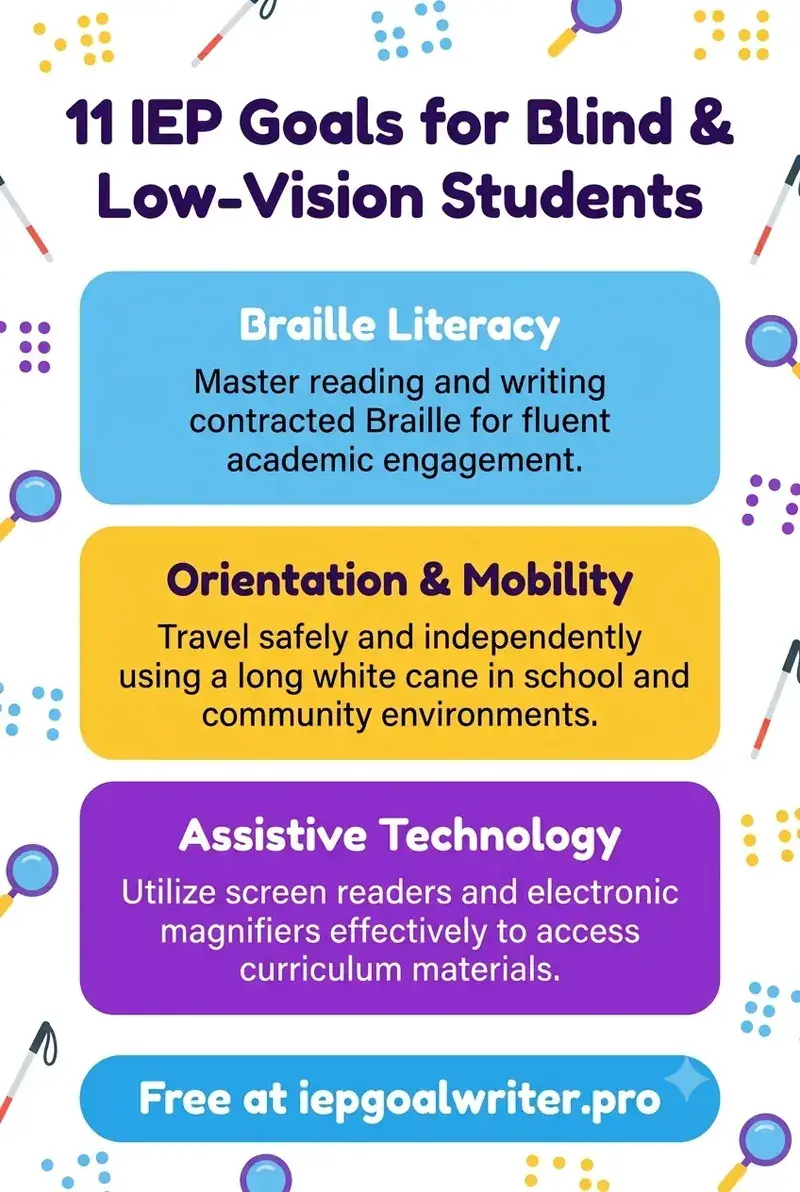
IEP goals for blind and low-vision students typically target braille or large-print literacy, orientation and mobility, and assistive technology use — for example, reading grade-level braille text at a target words-per-minute rate, or independently navigating a familiar school route using a cane.
For students who are blind or have low vision, goals should be built from the Expanded Core Curriculum areas — not just academics, but also independent travel, technology access, and self-advocacy — in coordination with a Teacher of the Visually Impaired (TVI) and O&M specialist.
Braille / Print Literacy
- 1.By [date], [student] will read grade-level braille text at [X] words per minute with 90% accuracy, as measured by TVI-administered probes.
- 2.By [date], [student] will write using a braillewriter or slate and stylus with 85% accuracy across 4 of 5 writing samples.
- 3.By [date], [student] will use large-print or magnification tools to read grade-level text with 80% comprehension accuracy across 4 of 5 trials.
Orientation & Mobility
- 1.By [date], [student] will independently navigate a familiar school route (classroom to cafeteria) using a cane or established technique in 4 of 5 trials.
- 2.By [date], [student] will use protective and trailing techniques to navigate an unfamiliar hallway with no more than 1 prompt in 4 of 5 trials.
- 3.By [date], [student] will cross a controlled intersection safely and independently in 4 of 5 O&M-supervised trials.
Assistive Technology & Self-Advocacy
- 1.By [date], [student] will independently operate screen-reading software to complete a classroom assignment with 80% accuracy in 4 of 5 opportunities.
- 2.By [date], [student] will request needed accommodations (preferential seating, enlarged materials) from a teacher without prompting in 4 of 5 opportunities.
- 3.By [date], [student] will independently organize and locate personal materials using tactile or large-print labeling in 4 of 5 school days.
- 4.By [date], [student] will explain their visual impairment and needed supports to a peer or new teacher with 80% accuracy in a role-play scenario.
Working with the TVI and O&M Specialist
Goals for blind and low-vision students are typically co-owned by the classroom teacher, the Teacher of the Visually Impaired, and an Orientation & Mobility specialist. Braille literacy and O&M goals in particular need specialized instructional time built into the schedule — they cannot be folded into general classroom instruction the way an accommodation can.
Paste your assessment data and generate an IDEA-compliant, individualized goal in seconds.
Try it free →