How to Write IEP Goals (SMART Goal Framework + Examples)
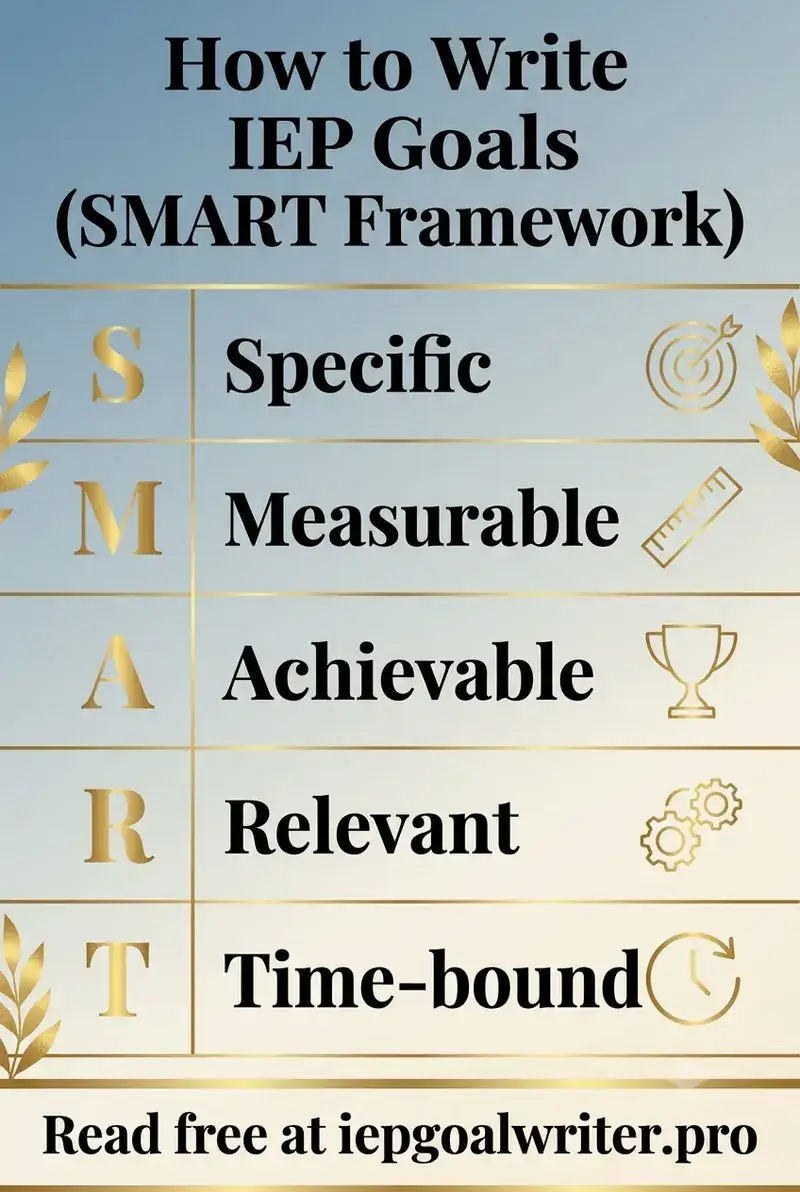
To write an IEP goal, use the SMART framework: make it Specific (name the exact skill), Measurable (include a percentage, count, or rate), Achievable (based on the student's current baseline), Relevant (tied to the disability's impact on education), and Time-bound (with a deadline, usually the next annual review).
A well-written IEP goal should let anyone — a substitute teacher, a new case manager, a parent — understand exactly what the student is working toward and how progress will be measured. Here's the structure that makes that possible.
The SMART framework
Specific: name the exact skill, not a general area ("decode multi-syllabic words," not "improve reading"). Measurable: include a percentage, count, or rate, and how many trials (e.g., "80% accuracy in 4 of 5 trials"). Achievable: set based on the student's actual present levels, not an arbitrary standard. Relevant: connects to how the disability affects access to the curriculum. Time-bound: includes a target date, almost always the next annual review.
The standard goal formula
Most compliant IEP goals follow this structure: "By [date], [student] will [specific measurable behavior] with [criteria — % accuracy, rate, or count] across [number] of [number] trials/opportunities, as measured by [evaluation method — CBM, work samples, observation data, etc.]." Filling in each blank with real data, rather than a generic placeholder, is what separates a strong goal from a template.
Common mistakes to avoid
Avoid goals that describe an activity instead of a skill ("will complete 10 worksheets" isn't measurable progress). Avoid setting the accuracy criteria too high or too low relative to baseline — a goal should be a meaningful stretch, not automatic or impossible. And avoid vague evaluation methods like "teacher observation" alone when a data sheet or CBM probe would be more defensible and easier to track.
Where the baseline number comes from
Every goal's criteria should be set relative to a real starting point, not a guess. If a student currently reads 42 correct words per minute, a goal targeting 100 CWPM by the next annual review may be unrealistic, while a goal targeting 70 CWPM is a meaningful, evidence-based stretch. Pull the baseline from the same assessment method you plan to use for progress monitoring — mixing a baseline from an old evaluation with a totally different progress-monitoring tool makes it hard to tell if a student actually made a full year of growth.
Annual goals vs. short-term objectives
Most states now only require annual goals, but a small number of students — often those working on alternate assessments — also need short-term objectives, which break one annual goal into 2-4 smaller measurable steps along the way. If a state or district requires them, each short-term objective should still follow the same SMART structure as the annual goal, just at a smaller scale and shorter timeframe (often quarterly).
What happens if a goal isn't met
An unmet goal isn't automatically a compliance problem — IDEA expects that not every student will master every goal on schedule. What matters is what the team does with that information: reviewing the data at the annual meeting, adjusting the instructional approach or service minutes, and either extending a still-relevant goal with updated criteria or replacing it with a more appropriate one based on updated present levels.
FAQ
Paste your assessment data and generate an IDEA-compliant, individualized goal in seconds.
Try it free →