What Is a PLAAFP in an IEP? (Definition + Examples)
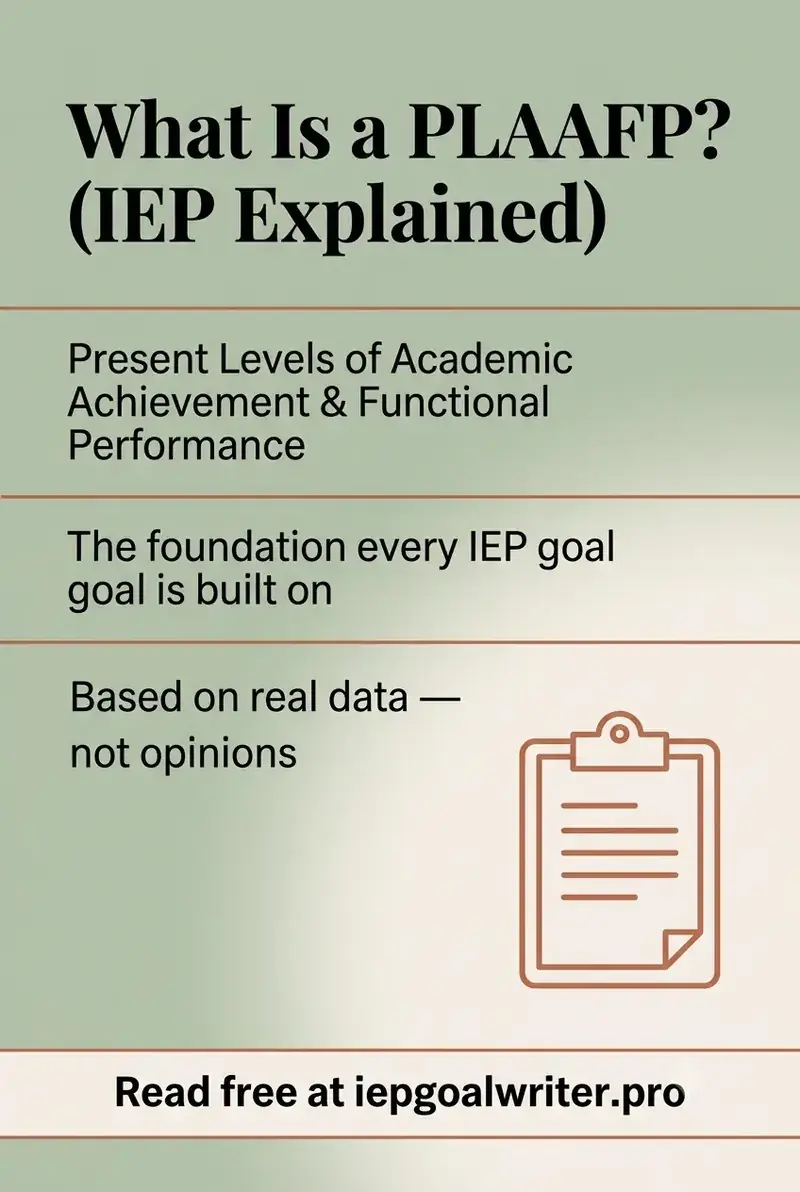
A PLAAFP (Present Levels of Academic Achievement and Functional Performance) is the IEP section describing a student's current skills, strengths, and needs using assessment and observation data. It's the foundation the rest of the IEP is built on — every goal, service, and accommodation must connect back to what the PLAAFP says the student can and can't yet do.
If you're new to case management, the PLAAFP is the single most important section of the IEP to get right — everything downstream (goals, services, accommodations) has to trace back to it. Here's what it actually needs to include.
What a PLAAFP includes
A complete PLAAFP describes the student's current academic performance (reading, math, writing) and functional performance (behavior, communication, social skills, self-care) using specific, data-based language — test scores, percentiles, work samples, and observed classroom behavior. It should explain how the disability affects the student's involvement and progress in the general education curriculum, not just list a diagnosis.
Why it matters so much
IDEA requires that every goal in the IEP be based on the student's present levels. If the PLAAFP is vague or copied from a template, the goals built on top of it won't hold up — either in a due process hearing or, more practically, in actually meeting the student's real needs. A strong PLAAFP is specific enough that someone who has never met the student could understand exactly where they are and why they qualify for services.
A simple structure that works
Start with assessment data (not opinions), describe current skills in measurable terms, connect directly to the goals that follow, and write in plain language that parents can understand without a special education glossary. Avoid vague phrases like 'struggles with reading' — instead write something like 'reads 42 words correct per minute on a 4th-grade passage, compared to a benchmark of 100+.'
Weak PLAAFP vs. strong PLAAFP
A weak PLAAFP reads like an opinion: 'Jordan struggles with reading and gets frustrated during independent work.' A strong PLAAFP reads like evidence: 'On a district benchmark assessment administered in September, Jordan read a 3rd-grade passage at 38 correct words per minute with 82% accuracy, compared to a fall benchmark of 70+ CWPM. Jordan independently completes reading tasks for an average of 6 minutes before requiring redirection, based on 4 classroom observations.' The second version gives the IEP team something they can actually build a goal, a service, and a data plan around — the first doesn't.
PLAAFP vs. the evaluation report
The evaluation report and the PLAAFP are related but not the same document. The evaluation (or reevaluation) is the formal, comprehensive assessment that determines eligibility and often happens only every three years. The PLAAFP is a living summary that pulls from that evaluation plus more recent classroom data, work samples, and progress monitoring — and it gets rewritten at every annual review, not just every three years. Think of the evaluation as the foundation and the PLAAFP as the current status report built on top of it.
How the PLAAFP drives everything else
Every other section of the IEP should be traceable back to a specific statement in the PLAAFP. If the PLAAFP says a student reads at a 2nd-grade level with weak decoding of multi-syllabic words, the goals should target decoding, the services should include instructional time for it, and any accommodations (like audiobooks) should logically follow from that same gap. If a reviewer can't connect a goal or service back to something stated in the present levels, that's usually a sign the PLAAFP needs to be more specific — not that the goal is wrong.
FAQ
Paste your assessment data and generate an IDEA-compliant, individualized goal in seconds.
Try it free →