IEP Data Collection: 6 Ways to Track Progress
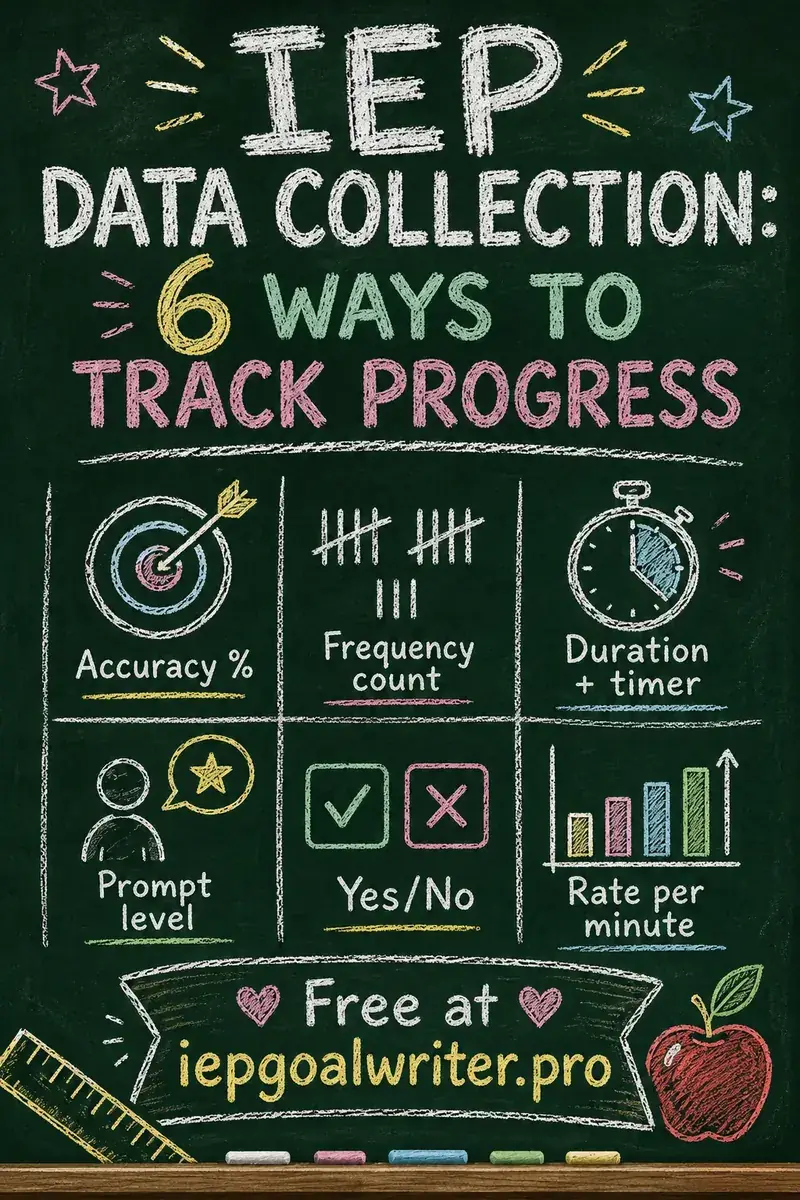
The 6 most common IEP data collection methods are accuracy percentage, frequency count, duration/timer, prompt level, yes/no, and rate per minute. Choosing the wrong method for a goal — like tracking frequency for a fluency goal — is one of the most common reasons progress monitoring data doesn't hold up at review.
Not every goal should be measured the same way. Picking a data method that actually matches the skill makes progress monitoring faster to collect and far more useful at the annual review.
Accuracy percentage
Best for goals with a clear right/wrong answer across multiple trials — math facts, decoding words, answering comprehension questions. Track correct responses out of total attempts. This is the most common method because it's simple, but it doesn't capture speed, so it's a poor fit for fluency-based goals on its own.
Frequency count
Best for behaviors or skills that either happen or don't, counted across a set period — number of times a student initiates a peer interaction, or number of behavioral incidents in a day. Frequency alone can be misleading without also tracking the observation window, since 3 incidents in a 30-minute class means something different than 3 incidents across a full school day.
Duration and timer
Best for goals about sustained behavior over time — how long a student stays on-task, how long a tantrum lasts, or how long a student engages in independent work. Track using a stopwatch or timer app, and record either total duration or average duration across multiple instances.
Prompt level
Best for skills where the target is fading independence, not just accuracy — a student may already perform a task correctly with a full physical prompt, and the real goal is reducing to a gestural or verbal prompt, then to independence. Use a defined prompt hierarchy (full physical → partial physical → gestural → verbal → independent) so "less support needed" is measured consistently.
Yes/No
Best for simple presence/absence of a behavior within a defined opportunity — did the student request appropriately, yes or no; did the student complete the morning routine, yes or no. Simple to collect but loses nuance, so it works best for goals where partial credit doesn't make sense.
Rate per minute
Best for fluency-based goals — oral reading rate, math fact fluency, typing speed. Combines accuracy and speed into one number (correct responses per minute), which is exactly what's needed for skills where both getting it right and getting it fast matter for real-world use.
FAQ
Paste your assessment data and generate an IDEA-compliant, individualized goal in seconds.
Try it free →