IEP Eligibility: 3 Things Evaluators Miss
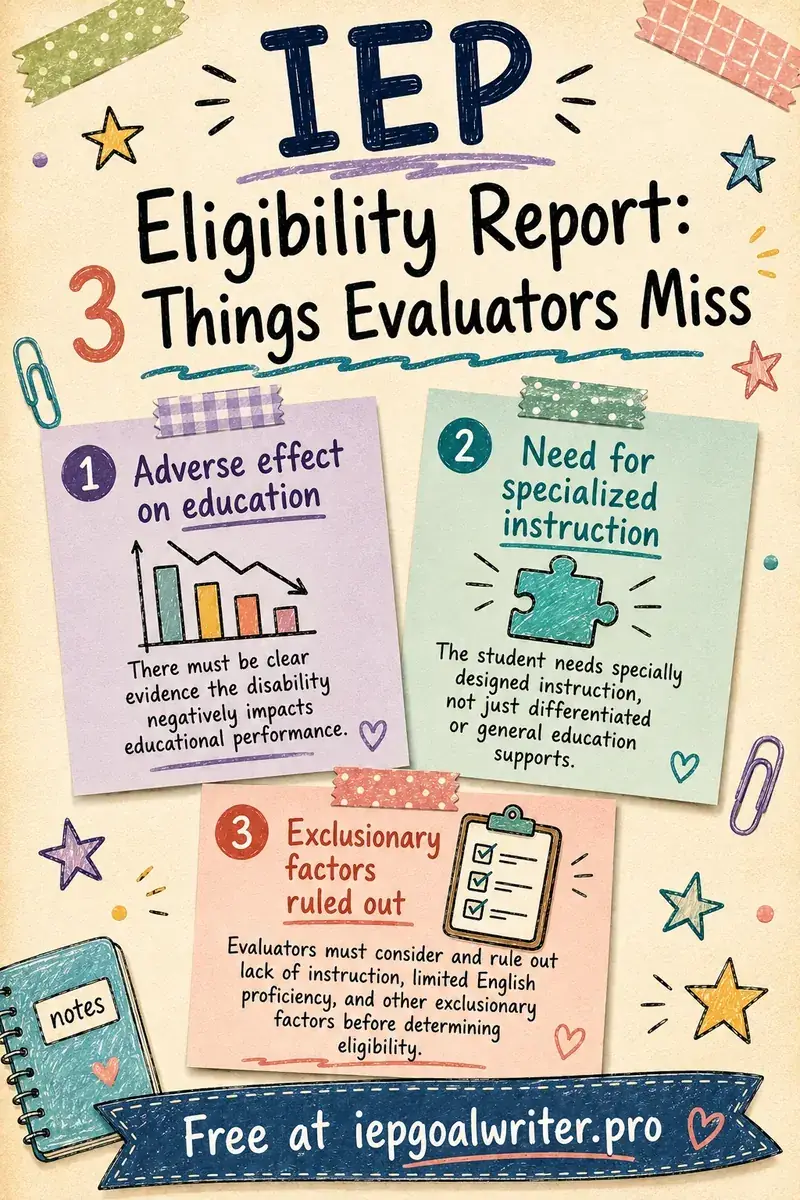
A strong eligibility report needs 3 things beyond a diagnosis: clear evidence of adverse effect on educational performance, documentation that the student needs specially designed instruction (not just accommodations), and confirmation that exclusionary factors — like lack of instruction or limited English proficiency — have been ruled out.
A diagnosis alone doesn't make a student eligible for special education under IDEA. Eligibility teams sometimes miss one of the three pieces below, and it's one of the most common reasons an eligibility decision gets challenged.
1. Adverse effect on educational performance
The evaluation needs to show, with data, that the disability actually and measurably affects the student's access to or progress in the curriculum — not just that a diagnosis exists. A student with a diagnosed condition who is performing at or above grade level with no functional impact generally would not meet this prong, since the disability isn't creating an educational impact requiring specialized instruction.
2. Need for specially designed instruction
Eligibility also requires evidence that the student needs specialized instruction to make progress — not that general education differentiation or accommodations alone would be sufficient. This is the same SDI concept that shows up throughout the IEP: eligibility isn't just "does this student have a diagnosis and a struggle," it's "does closing that gap require specially designed teaching."
3. Exclusionary factors ruled out
IDEA specifically requires evaluators to rule out that the underlying cause is a lack of appropriate instruction in reading or math, or limited English proficiency, rather than a disability. This step gets skipped more often than it should — especially for multilingual learners, where distinguishing a language acquisition process from a true disability requires more careful, layered evidence than a single test score.
Putting it together in the report
A defensible eligibility report should have a clearly labeled section addressing each of these three prongs with specific evidence — not just narrative that touches on them indirectly. If a due process hearing officer or an outside reviewer can't point to where in the report each prong is addressed, that's a sign the report needs to be more explicit, even if the underlying data is solid.
FAQ
Paste your assessment data and generate an IDEA-compliant, individualized goal in seconds.
Try it free →