8 IEP Goals for Students Who Are Deafblind
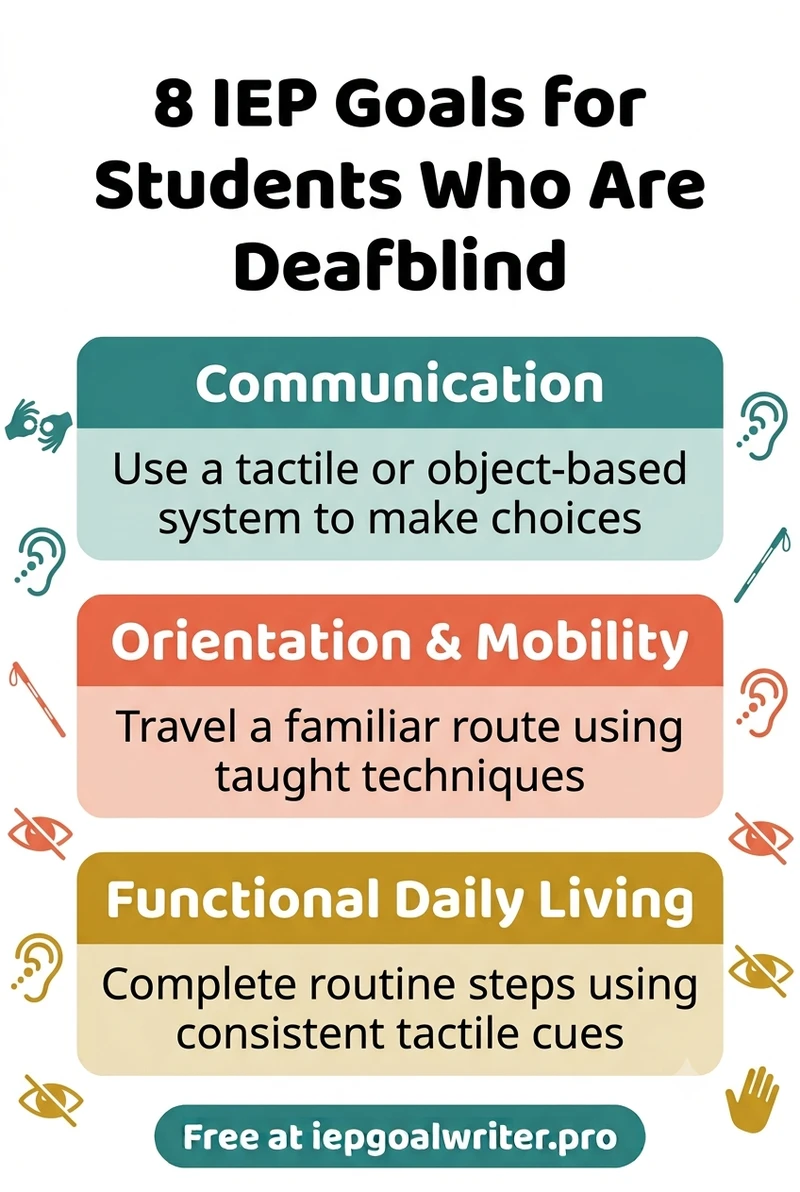
IEP goals for a student who is deafblind should center on tactile or near-vision communication systems, orientation and mobility with combined vision and hearing loss, and functional daily living skills — areas that typically require the support of a trained intervener alongside the classroom team.
Deaf-blindness is a distinct IDEA category, defined as concomitant hearing and visual impairments whose combination causes severe communication and other developmental and educational needs that cannot be accommodated in a program designed solely for students who are deaf or solely for students who are blind. Very few students fall into this category, but their goals are highly specialized and usually depend on a documented communication and orientation-mobility assessment.
Communication
- 1.By [date], [student] will use their identified tactile or near-vision communication system to indicate a choice between two familiar items in 4 of 5 observed opportunities.
- 2.By [date], [student] will use an established object or tactile calendar system to anticipate an upcoming activity in 4 of 5 trials.
- 3.By [date], [student] will initiate a request for a preferred activity using their identified communication method in 3 of 5 observed opportunities.
Orientation & Mobility
- 1.By [date], [student] will travel a familiar, previously taught route (such as classroom to bathroom) using taught orientation techniques with no more than 1 prompt, across 4 of 5 trials.
- 2.By [date], [student] will use a mobility tool (cane, trailing technique, or guide) as specified in the O&M evaluation to navigate a known space with increasing independence.
Functional Daily Living
- 1.By [date], [student] will complete a familiar self-care routine step using tactile cues with physical assistance reduced from full to partial support, across 4 of 5 sessions.
- 2.By [date], [student] will demonstrate an observable, consistent response to a familiar tactile or vibrational cue signaling a routine change, in 4 of 5 opportunities.
The Role of an Intervener
Many students who are deafblind are supported by a trained intervener — a paraprofessional with specialized training in deafblindness who provides consistent access to communication and environmental information throughout the school day. An intervener is a distinct role from a general classroom paraprofessional, and if the IEP team determines one is needed, that support and its specific function should be documented, not assumed to be covered by generic aide support.
FAQ
Paste your assessment data and generate an IDEA-compliant, individualized goal in seconds.
Try it free →