10 IEP Goals for Students with Multiple Disabilities
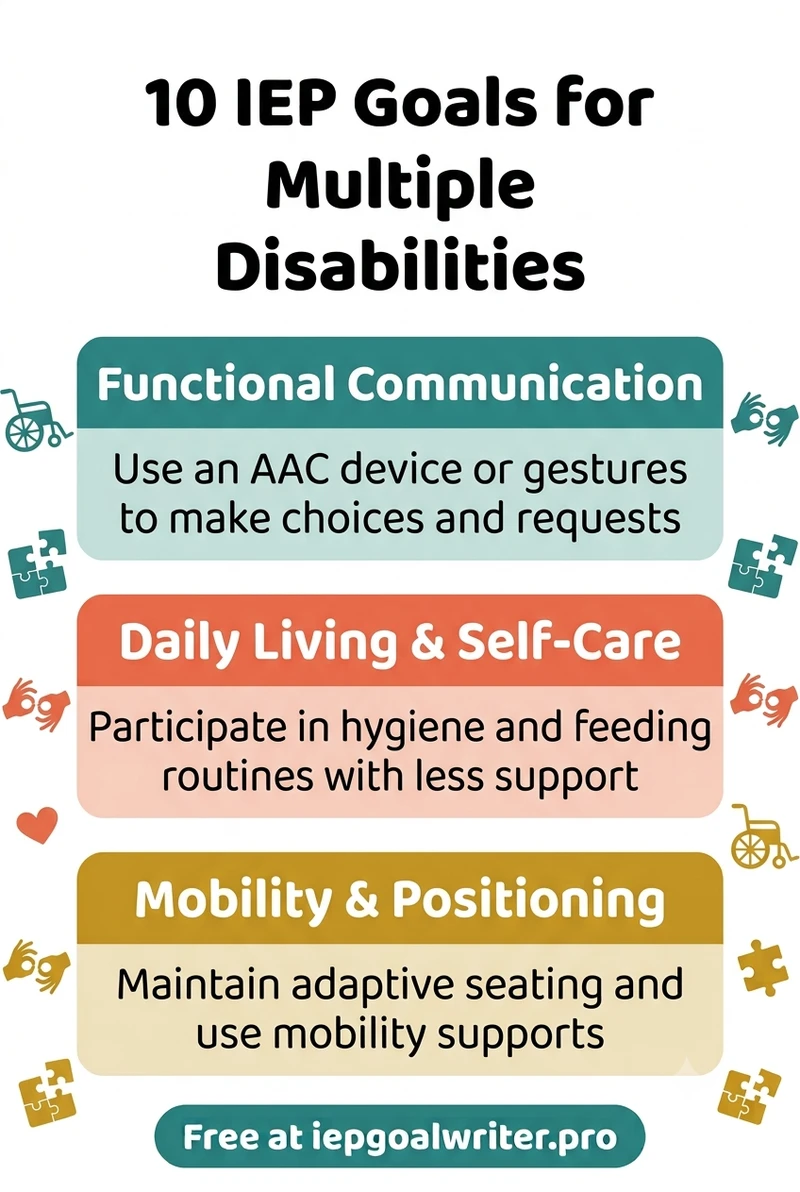
IEP goals for the Multiple Disabilities category should be built from the student's actual functional needs across communication, daily living, mobility, and sensory response, since the category applies to concomitant impairments whose combination creates needs that can't be met in a program designed for just one of them.
Multiple Disabilities is an IDEA category for students with two or more concomitant impairments — for example, an intellectual disability combined with an orthopedic impairment — where the combination creates educational needs that a program addressing only one of the impairments could not accommodate. Goals here are highly individualized by necessity; the categories below are common functional target areas, not a fixed list to apply uniformly.
Functional Communication
- 1.By [date], [student] will use their identified communication system (AAC device, picture exchange, or gestures) to make a choice between two options in 4 of 5 observed opportunities.
- 2.By [date], [student] will indicate 'yes' or 'no' using a consistent, reliable method in response to a familiar question with 80% accuracy across 4 of 5 trials.
- 3.By [date], [student] will initiate a request for a preferred item or activity using their communication system in 3 of 5 observed opportunities.
Daily Living & Self-Care
- 1.By [date], [student] will participate in a self-care routine (handwashing, dressing step, feeding) with physical assistance reduced from full support to partial support, as measured across 4 of 5 sessions.
- 2.By [date], [student] will indicate a basic need (hunger, discomfort, needing a break) through their identified communication method in 4 of 5 observed opportunities.
- 3.By [date], [student] will tolerate a full daily-living routine step (such as a hygiene task) with no more than 1 instance of resistance, across 4 of 5 sessions.
Mobility & Positioning
- 1.By [date], [student] will maintain an assigned adaptive seating or positioning setup for a full instructional period with no more than 1 adult repositioning cue.
- 2.By [date], [student] will use a mobility device or support to move between two specified locations with the level of assistance specified in the PT evaluation.
Sensory Response & Engagement
- 1.By [date], [student] will demonstrate an observable response (turning toward, reaching, vocalizing) to a preferred sensory stimulus in 4 of 5 presented opportunities.
- 2.By [date], [student] will tolerate a non-preferred but necessary sensory input (such as a required texture during a task) for the duration of a short activity, in 3 of 5 trials.
Why 'Multiple Disabilities' Isn't Just Two Diagnoses
Having two separate diagnoses does not automatically place a student in this category. IDEA's definition specifically requires that the impairments occur together in a way that causes such severe educational needs that they cannot be accommodated in a special education program designed for just one of the impairments — the combination itself is the defining feature, not the number of diagnoses on paper.
FAQ
Paste your assessment data and generate an IDEA-compliant, individualized goal in seconds.
Try it free →