20 IEP Goals for Selective Mutism
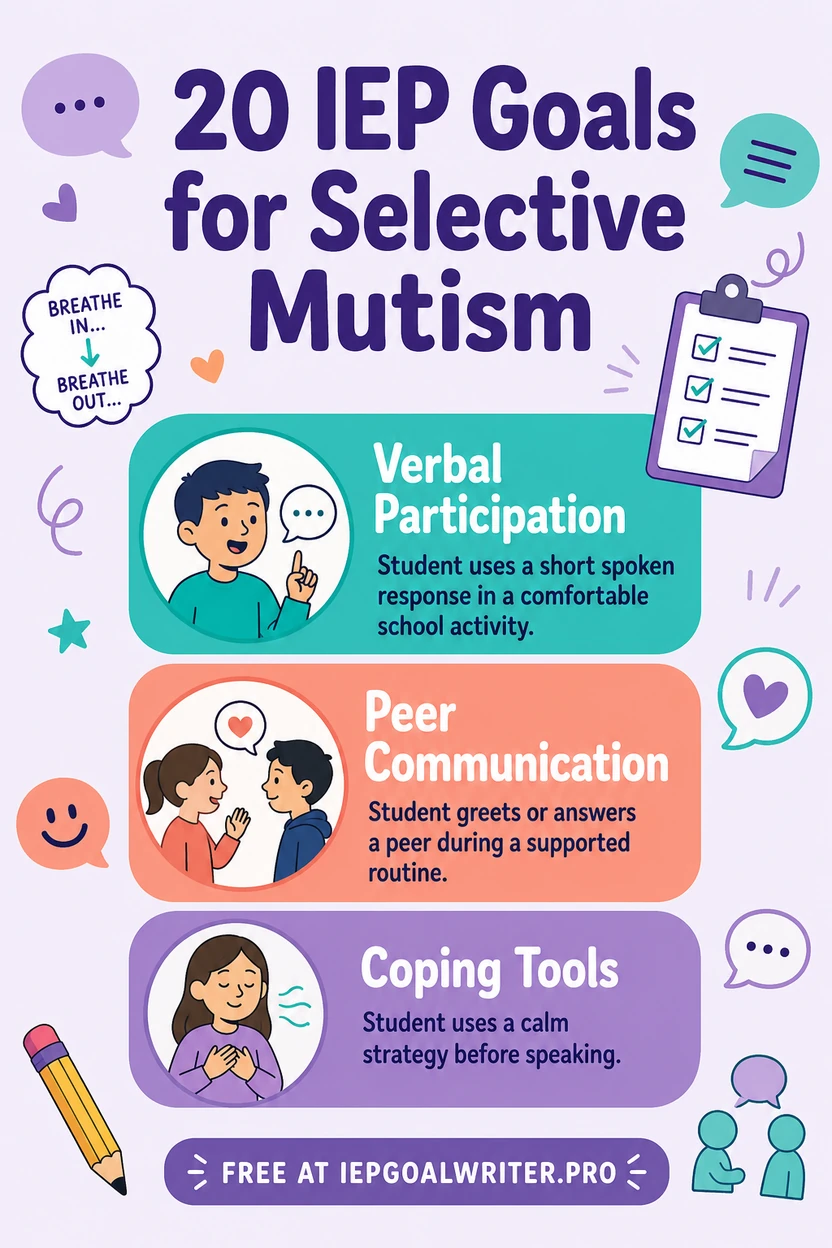
IEP goals for selective mutism should build participation gradually and never force speech on demand. For example: By [date], [student] will use an agreed nonverbal-to-verbal response ladder to answer a familiar adult in 4 of 5 planned opportunities, as measured by a communication participation log.
Selective mutism is a clinical diagnosis, not an IDEA category. A student may qualify for services under an IDEA category only when evaluation data show an educational impact and a need for special education. School goals should be coordinated with family and appropriate clinicians, while remaining educational: graded communication, access to instruction, coping, and peer participation. The right starting point may be a gesture, written response, AAC, recorded voice, whisper, or speech—whatever the student’s baseline and team plan support.
Graded Verbal Participation
- 1.By [date], [student] will use the student’s current most comfortable voice level to answer a predictable one-word or one-phrase question with a trusted adult in 4 of 5 opportunities across 3 sessions, as measured by graded-participation tally data.
- 2.By [date], [student] will produce a rehearsed verbal response with one familiar peer present after successful practice with the trusted adult alone in 4 of 5 planned opportunities, as measured by communication hierarchy data.
- 3.By [date], [student] will read or say a practiced classroom line aloud in a small group of 2 to 3 familiar people in 3 of 4 opportunities across 3 weeks, as measured by teacher/SLP participation records.
- 4.By [date], [student] will give a brief verbal academic response in the target classroom setting using the individualized stimulus-fading plan in 4 of 5 planned trials, as measured by graded-exposure data.
- 5.By [date], [student] will initiate one spontaneous verbal message in a setting already mastered on the student’s communication hierarchy on 4 of 5 school days, as measured by spontaneous-speech tally data.
Nonverbal-to-Verbal Bridge
- 1.By [date], [student] will respond to a teacher using gesture, writing, AAC, or another established nonverbal method when speech is not available in 4 of 5 opportunities, as measured by functional communication tally data.
- 2.By [date], [student] will move from a nonverbal response to a rehearsed whispered or voiced response within the same low-pressure activity in 3 of 4 planned opportunities, as measured by communication-bridge data.
- 3.By [date], [student] will use a choice board or written response to select the content of a message before attempting the spoken form in 4 of 5 supported trials, as measured by SLP/teacher scaffold data.
- 4.By [date], [student] will signal “not ready to talk” and still complete the academic response through an approved alternative communication mode in 4 of 5 high-demand speaking situations, as measured by access-response records.
- 5.By [date], [student] will use the same answer first through the preferred nonverbal mode and then verbally with a trusted partner when the hierarchy step calls for it in 4 of 5 planned trials, as measured by paired-mode communication data.
Coping and Self-Advocacy
- 1.By [date], [student] will identify the current step on the student’s communication hierarchy before a planned speaking activity in 4 of 5 sessions with no more than 1 prompt, as measured by student self-monitoring checklist data.
- 2.By [date], [student] will request an approved lower-pressure communication option before shutting down or leaving the activity in 4 of 5 relevant opportunities, as measured by self-advocacy tally data.
- 3.By [date], [student] will use one taught coping routine, such as paced breathing, grounding, or a prepared script, before a planned verbal participation step in 4 of 5 sessions, as measured by coping-strategy checklist data.
- 4.By [date], [student] will tell or indicate to a staff member whether the planned speaking demand is “ready,” “need support,” or “not yet” using the agreed scale in 80% of planned exposures, as measured by readiness-rating data.
- 5.By [date], [student] will return to the academic activity after a communication demand without losing more than the individually defined interval in 4 of 5 opportunities, as measured by return-to-task timing data.
Peer Communication
- 1.By [date], [student] will use a rehearsed greeting, request, or comment with one familiar peer in a low-pressure routine in 4 of 5 planned opportunities, as measured by peer-communication tally data.
- 2.By [date], [student] will answer a peer’s predictable question verbally at the mastered communication-hierarchy step in 4 of 5 opportunities across 3 weeks, as measured by peer-response records.
- 3.By [date], [student] will initiate a shared-activity message using speech or the approved bridge mode during partner work at least 2 times in 4 of 5 partner sessions, as measured by peer-interaction event recording.
- 4.By [date], [student] will repair a missed or unheard peer message using a second attempt, gesture, writing, or AAC instead of ending the interaction in 4 of 5 breakdowns, as measured by communication-repair tally data.
- 5.By [date], [student] will participate in a 3-turn peer exchange at the student’s mastered voice or communication level in 4 of 5 structured opportunities, as measured by conversation-sample data.
A Worked Example: One Student, PLAAFP to Data Plan
Present levels: Lina completes grade-level written work and communicates comfortably with family. At school she reliably nods, points, and writes to her classroom teacher but has not used audible speech in whole group. In six low-pressure sessions with the SLP, she used a recorded voice message in 5, whispered to one trusted adult in 3, and whispered to a trusted peer in 2; she did not speak when a second adult entered the room. Her strength is accurate academic responding when she can use a comfortable mode. The educational impact is reduced access to spontaneous participation, clarification, and peer communication in routines where no alternative response mode has been planned.
Annual goal derived from that baseline: By [date], within the student’s agreed communication hierarchy, Lina will use the next individualized response mode with a familiar partner during one selected school routine in 4 of 5 opportunities across 3 consecutive weeks, as measured by hierarchy-step and prompt-level data. Specially designed instruction should use planned, low-pressure practice, predictable partners, gradual changes in setting or audience, and full access to nonverbal/AAC options while the team expands participation.
Goal versus accommodation: Allowing written responses, choice cards, recorded messages, extra response time, or a trusted communication partner can be access accommodations. The annual goal is a carefully selected participation step—not “will speak in class” and not the removal of alternative communication. Staff should not surprise the student with public speaking demands to collect data.
Data plan: Code partner, setting, communication mode, hierarchy step attempted, prompt level, and whether the response was spontaneous or elicited. Change only one major variable at a time when possible—partner, setting, or response demand—so the team can see what supports progress. If Lina succeeds with one trusted partner, probe a small, planned expansion rather than jumping to whole-group speech.
How These Goals Change by Grade Band
For younger students, define a very safe routine, familiar partner, and concrete communication ladder that may begin with gesture, pointing, written/visual choice, recorded voice, whisper, or another mode selected by the team. Progress is movement through an individualized hierarchy with low pressure, not speed toward public speech.
In grades 3–5, broaden participation carefully to selected academic routines, small groups, peer communication, and self-advocacy about how the student can answer. Teach teachers to preserve wait time and accept planned alternative modes so academic knowledge is not confused with verbal output.
In middle and high school, prioritize autonomy and access across changing teachers, presentations, group projects, extracurriculars, and transition settings. Goals may include communicating a preferred response mode, using planned steps with new partners, and independently handling situations that require clarification or help. Never make age progression mean forcing a more public or anxiety-provoking response mode than the student’s individualized plan supports.
Collecting Data Without Adding a Full-Time Job
Track the student’s communication hierarchy step, partner, setting, response mode, prompt level, and whether the response was spontaneous. A useful sheet might code gesture, written response, recorded message, whisper, audible voice, or another individualized mode instead of collapsing participation into “spoke/did not speak.” That keeps small but meaningful changes visible.
Collect data in preplanned routines and avoid repeated testing. The same adult asking “Will you say it now?” multiple times can increase pressure and distort the very skill being measured. Academic correctness should be scored separately from communication mode so the team can see whether the student knows the answer even when verbal participation is limited.
Use a one-variable-at-a-time generalization rule when practical. If a response mode is stable with one partner, keep the task and setting familiar while adding a second partner; or keep the partner while moving to a nearby setting. If performance drops sharply, return to the last successful step and rebuild rather than labeling the student noncompliant.
Personalization warning: Selective mutism is a clinical diagnosis, not an IDEA eligibility category. School goals should be coordinated with the student’s evaluation, family, school mental-health/SLP team, and communication plan. Do not write goals that require forced speech, remove alternative communication, use surprise speaking demands, or treat silence as willful refusal.
FAQ
Paste your assessment data and generate an IDEA-compliant, individualized goal in seconds.
Try it free →