20 IEP Goals for Twice-Exceptional Students
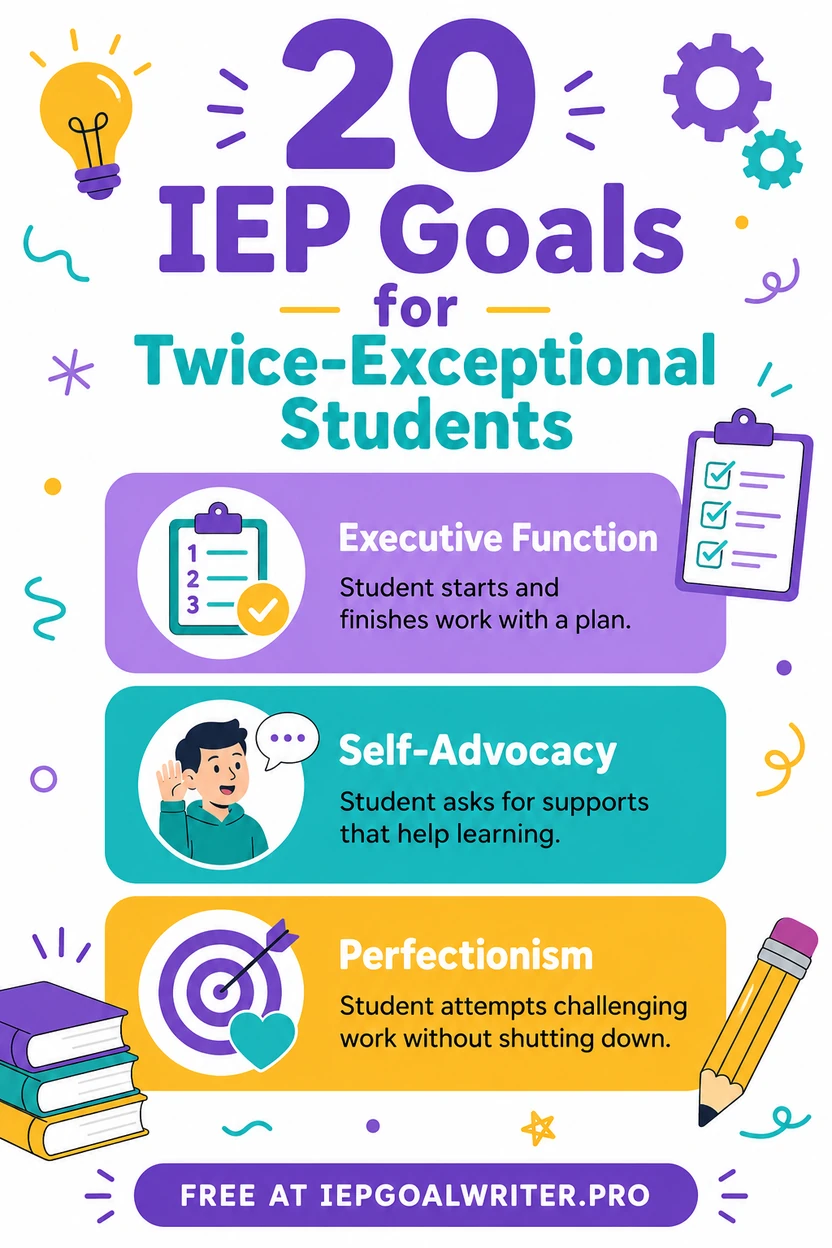
IEP goals for twice-exceptional students should address the disability-related skill barrier while preserving access to appropriately challenging work. For example: By [date], [student] will use a planning system to break an advanced assignment into three dated steps and begin the first step in 4 of 5 assignments, as measured by planner and work samples.
Twice-exceptional, or 2e, describes a student who is gifted and also has a disability; it is not an IDEA category. An IEP is based on the individual evaluation, educational impact, and need for specialized instruction—not on giftedness alone or on a student’s high test scores. These goals are strength-aware: they target the documented barrier while keeping rigorous content, choice, and advanced thinking in view. Do not lower the cognitive demand just to make a goal easier to score.
Executive Functioning for Complex Work
- 1.By [date], [student] will break a long-term assignment into at least 4 dated action steps using the class planning tool with all required steps entered in 4 of 5 assignments, as measured by planner and project-plan review data.
- 2.By [date], [student] will begin the first planned step of a complex assignment within 5 minutes after materials are available in 4 of 5 class periods, as measured by task-initiation latency data.
- 3.By [date], [student] will estimate the time needed for an assignment and compare the estimate with actual completion time for 4 of 5 assignments across 3 weeks, as measured by time-estimation logs.
- 4.By [date], [student] will use a teacher-approved priority system to choose which of at least 3 competing tasks to complete first in 4 of 5 planning opportunities, as measured by executive-function rubric data.
- 5.By [date], [student] will submit each required component of a multi-part assignment by its intermediate deadline for at least 80% of components across 2 projects, as measured by learning-platform submission records.
Self-Advocacy
- 1.By [date], [student] will state one specific learning support needed for a challenging task without minimizing the need because the student is advanced in another area in 4 of 5 opportunities, as measured by self-advocacy rubric data.
- 2.By [date], [student] will request clarification about the rubric, workload, or access support before abandoning or overworking an assignment in 4 of 5 relevant situations, as measured by help-seeking tally data.
- 3.By [date], [student] will explain to a new teacher one strategy that improves access and when it should be used in 4 of 5 structured practice opportunities, as measured by student explanation rubric data.
- 4.By [date], [student] will choose between at least 2 approved ways to demonstrate mastery when both meet the learning objective in 4 of 5 choice opportunities, as measured by student choice and completion records.
- 5.By [date], [student] will participate in a progress check by identifying one strength, one barrier, and one next support to test with all 3 elements in 4 of 5 meetings, as measured by student-led conference checklist data.
Emotional Regulation and Perfectionism
- 1.By [date], [student] will use the class rubric to identify the required completion standard and stop revising after all required criteria are met in 4 of 5 assignments, as measured by revision-count and rubric data.
- 2.By [date], [student] will submit a completed assignment with one known minor imperfection when the work meets the agreed rubric threshold in 4 of 5 planned opportunities, as measured by submission records and teacher rubric scores.
- 3.By [date], [student] will use a taught coping or reset routine after receiving corrective feedback and resume work on the revision within 5 minutes in 4 of 5 opportunities, as measured by feedback-to-return timing data.
- 4.By [date], [student] will rate task difficulty and emotional intensity separately on 3-point scales before choosing a support with 80% accurate use of both scales across 10 check-ins, as measured by self-monitoring forms.
- 5.By [date], [student] will complete a defined first draft before seeking enrichment, redesigning the task, or adding optional complexity in 4 of 5 assignments, as measured by draft-completion records.
Strength-Based Access
- 1.By [date], [student] will use a documented area of strength to access a grade-level task while still completing the target skill requirement in 4 of 5 teacher-designed assignments, as measured by work-sample rubric data.
- 2.By [date], [student] will select an advanced-interest example or topic and produce work that meets the same accessibility and skill criteria as peers in 4 of 5 opportunities, as measured by assignment rubric scores.
- 3.By [date], [student] will explain a complex idea using the communication or output support named in the IEP with at least 80% of rubric elements present across 4 samples, as measured by work-sample and presentation rubric data.
- 4.By [date], [student] will complete a compacted or enriched task after demonstrating prerequisite mastery and following the agreed project plan in 4 of 5 opportunities, as measured by mastery-check and project-completion data.
- 5.By [date], [student] will reflect on whether a chosen strength-based strategy improved access to the target skill and identify one adjustment for next time in 4 of 5 reflections, as measured by student reflection rubric data.
A Worked Example: One Student, PLAAFP to Data Plan
Present levels: Ava contributes sophisticated oral analysis, reads well above grade level in her areas of interest, and generates original project ideas. Across the last six long-term written projects, she submitted three on time; on four projects she spent more than half of available work periods revising the opening section and missed intermediate deadlines. She can break a project into steps with an adult conference but independently used the digital planner in 2 of 10 observed work sessions. The educational impact is inconsistent demonstration of advanced knowledge because executive-function and perfectionism-related barriers interfere with production.
Annual goal derived from that baseline: By [date], given a teacher-approved project rubric, Ava will independently create a task plan with at least 3 intermediate steps, record deadlines, begin the scheduled step within 5 minutes, and update completion status in 4 of 5 long-term assignments, as measured by planner artifacts and submission data. Specially designed instruction should explicitly teach backward planning, “good-enough first draft” criteria, time estimation, and a stopping rule for revision while preserving access to appropriately advanced content.
Goal versus accommodation: Flexible ways to demonstrate learning, enrichment, extended time when justified, reduced copying demands, or access to advanced material may be accommodations/services. The annual goal targets the disability-related skill that prevents Ava from using her strengths consistently. It should not lower the intellectual level of the work simply to make completion easier.
Data plan: Save the project plan, first-start time, intermediate deadlines, revision time, and final submission status. Compare performance on high-interest and lower-interest assignments. If Ava meets planning steps but still does not submit, identify whether the breakdown is initiation, perfectionistic revision, workload estimation, or another skill before changing the annual criterion.
How These Goals Change by Grade Band
In younger grades, protect access to advanced learning while teaching one concrete executive or self-advocacy routine: starting a less-preferred task, asking for an appropriate challenge, tolerating a first draft, or using a visual plan. A 2e goal should not turn giftedness into a reward the student earns only after “fixing” a disability-related need.
In grades 3–5, add project planning, flexible ways to show learning, explicit self-advocacy about challenge and support, and strategies for recovering from mistakes or incomplete work. Instruction can use the student’s strengths as the content vehicle while the IEP measures the underlying executive, writing, communication, or regulation skill.
In middle and high school, goals should support increasingly complex schedules, advanced coursework, long-term projects, self-advocacy with multiple teachers, and transition planning. The team should distinguish lack of skill from lack of challenge and from disability-related performance variability. Standards and course rigor remain grade-appropriate; the IEP goal targets the access barrier that prevents the student from demonstrating what they know.
Collecting Data Without Adding a Full-Time Job
Do not let high test scores or advanced verbal reasoning erase the disability-related baseline. For executive-function goals, collect artifacts: plans, intermediate deadlines, initiation latency, time estimates, revisions, submission records, and prompt levels. For self-advocacy, use a rubric that scores whether the student identified the barrier, named a reasonable support, and communicated it to the relevant adult.
Pair outcome data with process data. A project submitted on time may still require unsustainable adult prompting, while a late project may show major improvement in planning independence. Track both. For emotional-regulation or perfectionism-related school goals, measure observable routines—using a stopping rule, submitting a draft, requesting feedback once—not internal feelings or a demand to “be less anxious.”
Use strengths as a comparison condition when useful. If the student independently plans a complex robotics project but not a five-paragraph essay, analyze what differs: interest, task clarity, written-output demand, feedback uncertainty, or organization. That comparison can point to more precise SDI. If performance meets criterion only when a parent or teacher manages the planner, independence has not generalized.
Personalization warning: “Twice exceptional” is a descriptive educational term, not an IDEA eligibility category. Do not assume the student needs easier work, more work, or the same goal bank as every gifted learner with a disability. Goals should come from the disability-related educational need while services also preserve meaningful access to strengths and appropriate challenge.
FAQ
Paste your assessment data and generate an IDEA-compliant, individualized goal in seconds.
Try it free →