20 IEP Goals for Students With Cerebral Palsy
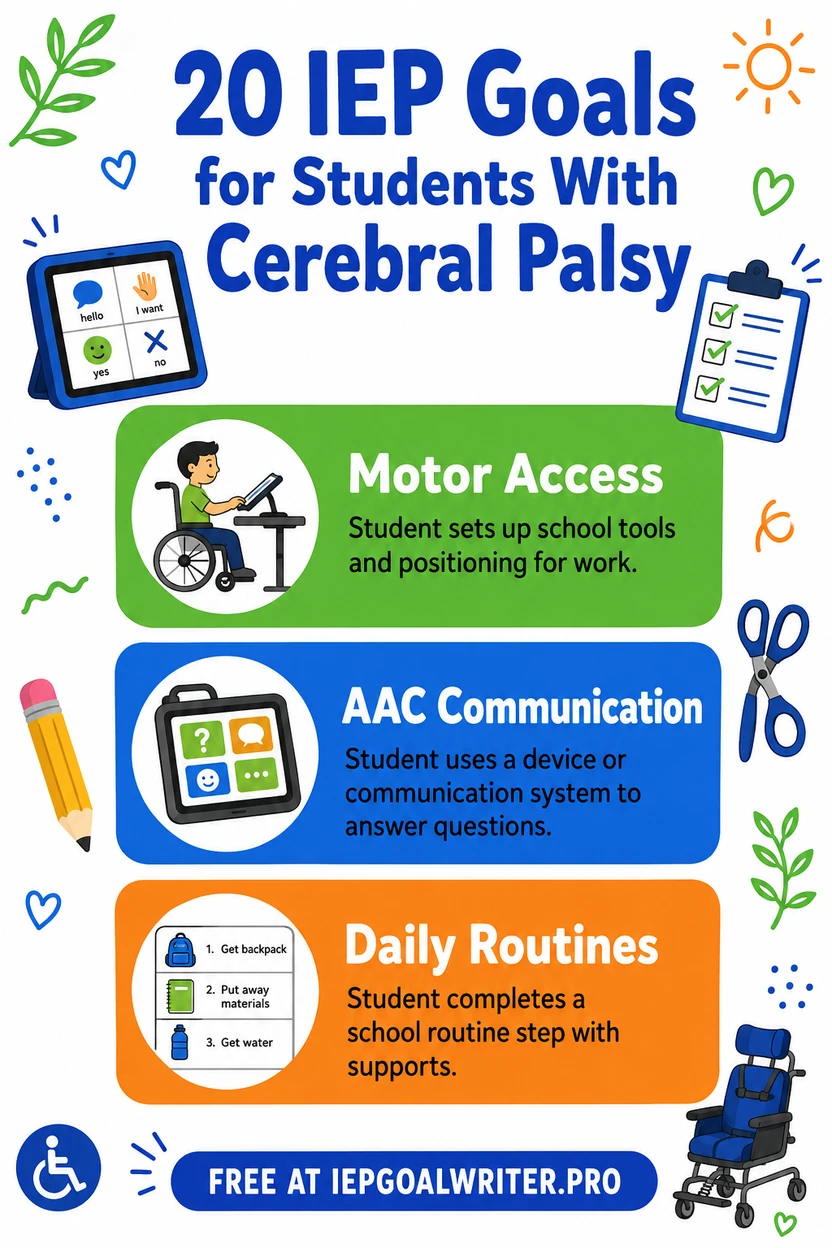
IEP goals for students with cerebral palsy should target the access skill the student needs to learn, such as operating an assistive technology feature or using a communication system. For example: By [date], [student] will use the assigned access method to compose and submit a three-sentence response in 4 of 5 class tasks, as measured by work samples.
Cerebral palsy is a medical condition, not an IDEA category. Depending on the evaluation and educational needs, a student may be eligible under Orthopedic Impairment, Speech or Language Impairment, Multiple Disabilities, or another category. These goals focus on skills that can be taught and measured at school: motor access, communication, daily routines, and academic participation through assistive technology. They are not therapy prescriptions or a substitute for PT, OT, SLP, and family collaboration.
Motor Access and Positioning
- 1.By [date], [student] will independently position the assigned classroom access equipment according to a 3-step setup routine before beginning work in 4 of 5 opportunities, as measured by OT/PT task-analysis data.
- 2.By [date], [student] will activate the student’s primary access method—switch, touch target, eye gaze, adapted mouse, or other assigned system—to make a classroom choice with 80% successful selections across 20 trials, as measured by access-method probe data.
- 3.By [date], [student] will move between two designated school locations using the student’s mobility method and planned supports within the individualized time criterion in 4 of 5 transitions, as measured by PT mobility timing data.
- 4.By [date], [student] will retrieve or request assistance for a needed positioning or access item before starting a task in 4 of 5 opportunities across 2 settings, as measured by independence checklist data.
- 5.By [date], [student] will maintain the agreed functional position for the defined instructional interval while participating in the task for at least 15 minutes in 4 of 5 sessions, as measured by positioning and participation records.
AAC and Communication
- 1.By [date], [student] will use the established AAC system to independently initiate one classroom-relevant message during each of 3 daily routines on 4 of 5 school days, as measured by AAC initiation tally data.
- 2.By [date], [student] will navigate from the home screen to a needed vocabulary page and select the target message in 4 of 5 opportunities with no more than 1 prompt, as measured by AAC navigation checklist data.
- 3.By [date], [student] will compose a 3-unit message using words, symbols, or stored phrases to answer an academic question with 80% completeness across 10 opportunities, as measured by SLP/classroom language-sample data.
- 4.By [date], [student] will signal a communication breakdown and use a second mode or repair strategy to clarify the message in 4 of 5 observed breakdowns, as measured by communication-repair log data.
- 5.By [date], [student] will direct an unfamiliar school partner to wait, reposition the device, or provide another access support needed for communication in 4 of 5 structured or natural opportunities, as measured by self-advocacy rubric data.
Self-Care and Daily Routines
- 1.By [date], [student] will complete the individualized arrival routine using adaptive equipment and the established prompt hierarchy with at least 80% of task-analysis steps independent across 5 school days, as measured by task-analysis data.
- 2.By [date], [student] will manage one personal school item, such as backpack, lunch materials, coat, or device bag, using the assigned adaptation in 4 of 5 opportunities, as measured by daily-living checklist data.
- 3.By [date], [student] will participate in the individualized eating or drinking routine using the supports specified by the team with the targeted step completed independently in 4 of 5 opportunities, as measured by related-service task-analysis data.
- 4.By [date], [student] will complete the student-specific hygiene or toileting participation step identified by the team in 80% of opportunities across 2 consecutive weeks, as measured by staff task-analysis data.
- 5.By [date], [student] will request help for a physical access task when independent completion is not expected rather than waiting passively or abandoning the routine in 4 of 5 naturally occurring opportunities, as measured by self-advocacy tally data.
Academic Access With Assistive Technology
- 1.By [date], [student] will open the assigned word-processing or learning application and access the required file using the student’s assistive-technology setup routine in 4 of 5 class tasks, as measured by technology independence checklist data.
- 2.By [date], [student] will produce a 3-sentence academic response using the assigned access feature, such as switch scanning, eye gaze, speech-to-text, or word prediction in 4 of 5 opportunities, as measured by saved work samples and technology logs.
- 3.By [date], [student] will edit one identified error in a digital assignment using the student’s established access method in 4 of 5 work samples with no more than 1 prompt, as measured by work-sample review data.
- 4.By [date], [student] will submit a completed digital assignment through the class platform using the assigned access tools in 80% of opportunities across 3 consecutive weeks, as measured by submission records and staff checklist data.
- 5.By [date], [student] will identify and communicate one technology problem that prevents access and select the correct next step from a taught troubleshooting routine in 4 of 5 incidents, as measured by assistive-technology problem-solving log data.
A Worked Example: One Student, PLAAFP to Data Plan
Present levels: Noah contributes accurate ideas during discussion and uses a switch-accessed tablet for communication and writing. Across five language-arts tasks, he independently opened the correct writing app in 4 of 5 trials when equipment was already positioned, but needed adult physical setup in all five and produced an average of one sentence in 20 minutes. With word prediction turned on and a prepared access position, he produced two sentences in 18 minutes. The educational impact is that motor-access demands, not content knowledge, limit how much grade-level work he can express and submit.
Annual goal derived from that baseline: By [date], Noah will use his established access method and assistive-technology features to open the assigned file, compose at least three sentences meeting the task criteria, and submit the work in 4 of 5 class assignments with no more than one verbal prompt, as measured by saved work samples and an access-independence checklist. Specially designed instruction should teach the exact technology routine, efficient navigation, error correction, and how to request setup or troubleshooting help that Noah cannot reasonably perform independently.
Goal versus accommodation: Positioning, switch mounting, adapted seating, extended time, AAC, word prediction, and physical access support can be accommodations or related-service supports. The annual goal targets an attainable independence skill within that accessible setup. The team should not remove equipment or physical support to create a harder “independent” test.
Data plan: Score setup/requesting help, navigation, composition output, editing, and submission as separate steps. Track both independence and time so the team can see whether efficiency changes without sacrificing accuracy. Review work samples from more than one class. If Noah meets the routine in language arts but not science, teach generalization to the new platform or task demand before increasing the output criterion.
How These Goals Change by Grade Band
For younger students, goals often begin with reliable access to play, choice-making, early communication, mobility routines, and participation with peers using the student’s established positioning and access system. A meaningful progression might move from activating one target, to choosing between options, to completing a short classroom sequence.
In grades 3–5, connect access skills directly to grade-level participation: navigating digital materials, producing longer written responses, joining group work, managing personal materials, and directing adults when an access setup needs adjustment. The goal should identify what the student is learning, while equipment and physical supports remain available.
In middle and high school, shift toward portable self-advocacy and efficient technology use across classes, community-based instruction, career exploration, and transition routines. Skills may include troubleshooting, file management, directing personal assistance, selecting the fastest effective access method, and completing authentic academic or vocational tasks. Do not lower the cognitive demand of the goal simply because the student needs substantial physical access support.
Collecting Data Without Adding a Full-Time Job
Collect data with the student’s actual mobility, positioning, communication, and technology supports in place. Removing an access support answers the wrong question: the goal is usually whether the student can perform the educational skill within the accessible system the team has designed. Document the access method and support level so later scores are comparable.
For motor-access and daily-routine goals, use a task analysis and score each step as independent, verbal/gestural prompt, or physical assistance. For AAC goals, track initiations, navigation, message completeness, and repair separately. For assistive-technology goals, save representative work samples and note whether the barrier was academic, motor, software, hardware, or setup.
Add a generalization and efficiency check. When a routine reaches criterion in one class, probe another class, device state, or authentic task before deciding the skill is generalized. Track time only when time matters educationally; faster is not automatically better if accuracy or fatigue worsens. If performance drops because the access system changed, restore comparability before interpreting it as regression.
Personalization warning: Cerebral palsy is a medical diagnosis, not an IDEA eligibility category, and students with cerebral palsy have widely different motor, communication, cognitive, and sensory profiles. Do not choose goals from the diagnosis label. Use current PT/OT/SLP, assistive-technology, classroom, and student/family data to identify the specific school skill requiring instruction.
FAQ
Paste your assessment data and generate an IDEA-compliant, individualized goal in seconds.
Try it free →