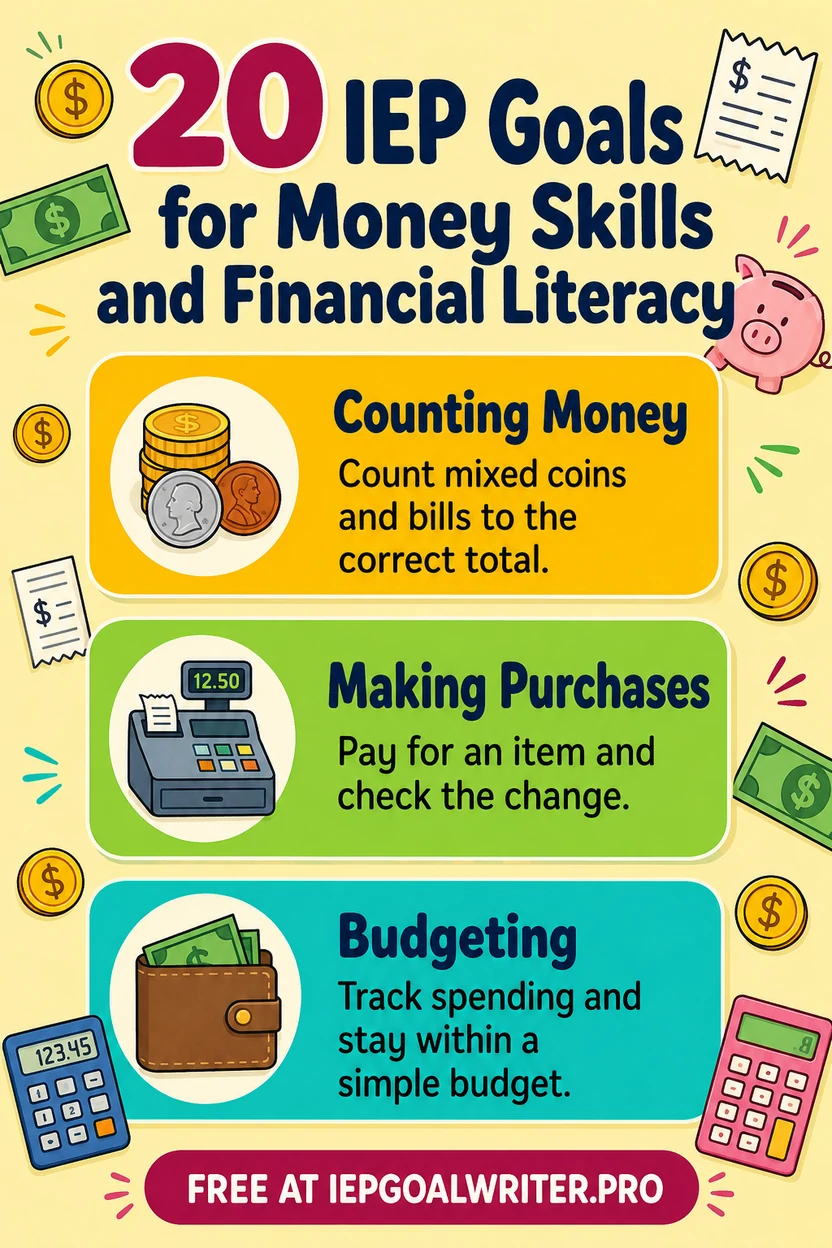
20 IEP Goals for Money Skills and Financial Literacy
Money-skills IEP goals should start with a functional baseline and an authentic task. For example: By [date], [student] will use a calculator and price list to determine whether available money covers a planned purchase in 4 of 5 community-based or simulated trials, as measured by task-analysis data.
Money goals can be highly useful when transition assessment and present levels show a student needs specialized instruction in functional math, purchasing, budgeting, or financial routines. The goal should respect the student’s age, culture, safety needs, and actual future environments; counting coins is not automatically the right target for a teenager who already uses digital payments. These 20 examples move from identifying values to making supported purchases and understanding paycheck or banking basics. Choose only the skills documented by data and the transition plan.
Identifying and Counting Money
- 1.By [date], [student] will identify the value of common U.S. coins and bills presented individually with 90% accuracy across 20 mixed items for 3 consecutive probes, as measured by functional money identification probes.
- 2.By [date], [student] will count a mixed set of coins to a target value up to the individualized amount using the student’s taught counting strategy with 80% accuracy across 10 trials, as measured by teacher-scored money tasks.
- 3.By [date], [student] will combine bills and coins to make an exact teacher-specified amount in 4 of 5 trials across 3 sessions, as measured by functional math work samples.
- 4.By [date], [student] will select from 3 money sets the set that equals a displayed price with 80% accuracy across 15 trials, as measured by purchase-preparation probe data.
- 5.By [date], [student] will use a calculator, coin chart, or other approved support to verify the total value of a mixed money set in 4 of 5 opportunities, as measured by support-use checklist data.
Making Purchases and Checking Change
- 1.By [date], [student] will determine whether the money available is enough to purchase one item at the displayed price with 80% accuracy across 10 simulated or community-based trials, as measured by purchase task data.
- 2.By [date], [student] will select the correct bills or card-payment routine to complete a purchase within the individualized price range in 4 of 5 opportunities, as measured by community-based instruction checklist data.
- 3.By [date], [student] will state or indicate the expected change after paying with a whole-dollar amount with 80% accuracy across 10 purchase scenarios, as measured by functional money probes.
- 4.By [date], [student] will compare the change received with the calculated or displayed expected change and identify a mismatch in 4 of 5 trials, as measured by change-checking task data.
- 5.By [date], [student] will complete the full purchase routine—choose item, check price, pay, receive receipt/change, and secure money or card with at least 4 of 5 steps independent in 4 of 5 opportunities, as measured by purchase task-analysis data.
Budgeting and Spending Decisions
- 1.By [date], [student] will sort a set of expenses into needs, wants, and fixed obligations using the student’s transition-level examples with 80% accuracy across 15 items, as measured by budgeting classification probes.
- 2.By [date], [student] will create a weekly budget by assigning an individualized amount to at least 3 required categories without exceeding available funds in 4 of 5 budgeting tasks, as measured by completed budget worksheets.
- 3.By [date], [student] will compare 2 purchase options and choose the one that fits the stated budget constraint with 80% accuracy across 10 scenarios, as measured by spending-decision rubric data.
- 4.By [date], [student] will record 5 purchases in a simple spending log and calculate the remaining balance using the approved support with 80% accuracy across 3 practice weeks, as measured by spending-log review data.
- 5.By [date], [student] will adjust one planned expense after an unexpected cost is added while keeping the budget at or below available funds in 4 of 5 scenarios, as measured by budget-revision work samples.
Banking, Paychecks, and Transition Routines
- 1.By [date], [student] will identify gross pay, deductions, and net pay on a simplified paycheck or pay statement with 80% accuracy across 10 examples, as measured by transition finance probe data.
- 2.By [date], [student] will complete the taught routine for checking an account balance before a planned purchase using a simulated or school-approved banking tool in 4 of 5 trials, as measured by banking routine checklist data.
- 3.By [date], [student] will identify whether a sample account transaction is a deposit, withdrawal, purchase, or fee with 80% accuracy across 15 items, as measured by banking vocabulary probe data.
- 4.By [date], [student] will reconcile 5 recorded transactions against a simplified account statement and identify any mismatch with 80% accuracy across 3 statements, as measured by functional finance work samples.
- 5.By [date], [student] will use a privacy and safety checklist before entering account or payment information in a simulated digital transaction with all required checklist steps completed in 4 of 5 trials, as measured by digital finance safety checklist data.
A Worked Example: One Student, PLAAFP to Data Plan
Present levels: DeShawn identifies common bills, reads price labels, and independently uses his phone calculator. In five classroom-store simulations, he correctly totaled purchases in 4 but exceeded the assigned $25 budget in 3 because he did not compare the running total with the amount available. When given a three-column plan—budget, running total, amount left—he stayed within budget in 4 of 5 trials with one teacher reminder. The educational impact is not basic coin identification; it is using money information to make a safe, functional decision.
Annual goal derived from that baseline: By [date], given a simulated or authentic school-based purchase and the student’s approved calculator/budget tool, DeShawn will identify the amount available, maintain a running total, determine whether the purchase fits the budget, and complete or revise the purchase plan in 4 of 5 opportunities, as measured by a transaction task-analysis rubric. Specially designed instruction should model the decision sequence, use realistic receipts and prices, teach estimation/checking, and practice the same routine across classroom store, cafeteria, community-based instruction, or transition activities as appropriate.
Goal versus accommodation: A calculator, visual budget template, simplified account display, or extra time may be access supports. The annual goal is DeShawn’s independent use of those tools to make a financial decision. The team should not remove the calculator simply because “real life requires independence”; real-life financial independence often includes technology.
Data plan: Score the transaction steps separately: identifies available amount, reads price, enters/calculates accurately, compares total to budget, adjusts if needed, checks receipt/change, and records the result when that step is relevant. Use school-safe simulated data for banking/paycheck concepts. After criterion is met in one format, vary merchant layout, price combinations, or context to test generalization without changing the core skill.
How These Goals Change by Grade Band
For younger students, focus on concrete concepts: identifying coins/bills when instructionally relevant, matching money to a price, choosing between two affordable items, and participating in simple classroom-store routines. Functional meaning matters more than memorizing coin facts in isolation.
In grades 3–5, add counting mixed money, comparing prices, making exact or supported purchases, checking change, and connecting earned/spent/saved concepts to simple budgets. Students can begin using calculators or visual tables as legitimate tools while the goal measures the decision process.
In middle and high school, prioritize transition-relevant skills: budgeting recurring expenses, reading receipts, comparing unit/total cost, understanding a simplified pay statement, distinguishing debit/credit/cash concepts at the level needed, planning transportation or meal spending, and recognizing when to ask for help. Use authentic-looking but privacy-safe materials. Progression should move toward real decisions and tool use—not endless elementary coin worksheets for older students.
Collecting Data Without Adding a Full-Time Job
Use realistic but school-safe materials: classroom currency, store flyers, receipts, simplified budgets, mock pay statements, and simulated account records. For purchases, score the decision chain rather than only whether the final answer was correct. A student who totals accurately but does not compare the total with the budget needs different instruction from a student who misreads prices.
Keep access tools consistent. If the student is expected to use a calculator, phone accessibility feature, visual budget, or adapted worksheet in adult life, collect progress data with that tool available. For money-identification or computation goals, define whether the target is recognition, calculation, or functional application so one skill does not contaminate the measure of another.
Add generalization gradually. Once the student meets criterion in a familiar classroom-store format, change one variable: different prices, a different receipt layout, a second setting, or a less familiar purchase. For banking or paycheck goals, use simulations and score understanding of the specific fields taught rather than exposing real private account information.
Personalization warning: Functional money goals should reflect the student’s age, transition priorities, current math skills, access tools, and realistic degree of independence. Do not assume every student needs coin-counting goals, and do not write adult financial tasks that exceed the student’s evaluated needs simply because they sound “life skills” oriented.
FAQ
Paste your assessment data and generate an IDEA-compliant, individualized goal in seconds.
Try it free →