10 IEP Goals for Traumatic Brain Injury (TBI)
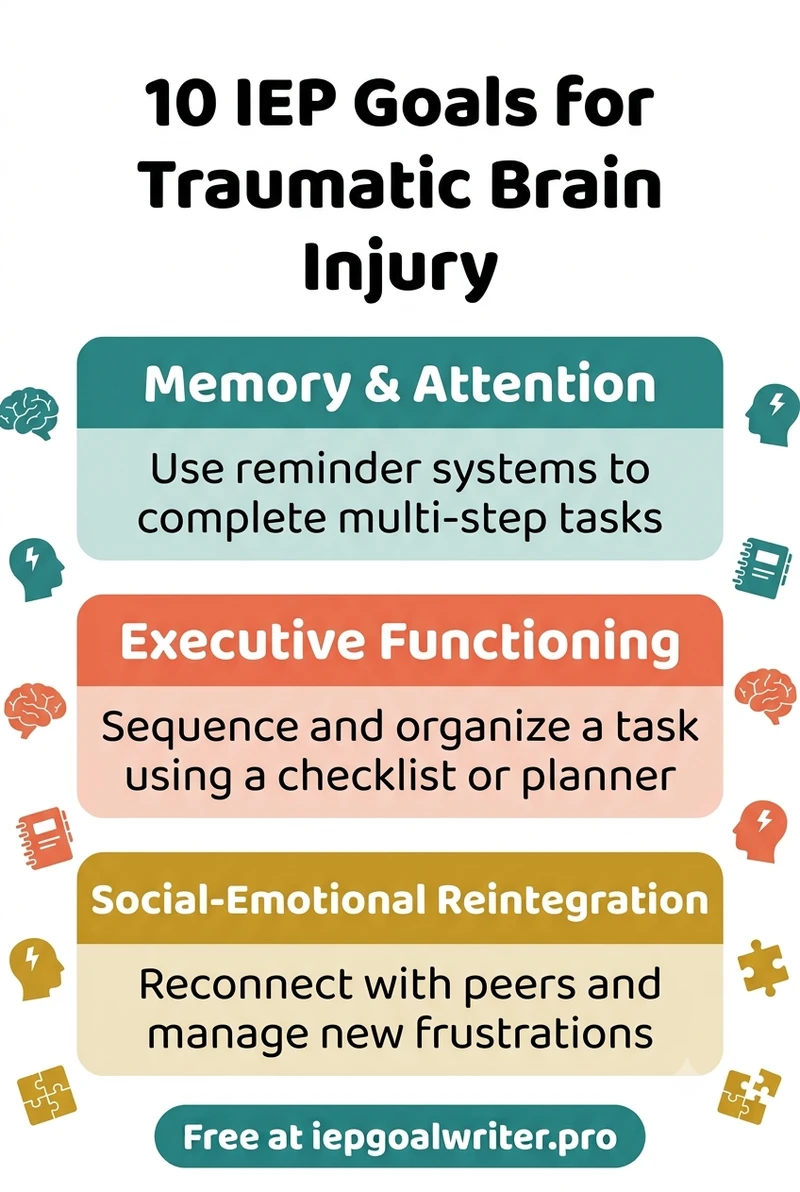
IEP goals for Traumatic Brain Injury should target the specific cognitive, physical, or social-emotional changes documented since the injury — memory, executive functioning, sensory tolerance, or reintegration into peer relationships — and should be reviewed more frequently than most other categories because recovery trajectories change.
Traumatic Brain Injury (TBI) is its own IDEA category specifically because the profile after an injury can look different from a student's pre-injury functioning and from other disability categories — the same student can show new memory or attention difficulties, physical changes, and social-emotional adjustment needs all at once. Present levels should describe functioning before and after the injury where that information is available, since baseline comparisons matter more here than in most categories.
Memory & Attention
- 1.By [date], [student] will use a written or picture-based reminder system to complete a 3-step multi-part task with no more than 1 prompt, in 4 of 5 observed opportunities.
- 2.By [date], [student] will recall and restate directions given more than 2 minutes earlier with 80% accuracy across 4 of 5 trials.
- 3.By [date], [student] will sustain attention to an assigned task for 10 minutes with no more than 2 redirections, as measured by teacher observation.
Executive Functioning
- 1.By [date], [student] will independently sequence the steps of a familiar multi-step task (such as a classroom routine) with 80% accuracy across 4 of 5 trials.
- 2.By [date], [student] will use a checklist or planner to organize and complete a multi-part assignment with no more than 1 adult prompt, in 4 of 5 opportunities.
- 3.By [date], [student] will identify when a chosen strategy is not working and independently try an alternative approach, in 3 of 4 observed opportunities.
Physical & Sensory Access
- 1.By [date], [student] will tolerate typical classroom sensory input (lighting, noise level) for a full class period with no more than 1 requested break, across 4 of 5 sessions.
- 2.By [date], [student] will use adapted materials or equipment (as specified by OT/PT) to complete a fine- or gross-motor classroom task with 80% independence.
Social-Emotional Reintegration
- 1.By [date], [student] will initiate an interaction with a familiar peer during an unstructured activity in 3 of 5 observed opportunities.
- 2.By [date], [student] will identify and use a coping strategy when frustrated by a task that has become harder since the injury, in 4 of 5 observed opportunities.
Why TBI Goals Change More Often Than Other Categories
Recovery after a brain injury is rarely a straight line — a student can show rapid improvement in one area and a plateau or even regression in another, sometimes months apart. Because of that, TBI goals often need more frequent progress monitoring and re-baselining than an annual review alone provides; a team that only checks in once a year risks working from present levels that are already out of date.
FAQ
Paste your assessment data and generate an IDEA-compliant, individualized goal in seconds.
Try it free →