20 IEP Vocabulary Goals for School-Age Students
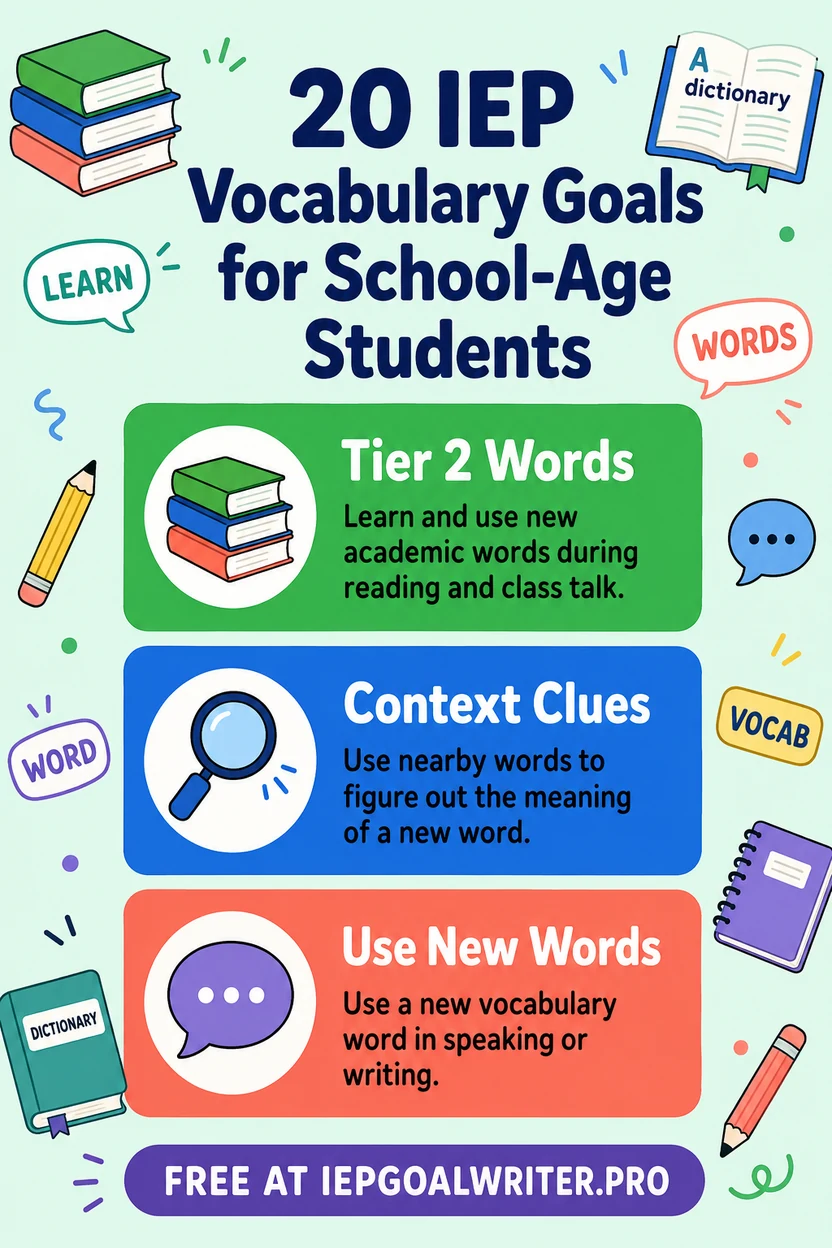
Vocabulary IEP goals should identify the word type and language action the student needs to learn, such as explaining a Tier 2 word or using a context-clue strategy. For example: By [date], [student] will use a taught context-clue strategy to determine the meaning of targeted Tier 2 words with 80% accuracy across 3 probes, as measured by curriculum-based vocabulary data.
Vocabulary instruction becomes an IEP goal when data show a specific receptive or expressive language skill needs specialized instruction. Start with a baseline: Does the student recognize the word, explain it, identify relationships, use morphology, retrieve it in conversation, or apply it in writing? These 20 examples separate those actions so the team can measure real progress. A large weekly word list is not a goal unless the list, response type, and data system match the student’s documented language need.
Receptive Tier 2 and Academic Vocabulary
- 1.By [date], [student] will match a taught Tier 2 or content-area word to its student-friendly definition, picture, or example with 80% accuracy across 20 mixed items, as measured by receptive vocabulary probe data.
- 2.By [date], [student] will identify the correct meaning of a taught multiple-meaning word within a sentence with 80% accuracy across 15 items, as measured by contextual vocabulary probes.
- 3.By [date], [student] will sort 15 taught academic words into 3 meaningful categories and explain or indicate the category rule with 80% accurate sorting across 3 probes, as measured by semantic-sorting task data.
- 4.By [date], [student] will identify a taught academic word after hearing or reading a brief definition without a picture cue with 80% accuracy across 15 items, as measured by receptive retrieval probes.
- 5.By [date], [student] will demonstrate understanding of a new content word by selecting both an example and a nonexample in 4 of 5 word-learning trials, as measured by concept-knowledge rubric data.
Using Context Clues
- 1.By [date], [student] will use surrounding sentence information to choose the meaning of an unfamiliar word from 3 options with 80% accuracy across 10 grade-appropriate passages, as measured by context-clue probes.
- 2.By [date], [student] will identify which context clue type—definition, example, contrast, or synonym—supports a word meaning with 80% accuracy across 15 items, as measured by strategy-classification data.
- 3.By [date], [student] will underline or point to the specific words in a sentence that support the inferred meaning of an unfamiliar word in 4 of 5 items, as measured by work-sample rubric data.
- 4.By [date], [student] will generate a reasonable student-friendly meaning for an unfamiliar word and then revise it after checking a glossary or dictionary in 4 of 5 opportunities, as measured by vocabulary strategy sheets.
- 5.By [date], [student] will apply the context-clue routine to an unfamiliar word in science, social studies, or ELA with 80% accuracy across 10 cross-content items, as measured by cross-curricular work samples.
Word Relationships and Morphology
- 1.By [date], [student] will state or indicate one synonym and one antonym for a taught word when both are appropriate with 80% accuracy across 10 words, as measured by semantic-relations probes.
- 2.By [date], [student] will identify the base or root and one affix in a taught morphologically complex word with 80% accuracy across 15 words, as measured by morphology probe data.
- 3.By [date], [student] will use the meaning of a taught prefix or suffix to predict the meaning of an unfamiliar related word with 80% accuracy across 10 items, as measured by morphology generalization probes.
- 4.By [date], [student] will explain or indicate how 3 related words differ in intensity, category, or use in 4 of 5 semantic-gradient tasks, as measured by semantic relationship rubric data.
- 5.By [date], [student] will add at least 3 connected words, examples, or attributes to a semantic map for a new academic concept in 4 of 5 vocabulary lessons, as measured by completed semantic-map data.
Expressive Use in Speech and Writing
- 1.By [date], [student] will use 5 targeted academic words accurately in original spoken, AAC, or written sentences with at least 4 of 5 used correctly across 3 probes, as measured by expressive language samples.
- 2.By [date], [student] will use a newly taught word during a content discussion or written response without a direct model in the same turn at least 2 times in 4 of 5 instructional sessions, as measured by teacher/SLP expressive vocabulary tallies.
- 3.By [date], [student] will replace a vague word in a draft with a more precise taught vocabulary word that fits the intended meaning in 4 of 5 editing opportunities, as measured by before-and-after writing samples.
- 4.By [date], [student] will define a taught word in student-friendly language and give one accurate example with both elements present for 8 of 10 words, as measured by expressive vocabulary rubric data.
- 5.By [date], [student] will use a target word correctly in a new subject, setting, or conversational context in 3 of 4 generalization opportunities across 2 settings, as measured by cross-setting language-sample data.
A Worked Example: One Student, PLAAFP to Data Plan
Present levels: Kiara decodes grade-level science text accurately but has difficulty with high-utility academic vocabulary. On two 12-word probes containing taught Tier 2 verbs such as compare, justify, infer, and summarize, she selected an accurate definition for 5/12 and 6/12 words, explained 3/12 in her own words, and used none accurately in a written response without a sentence frame. With a concept map showing example, nonexample, and related words, she explained 8/12. The educational impact is reduced comprehension of task language and limited precision in oral/written academic responses.
Annual goal derived from that baseline: By [date], given explicitly taught academic vocabulary from current content units, Kiara will explain the meaning in her own words, identify or generate a relevant example, and use the word accurately in an oral, AAC, or written academic response for at least 80% of a cumulative 10-word set across 3 probes, as measured by a vocabulary rubric and work samples. Specially designed instruction should include student-friendly definitions, morphology/word relationships, multiple examples and nonexamples, retrieval practice, and repeated use across subjects.
Goal versus accommodation: Glossaries, visuals, preteaching essential terms, text-to-speech, or sentence frames may be access supports. The annual goal targets durable word knowledge and use; those supports do not need to be removed from grade-level content tasks just because vocabulary is being taught.
Data plan: Separate receptive recognition, explanation, and expressive use. Keep a cumulative sample of older words so same-week rehearsal does not inflate progress. Every few weeks, score a real content response for use of taught vocabulary. If Kiara recognizes definitions but cannot use words, shift instruction toward retrieval and production rather than adding more new words.
How These Goals Change by Grade Band
For young learners, choose functional and high-utility words, connect them to objects/actions and repeated routines, and accept speech, AAC, gesture, or other valid response modes that show word knowledge. Early goals may emphasize categories, attributes, basic relational words, and explaining a familiar word with support.
In grades 3–5, prioritize Tier 2 academic vocabulary, morphology, word relationships, context clues, and deliberate use of new words in discussion and writing. Connect the goal to grade-level reading and content tasks, but select the vocabulary-learning process the student needs rather than trying to put every unit word into the IEP.
In middle and high school, focus on independent strategies for learning unfamiliar academic and domain-specific vocabulary: using roots/affixes, context plus reference tools, distinguishing multiple meanings, and applying precise terms in subject-area responses. The progression should move from teacher-selected word learning to strategic acquisition and use across courses.
Collecting Data Without Adding a Full-Time Job
Use both receptive and expressive measures. A student may point to the correct definition before being able to explain or use the word, so keep those levels separate. A compact rubric can score recognition, student-friendly explanation, example/nonexample, word relationship or morphology, and accurate use in context.
Use cumulative probes rather than testing only the five words taught that week. Mix recently taught words with older targets and a small number of transfer items. Save periodic content-area work samples to see whether vocabulary appears when the student is solving a real reading, science, social-studies, or writing task.
Add a decision rule tied to the error pattern. If recognition is strong but expressive use is weak, increase retrieval, sentence generation, and discussion practice. If the student relies on context clues but misunderstands morphology, teach roots/affixes directly. If new words are learned but forgotten after two weeks, reduce the number of new targets and increase spaced cumulative review.
Personalization warning: Do not choose a vocabulary goal only because a student “needs more words.” Identify whether the barrier is receptive knowledge, word retrieval, morphology, semantic relationships, using context, or expressive application. Then use grade-level content as the context for instruction while keeping the annual goal narrow enough to measure reliably.
FAQ
Paste your assessment data and generate an IDEA-compliant, individualized goal in seconds.
Try it free →