10 IEP Goals for Dyscalculia (Math-Based Specific Learning Disability)
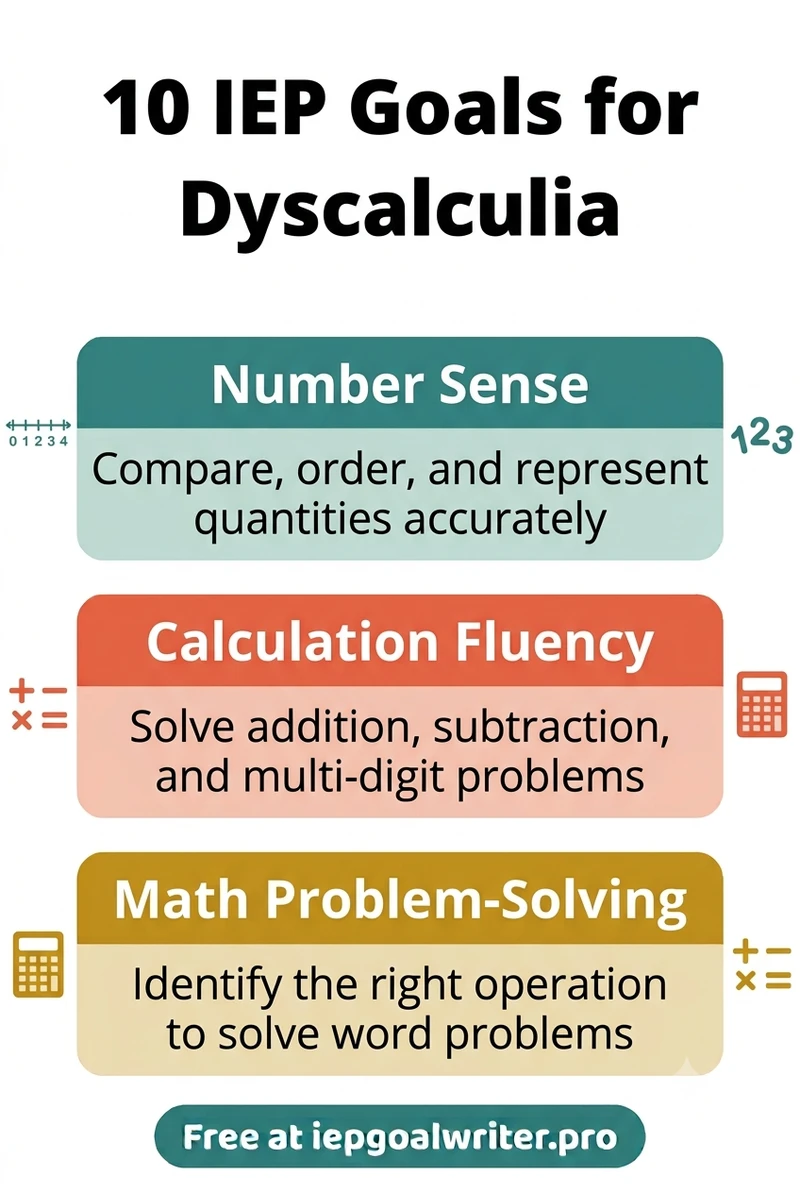
IEP goals for dyscalculia should target the specific math skill gaps identified in the evaluation — number sense, calculation fluency, or math reasoning and problem-solving — since dyscalculia, like dyslexia, is a manifestation of the Specific Learning Disability category rather than its own separate IDEA classification.
Dyscalculia describes a specific and persistent difficulty with number sense and mathematical calculation, and it qualifies a student for special education under the same IDEA category as dyslexia: Specific Learning Disability. The evaluation should pinpoint which math skill areas are affected — some students struggle mainly with number sense and quantity, others with calculation fluency, and others with applying math to multi-step word problems — and goals should follow that specific profile.
Number Sense
- 1.By [date], [student] will compare and order a set of numbers up to [grade-level range] with 80% accuracy across 4 of 5 trials.
- 2.By [date], [student] will use a number line or hundreds chart to represent a given quantity with 80% accuracy across 4 of 5 trials.
- 3.By [date], [student] will estimate a reasonable answer to a computation problem before solving it, with 80% accuracy across 4 of 5 trials.
Calculation Fluency
- 1.By [date], [student] will accurately solve single-digit addition and subtraction facts within [X] seconds each, with 80% accuracy across 4 of 5 trials.
- 2.By [date], [student] will use a taught strategy (such as a visual algorithm or manipulatives) to solve multi-digit calculation problems with 80% accuracy across 4 of 5 trials.
- 3.By [date], [student] will independently check a completed calculation for a common error type (such as a place-value mistake) in 4 of 5 opportunities.
Math Problem-Solving & Reasoning
- 1.By [date], [student] will identify the correct operation needed to solve a one-step word problem with 80% accuracy across 4 of 5 trials.
- 2.By [date], [student] will solve a two-step word problem using a taught graphic organizer or step-by-step process with 80% accuracy across 4 of 5 trials.
Self-Monitoring Strategies
- 1.By [date], [student] will use an assistive tool (calculator, multiplication chart, or number line) independently and appropriately during a math task, as specified in the IEP, in 4 of 5 opportunities.
- 2.By [date], [student] will identify when they do not understand a math problem and request clarification rather than guessing, in 3 of 5 observed opportunities.
Dyscalculia Isn't Its Own IDEA Category
Like dyslexia, dyscalculia is a term describing a pattern of difficulty, not a separate legal eligibility category. A student with dyscalculia qualifies for an IEP under Specific Learning Disability, based on evaluation data showing a significant discrepancy or pattern of strengths and weaknesses in math-related skills. Knowing this matters when reading an eligibility report — 'dyscalculia' may appear as a descriptive term, but 'Specific Learning Disability' is what should appear as the formal IDEA category.
FAQ
Paste your assessment data and generate an IDEA-compliant, individualized goal in seconds.
Try it free →