20 IEP Goals for Math Word Problems
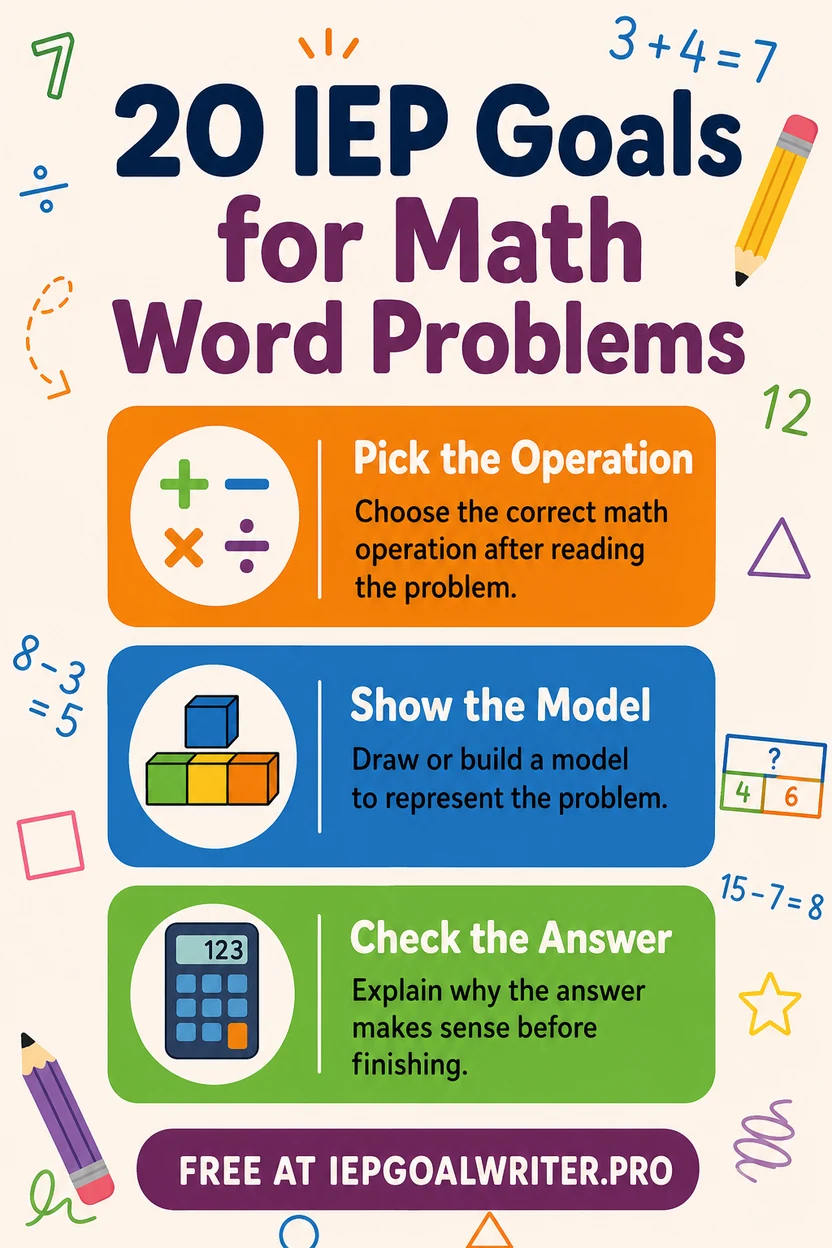
Math word-problem IEP goals should isolate the step the student cannot yet do, such as choosing an operation or representing quantities. For example: By [date], [student] will identify the operation and write a matching equation for one-step additive word problems with 80% accuracy in 4 of 5 probes, as measured by curriculum-based measurement.
A word-problem goal is not “will solve word problems.” It should say whether the student needs instruction in understanding the language, identifying relevant information, choosing an operation, representing quantities, solving multiple steps, or checking an answer. These 20 goals provide measurable structures across those skills. Use grade-level standards, student work, and error analysis to pick one barrier at a time; a student who computes correctly but chooses the wrong operation needs a different goal from a student who cannot read the problem independently.
Identifying the Operation and Relevant Information
- 1.By [date], [student] will identify the question being asked and underline the information needed to answer it in a one-step word problem with 80% accuracy across 10 problems, as measured by teacher-scored work samples.
- 2.By [date], [student] will cross out irrelevant numerical information in a word problem before selecting an operation with 80% accuracy across 10 problems, as measured by curriculum-based word-problem probes.
- 3.By [date], [student] will select the correct operation for one-step addition, subtraction, multiplication, or division situations from 4 choices with 80% accuracy across 20 mixed problems, as measured by operation-selection probe data.
- 4.By [date], [student] will explain in one sentence or communication turn why the selected operation matches the situation in 4 of 5 problems, as measured by problem-solving reasoning rubric data.
- 5.By [date], [student] will identify whether a problem asks for a total, difference, equal groups, comparison, or unknown quantity using the taught schema labels with 80% accuracy across 15 problems, as measured by schema-classification probe data.
Representing With a Model or Equation
- 1.By [date], [student] will draw a bar model, number line, array, diagram, or other taught representation that matches the quantities in a one-step problem in 4 of 5 problems, as measured by representation rubric data.
- 2.By [date], [student] will write an equation with a symbol or variable for the unknown after creating a model of the word problem with 80% accuracy across 10 problems, as measured by work-sample analysis.
- 3.By [date], [student] will match a teacher-provided model to the correct equation from 3 choices with 80% accuracy across 15 trials, as measured by model-equation matching probes.
- 4.By [date], [student] will label each number in a representation with the quantity and unit it represents in 4 of 5 problems, as measured by math work-sample rubric data.
- 5.By [date], [student] will revise a model that does not match the story after comparing it with the problem text in 4 of 5 error-analysis opportunities, as measured by student correction work samples.
Multi-Step Problem Solving
- 1.By [date], [student] will sequence the required operations for a two-step word problem before calculating with both steps in the correct order in 4 of 5 problems, as measured by multi-step planning rubric data.
- 2.By [date], [student] will solve a two-step word problem using the student’s approved calculator, reference sheet, or visual support after correctly planning the steps with 80% accurate final answers across 10 problems, as measured by curriculum-based problem-solving probes.
- 3.By [date], [student] will record the result of step 1 and use it correctly in step 2 without substituting an unrelated number in 4 of 5 problems, as measured by work-sample error analysis.
- 4.By [date], [student] will pause after the first step to check whether the remaining question still matches the planned second operation in 4 of 5 multi-step problems, as measured by self-monitoring checklist data.
- 5.By [date], [student] will apply the same two-step problem-solving routine to a novel but instructionally similar context with 80% accuracy across 10 generalization problems, as measured by generalization probe data.
Checking Reasonableness
- 1.By [date], [student] will estimate an expected answer range before calculating a grade-appropriate word problem in 4 of 5 problems, as measured by estimation work-sample data.
- 2.By [date], [student] will compare the calculated answer with the estimate and flag an answer that falls outside the expected range in 4 of 5 opportunities, as measured by reasonableness-check checklist data.
- 3.By [date], [student] will state the answer with the correct unit and in a complete response to the question asked with 80% accuracy across 10 problems, as measured by teacher-scored work samples.
- 4.By [date], [student] will use an inverse operation, second method, or calculator check to verify a computed answer when appropriate in 4 of 5 selected problems, as measured by verification-strategy tally data.
- 5.By [date], [student] will locate and correct the first incorrect step in a worked word-problem solution with 80% accuracy across 10 error-analysis items, as measured by error-analysis probe data.
A Worked Example: One Student, PLAAFP to Data Plan
Present levels: Owen computes addition and subtraction facts with about 90% accuracy and explains operations when equations are already written. Across two 10-item one-step word-problem probes, he selected the correct operation on 3/10 and 4/10 problems. His work samples show a consistent pattern: he underlines every number and immediately calculates without identifying the relationship in the story. When given a bar-model template and asked to state what is known and unknown first, he selected the operation correctly on 8/10 problems. The educational impact is difficulty translating grade-level mathematical situations into a representation even though basic computation is stronger.
Annual goal derived from that baseline: By [date], given a grade-level word problem within the student’s taught problem types, Owen will identify the question, select relevant information, create an appropriate representation or equation, solve, and check reasonableness with at least 80% rubric accuracy across 3 consecutive probes, as measured by problem-solving work samples. Specially designed instruction should explicitly teach problem structures, compare examples/nonexamples, model representation before calculation, and use think-alouds that fade as Owen becomes independent.
Goal versus accommodation: Reading the problem aloud, clarifying non-math vocabulary, providing a visual organizer, or allowing a calculator when computation is not the target may be accommodations. The annual goal measures mathematical problem representation and reasoning, not decoding speed or arithmetic facts unless those are separately identified needs.
Data plan: Score each stage—understanding the question, relevant information, structure/operation, representation, computation, and reasonableness. If computation is accurate but representation is weak, instruction stays on modeling; if representation is accurate and computation fails, address that separate skill. Include unfamiliar transfer problems so memorizing a worksheet format is not mistaken for mastery.
How These Goals Change by Grade Band
For early grades, use concrete joining, separating, comparing, part-whole, and equal-group situations with objects, drawings, and oral language support. The progression is from acting out a situation to drawing it to writing an equation—not memorizing “key words,” which often fail across problem types.
In grades 3–5, add multiplicative comparison, multi-step organization, fractions, measurement, and more explicit justification of the chosen model. The IEP target should connect to grade-level mathematical reasoning while isolating the prerequisite or strategy the student actually needs. Visual models and clarified language can remain available when they are access supports.
In middle and high school, word-problem goals may involve ratios, percent, proportional reasoning, equations, geometry, or applied financial situations. Teach students to define quantities, units, constraints, and the question before calculating. Older students should increasingly select their own representation and check whether the answer makes sense in context. The progression is mathematical modeling and strategic independence, not merely longer worksheets.
Collecting Data Without Adding a Full-Time Job
Score the problem-solving stage where the error occurs. A compact rubric can code: understood the question, selected relevant information, identified the mathematical relationship, built a representation, sequenced steps, computed accurately, labeled the answer, and checked reasonableness. This is much more useful than one percentage for “word problems.”
Keep problem sets equivalent in structure and difficulty. If the goal targets representation, do not let changing computation difficulty swamp the data. Conversely, if the student is expected to generalize across problem types, include enough variety to prevent memorizing a template. Save work samples because the representation itself is diagnostic.
Use an instructional decision rule. If the student consistently chooses an appropriate representation but computation errors dominate, consider whether a separate computation goal or accommodation is needed. If accuracy is high only when a teacher names the operation, the core problem-solving skill is not yet independent. After criterion is met on taught structures, include a small transfer set with novel wording and mixed problem types before declaring mastery.
Personalization warning: Do not write “will solve word problems with 80% accuracy” without identifying what currently breaks down. A student who cannot decode the text, a student who cannot identify the relationship, and a student who makes calculation errors need different goals. Use baseline work samples to identify the bottleneck and preserve access supports for non-target skills.
FAQ
Paste your assessment data and generate an IDEA-compliant, individualized goal in seconds.
Try it free →