20 IEP Goals for Nonverbal Learning Disability
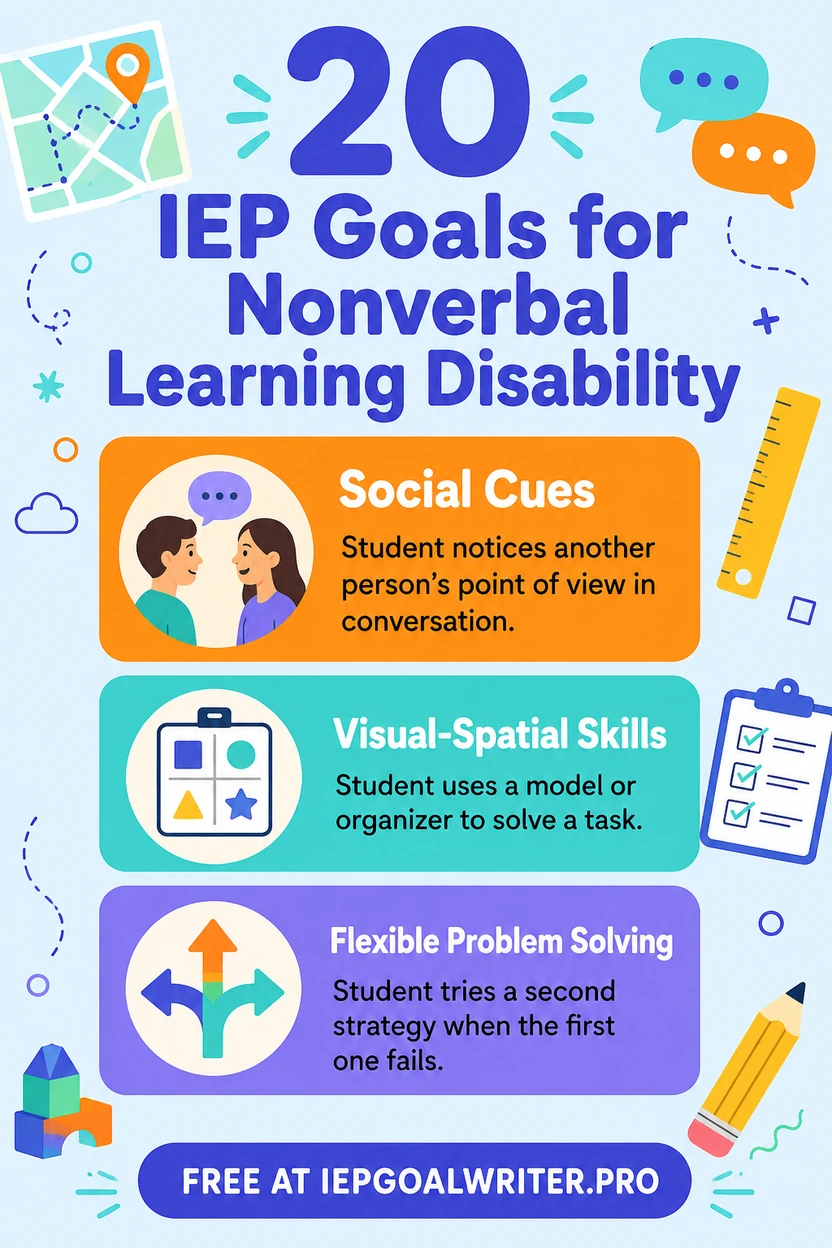
IEP goals for nonverbal learning disability should target the individual educational skill shown in data, such as interpreting a peer cue or organizing visual-spatial work. For example: By [date], [student] will identify one relevant nonverbal cue and choose an expected response in 4 of 5 role-play probes, as measured by a social-pragmatic rubric.
Nonverbal learning disability, often called NVLD, is not an IDEA eligibility category. A school team determines eligibility from the comprehensive evaluation and educational need, not from the label. Students described this way can have very different profiles, so these goals focus on measurable skills rather than broad traits: social pragmatics, visual-spatial reasoning, coordination, and flexible problem solving. Choose only a goal that matches present levels and the specialized instruction the student actually needs.
Social Pragmatics
- 1.By [date], [student] will identify the likely meaning of a pictured or acted nonverbal cue from 3 choices with 80% accuracy across 15 structured examples, as measured by social-pragmatic probe data.
- 2.By [date], [student] will state one observable cue and one possible interpretation before responding in a peer scenario in 4 of 5 structured opportunities, as measured by social-inference rubric data.
- 3.By [date], [student] will ask a clarifying question when a peer message could reasonably have more than one meaning in 4 of 5 role-play or natural opportunities, as measured by clarification tally data.
- 4.By [date], [student] will use a taught conversation check-in to determine whether the listener is following a story or explanation in 4 of 5 conversation samples, as measured by SLP pragmatic-language rubric data.
- 5.By [date], [student] will identify a mismatch between spoken words and tone/body cues and explain what additional information is needed with 80% accuracy across 10 scenarios, as measured by social-communication probe data.
Visual-Spatial Math and Organization
- 1.By [date], [student] will use graph paper, lined templates, or another assigned visual organizer to align multi-digit math work with place-value alignment correct in 4 of 5 work samples, as measured by math work-sample analysis.
- 2.By [date], [student] will translate a pictured or spatial math model into an equation using a taught step-by-step routine with 80% accuracy across 10 problems, as measured by curriculum-based math probes.
- 3.By [date], [student] will locate a required item on a page, chart, diagram, or coordinate grid using the taught scan strategy in 4 of 5 tasks, as measured by visual-search task data.
- 4.By [date], [student] will organize information from a complex worksheet into the correct labeled sections before solving in 4 of 5 assignments, as measured by organization rubric data.
- 5.By [date], [student] will check a visual-spatial math response with a second representation, such as equation, table, or verbal explanation in 4 of 5 problems, as measured by error-analysis work samples.
Motor Coordination and Classroom Access
- 1.By [date], [student] will copy or enter information from a classroom model using the assigned spacing or positioning support with at least 80% of required elements accurately placed across 4 samples, as measured by OT/classroom work-sample rubric data.
- 2.By [date], [student] will use a 3-step motor-planning checklist to set up materials for a classroom task with all 3 steps completed in 4 of 5 opportunities, as measured by task-analysis data.
- 3.By [date], [student] will navigate a familiar school route using visual landmarks or a map cue without missing a required turn in 4 of 5 trials, as measured by school-route checklist data.
- 4.By [date], [student] will complete a cutting, drawing, lab, or construction task using the assigned adaptive setup and sequence with at least 80% of task-analysis steps correct in 4 of 5 sessions, as measured by OT/teacher task-analysis data.
- 5.By [date], [student] will request a model, verbal description, or positioning support before a visual-motor task breaks down in 4 of 5 relevant opportunities, as measured by self-advocacy tally data.
Flexible Problem Solving
- 1.By [date], [student] will generate at least 2 possible solutions to a school problem before choosing one in 4 of 5 structured scenarios, as measured by problem-solving rubric data.
- 2.By [date], [student] will identify which part of a familiar routine changed and select the matching revised step in 4 of 5 planned change scenarios, as measured by flexibility checklist data.
- 3.By [date], [student] will use a taught “same/different/next” routine to adapt when a teacher changes materials, order, or grouping in 4 of 5 classroom opportunities, as measured by routine-adaptation data.
- 4.By [date], [student] will explain why a first strategy did not work and choose a different strategy from at least 2 options in 4 of 5 academic problem-solving opportunities, as measured by student reflection and work-sample data.
- 5.By [date], [student] will apply a previously taught problem-solving routine to a new but similar classroom situation in 3 of 4 generalization opportunities across 2 settings, as measured by generalization-probe data.
A Worked Example: One Student, PLAAFP to Data Plan
Present levels: Priya reads above grade level, remembers verbal information well, and contributes detailed factual knowledge. In 10 video-based social-inference probes, she correctly identified the speaker’s likely meaning in 2 and selected a reasonable clarification question in 3. During cooperative learning, she often interprets a peer looking away as anger and stops participating. When an adult explicitly names two possible interpretations, Priya can compare them accurately in 8 of 10 trials. The educational impact is difficulty using nonliteral, contextual, and visual-spatial information to stay engaged in peer and academic tasks.
Annual goal derived from that baseline: By [date], when a peer or classroom interaction is ambiguous, Priya will identify at least 2 observable/context clues, generate 2 possible interpretations, and select or ask one clarification response in 4 of 5 structured or natural opportunities, as measured by a social-inference rubric. Specially designed instruction should make hidden cues explicit, use think-aloud modeling, compare multiple interpretations, and gradually move from structured examples to real group work.
Goal versus accommodation: Explicit written directions, verbalizing visual information, graph paper, previewing group roles, or providing a model may be accommodations. The annual goal teaches Priya to use a defined reasoning or self-advocacy routine. The team should not write a broad goal to “understand body language” or assume every social misunderstanding has the same cause.
Data plan: Score cue identification, interpretation, alternative generation, and clarification separately. Include both structured probes and authentic group-work samples. If Priya succeeds on videos but not in live interaction, teach the speed and self-advocacy demands of real conversation rather than increasing probe complexity.
How These Goals Change by Grade Band
For younger students, use explicit visual and verbal teaching for concrete spatial routines, page organization, simple peer expectations, and asking when a situation is unclear. The progression should move from adult-modeled interpretations toward the student identifying observable clues and selecting a response.
In grades 3–5, goals can address cooperative learning, multi-step visual-spatial math, organizing written work on a page, motor-planning routines, and flexible problem solving. Verbal strengths can be used as an instructional bridge: narrate the visual pattern, name the steps, and create a self-talk routine the student can later apply independently.
In middle and high school, focus on complex group projects, navigation of changing schedules, visual data/graphs, self-advocacy, and interpreting ambiguous social or academic information without expecting mind-reading. The target should be a teachable process—identify clues, compare possibilities, clarify—not a personality standard. Note that NVLD is not an IDEA category, so the IEP goal must come from evaluated educational needs rather than the label.
Collecting Data Without Adding a Full-Time Job
Use separate measures for social inference, visual-spatial organization, motor access, and flexible problem solving. A broad “NVLD skills” rating is too vague to guide instruction. For social-pragmatic goals, score the observable clue identified, interpretation, alternative interpretation, clarification question, and response. For visual-spatial tasks, preserve the work sample so the team can see the error pattern.
Compare structured and natural performance. A student may score 90% when given unlimited time and highlighted clues but struggle in a live group where cues change quickly. Document supports and timing so the team knows whether the improvement reflects skill growth, added scaffolding, or both.
Use verbal mediation as a data point when it is part of instruction. Track whether the student independently uses a taught verbal routine—such as “What do I see? What could it mean? What can I ask?”—before an adult supplies the interpretation. If one component remains weak, teach that component rather than raising the whole rubric criterion.
Personalization warning: Nonverbal learning disability/NVLD is not an IDEA eligibility category and terminology is not used consistently across settings. Do not select goals from the label alone. Base the IEP on the student’s actual evaluation pattern and educational needs, and avoid goals that require masking, forced eye contact, or conformity to one “normal” social style.
FAQ
Paste your assessment data and generate an IDEA-compliant, individualized goal in seconds.
Try it free →