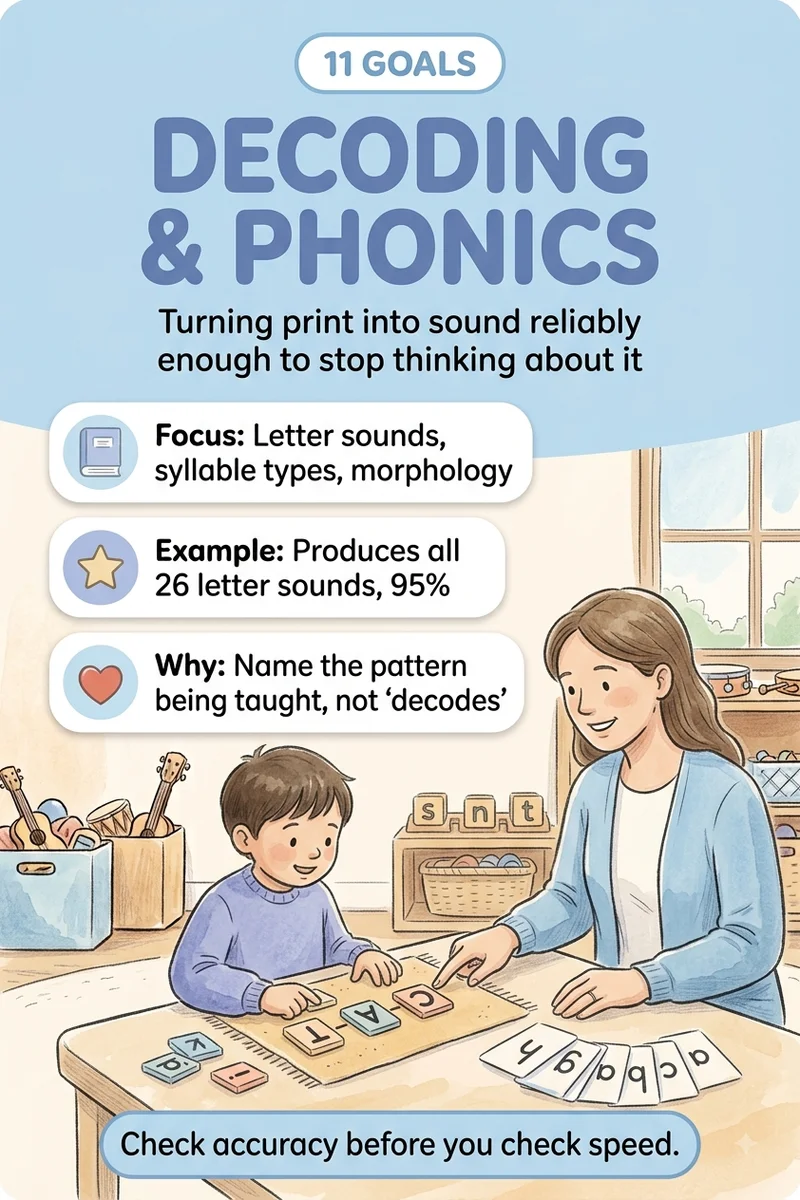
11 Decoding & Phonics IEP Goals, Preschool Through High School
Decoding goals should name the pattern being taught — closed syllables, silent-e, vowel teams, multisyllabic division — not just "will decode words". The specificity is what tells the next teacher where the student is in the sequence.
Free · no email required · opens your browser's print dialog
Kindergarten – 2nd
- 1By [date], [student] will produce the correct sound for all 26 letters with 95% accuracy across 4 of 5 trials.
- 2By [date], [student] will decode CVC words with 85% accuracy across 4 of 5 word-list probes.
- 3By [date], [student] will decode words with consonant blends and digraphs with 80% accuracy across 4 of 5 probes.
- 4By [date], [student] will apply the silent-e rule to decode CVCe words with 80% accuracy across 4 of 5 trials.
- 5By [date], [student] will decode words with common vowel teams (ai, ea, oa, ee) with 75% accuracy in 4 of 5 probes.
- 6By [date], [student] will decode 2-syllable words by dividing between syllables with 75% accuracy across 4 of 5 trials.
3rd – 5th Grade
- 7By [date], [student] will decode multi-syllabic words using syllable division rules with 80% accuracy across 4 of 5 word-list probes.
- 8By [date], [student] will apply the 6 syllable types to decode unfamiliar words with 80% accuracy in 4 of 5 trials.
- 9By [date], [student] will decode words with common prefixes and suffixes with 80% accuracy across 4 of 5 probes.
- 10By [date], [student] will use morphology (root, prefix, suffix) to determine the meaning of an unfamiliar word with 75% accuracy across 4 of 5 trials.
6th – 8th Grade
- 11By [date], [student] will decode unfamiliar academic and technical vocabulary using syllable division and morphology with 80% accuracy across 4 of 5 probes.
How to teach decoding & phonics in the classroom
Decoding is taught through explicit, systematic phonics — a planned scope and sequence, not incidental teaching as words come up. Introduce a few letter-sound correspondences at a time, model blending them into words, and have the student blend aloud with immediate feedback before reading connected text. Move from continuous sounds to stop sounds, from CVC words to blends and digraphs to multisyllable words, adding only when the prior step is reliable. Use decodable text at first so the student practices the patterns taught rather than guessing from pictures or context. Teach the student to check a word by sounding it fully rather than predicting. Keep sessions short and frequent, and target the specific pattern the error data points to. Connect decoding to spelling — writing the words uses the same knowledge from the other direction.
How to measure it
Use word-list probes rather than connected text so context cannot be used to guess, and check accuracy before rate. A decoding goal that reports 60 words per minute at 70% accuracy is reporting fast guessing.
Where these goals come from
Each goal above is drawn from a grade-band goal bank, where you can see it alongside the other targets it is usually paired with: Reading goals, 3rd – 5th Grade; Reading goals, 6th – 8th Grade; Reading goals, Kindergarten – 2nd Grade.
Related skills
A flat following-directions goal is often really a breakdown in one of these skills. If the data does not move, check whether the real target is here instead:
- Phonemic Awareness IEP goals — hearing and manipulating the sounds in a word, with no print involved at all
- Reading Fluency IEP goals — reading connected text accurately, at a workable rate, with expression
- Reading Comprehension IEP goals — understanding the text, not just reading the words
Common questions
Should decoding come before comprehension work?
Decoding is usually the priority, because a student spending all their effort sounding out words has nothing left for meaning. Comprehension and vocabulary can be kept moving through read-alouds and discussion while decoding catches up.
What does a decoding goal measure?
Common measures include accuracy reading a list of target-pattern words or nonsense words, accuracy on decodable connected text, or a nonsense-word fluency score. Note the pattern or level being tested so gains are not just easier words.
My student memorizes words but can't decode new ones — why?
That is a sight-word compensation strategy that stalls once the volume of words outgrows memory, usually around second or third grade. The fix is explicit, systematic phonics that teaches the patterns, plus decodable text so the student practices decoding rather than guessing.
Further reading
Need a goal built from your student's baseline? Generate one for your student →