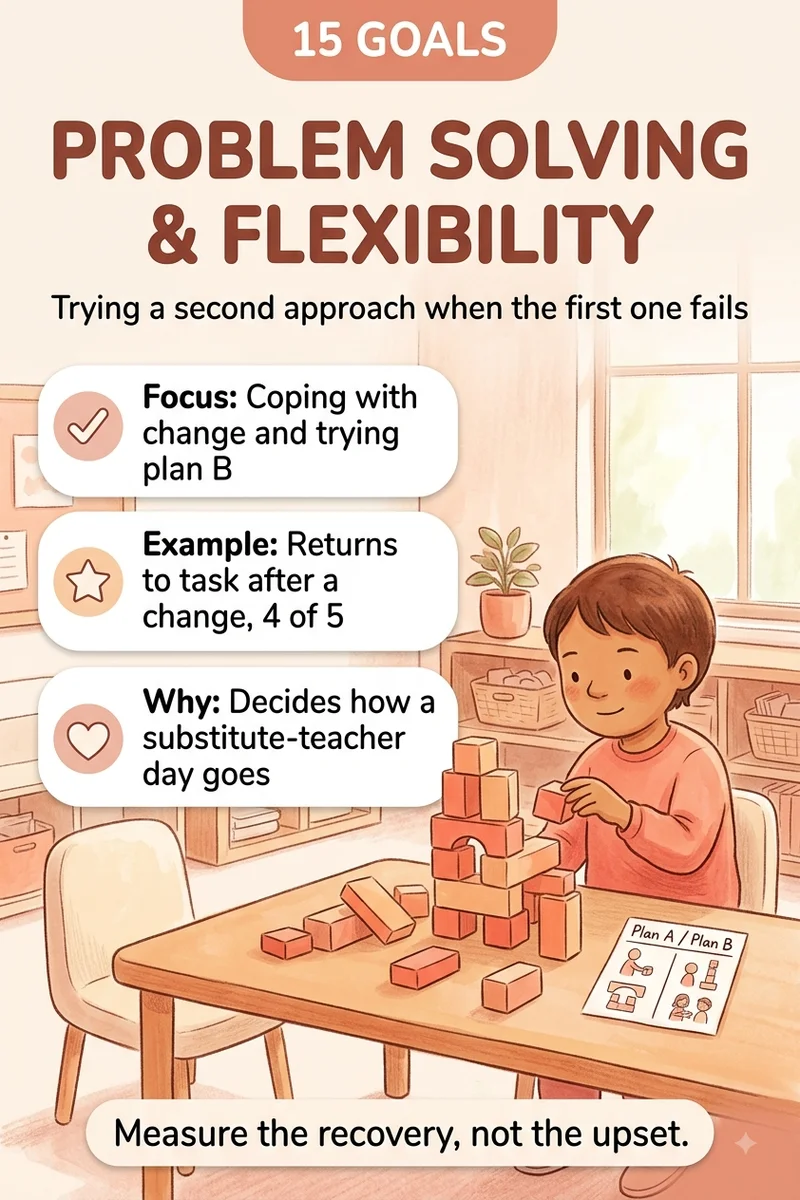
15 Problem Solving & Flexibility IEP Goals, Preschool Through High School
Flexibility and problem solving cover shifting between tasks, accepting an unexpected change, generating an alternative when a strategy does not work, and recovering from a mistake. They are the skills that decide whether a student can cope with a substitute teacher or an altered schedule.
Free · no email required · opens your browser's print dialog
Preschool & Pre-K
- 1[student] will transition from a preferred to a non-preferred activity using a visual or verbal cue, with no more than 1 redirection, across 3 consecutive observations.
- 2[student] will accept a change to an expected routine (a different snack, a substitute) with no more than 1 redirection, in 4 of 5 observed opportunities.
- 3[student] will try an alternative way to solve a simple problem (a puzzle piece, a block) when the first attempt doesn't work, in 4 of 5 observed opportunities.
Kindergarten – 2nd
- 4[student] will try a different strategy when the first approach to a problem doesn't work, with 1 adult prompt or fewer, in 4 of 5 observed opportunities.
- 5[student] will transition between subjects or activities within [X] minutes of the cue, with no more than 1 redirection, across 4 of 5 observed transitions.
- 6[student] will accept an unexpected change to the daily routine with no more than 1 redirection, in 4 of 5 observed opportunities.
3rd – 5th Grade
- 7[student] will try at least 2 different strategies before asking for help when stuck on a problem, in 4 of 5 observed opportunities.
- 8[student] will adjust to an unexpected change in schedule or task without significant distress, in 4 of 5 observed opportunities.
- 9[student] will shift between two different types of tasks or subjects without extended difficulty refocusing, across 4 of 5 observed transitions.
- 10By [date], [student] will solve two-step word problems using any of the four operations with 75% accuracy across 4 of 5 trials.
- 11By [date], [student] will identify the operations needed in a multi-step problem before solving with 80% accuracy in 4 of 5 opportunities.
- 12By [date], [student] will show and explain their work for a multi-step problem, scoring 3/4 or higher on a rubric in 4 of 5 samples.
- 13By [date], [student] will check whether an answer is reasonable using estimation in 4 of 5 opportunities.
9th – 12th Grade
- 14[student] will adjust a plan independently when an unexpected obstacle arises (a schedule change, a setback), without significant distress, in 4 of 5 documented opportunities.
- 15[student] will generate and evaluate at least 2 possible solutions before choosing how to solve a real problem, with 80% accuracy across 4 of 5 trials.
How to teach problem solving & flexibility in the classroom
Problem-solving is taught with a visible, repeatable framework the student can run without an adult. Pick one model — identify the problem, list options, weigh them, choose, check how it went — and use the same language and the same visual every time so it becomes a habit rather than a lesson. Start with low-stakes, familiar problems (a missing pencil, a disagreement over a turn) before academic or emotional ones. Think aloud through your own decisions so the student hears the internal steps most people never voice. Give a worked example, then a partly-completed one, then a blank template, fading your prompting each round. Keep a small bank of the student's own past solutions to point back to. Expect to re-teach the "weigh the options" step longest — jumping to the first idea is the most common breakdown — and treat a reasonable choice that did not work as a success if the process was followed.
How to measure it
Measure the recovery, not the upset. Count how often the student generates a second approach, or returns to task within a set number of minutes after a disruption — both are observable, unlike "will be more flexible".
Where these goals come from
Each goal above is drawn from a grade-band goal bank, where you can see it alongside the other targets it is usually paired with: Executive Function goals, 3rd – 5th Grade; Executive Function goals, 9th – 12th Grade; Executive Function goals, Kindergarten – 2nd Grade; Executive Function goals, Preschool & Pre-K; Math goals, 3rd – 5th Grade.
Related skills
A flat following-directions goal is often really a breakdown in one of these skills. If the data does not move, check whether the real target is here instead:
- Emotional Regulation IEP goals — recognising a feeling and doing something about it before it escalates
- Self-Monitoring IEP goals — noticing your own performance while it is happening
- Independent Functioning IEP goals — doing the routine without an adult standing there
Common questions
Is this an academic problem-solving goal or a social one?
The framework is the same — identify, generate options, weigh, choose, check — so one page covers both. What changes is the content: a math word problem, a peer conflict, a missing material, a schedule change. Write the goal around the steps of the process and specify the type of situation in the objective.
Why does my student jump straight to the first solution?
Generating and weighing multiple options is the step that takes the most working memory and the most tolerance for staying in an unsolved state. It is the most common breakdown and the part to teach longest — often with a required "name two options before you pick" rule and a visual to hold the choices.
What counts as meeting a problem-solving goal if the solution fails?
A reasonable choice that did not work still counts if the student ran the process — named the problem, considered options, chose with a reason, and checked the outcome. The goal is the method, not a guaranteed result, so scoring should follow the steps completed independently.
Need a goal built from your student's baseline? Generate one for your student →