20 IEP Goals for OCD in the School Setting
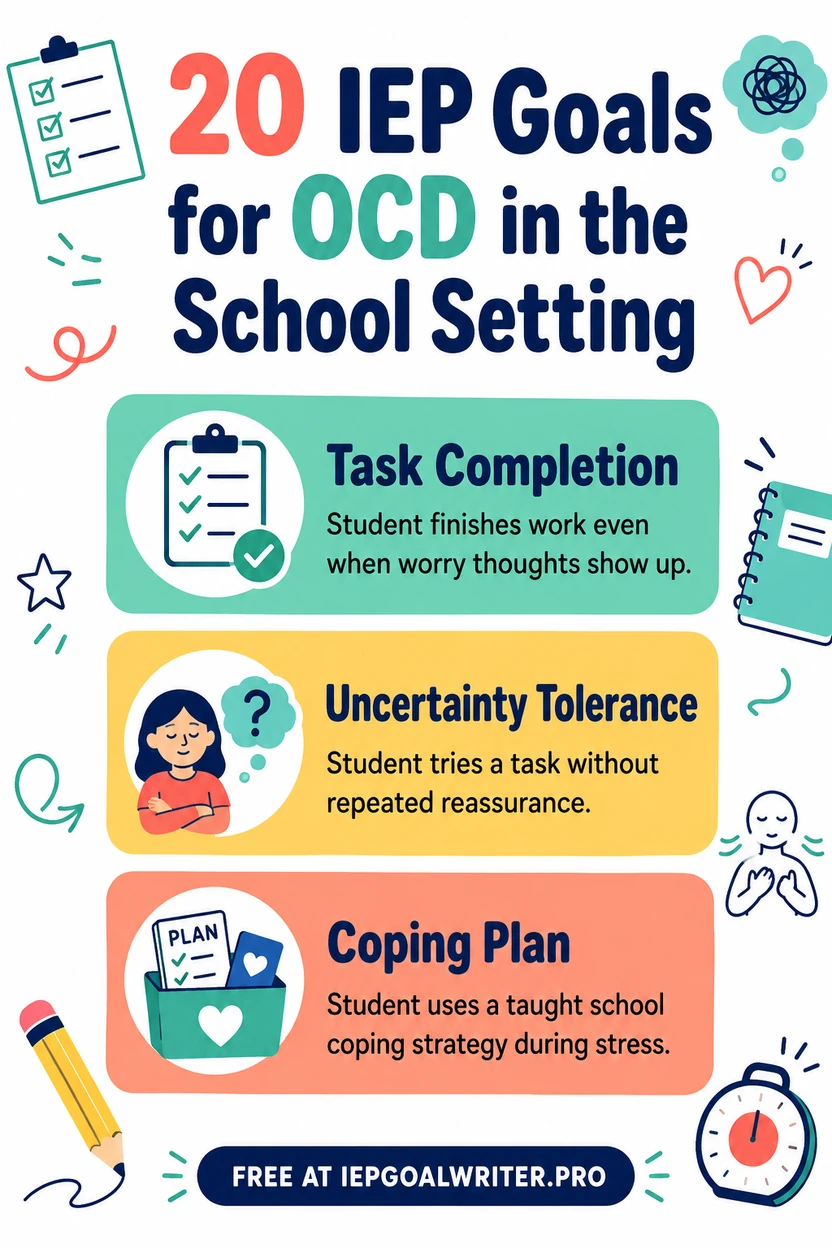
School-based IEP goals for OCD should support access and teach observable learning behaviors without asking staff to provide clinical treatment. For example: By [date], [student] will use the agreed coping plan and begin the assigned task after an intrusive-thought trigger in 4 of 5 planned opportunities, as measured by a task-initiation log.
Obsessive-compulsive disorder is a clinical diagnosis, not an IDEA category. If a student is eligible, the IEP should target documented educational needs and be coordinated with family and appropriate providers—not reproduce therapy inside a classroom. The goals below center on school participation: using coping plans, returning to tasks, communicating needs, and reducing adult reassurance routines only when that is part of the student’s individualized school plan. Do not assume every repetitive behavior has the same function.
Tolerating Uncertainty in School Routines
- 1.By [date], [student] will begin a familiar classroom routine when one nonessential detail is changed, using the posted routine rather than waiting for repeated reassurance in 4 of 5 planned opportunities, as measured by routine-initiation and reassurance tally data.
- 2.By [date], [student] will choose between 2 acceptable options when the “perfect” choice is not available and proceed within 3 minutes in 4 of 5 opportunities, as measured by decision-latency data.
- 3.By [date], [student] will complete a teacher-defined “good enough” stopping point for an assignment rather than restarting the entire task in 4 of 5 work samples, as measured by work-completion and restart-count data.
- 4.By [date], [student] will use the agreed school coping script after an unexpected schedule change and enter the next activity within 5 minutes in 4 of 5 incidents, as measured by transition and coping-log data.
- 5.By [date], [student] will leave a minor, pre-identified uncertainty unresolved during a structured school task and continue the next task step in 3 of 4 planned practice opportunities, as measured by staff observation and task-progress data.
Reducing Adult Accommodation-Seeking
- 1.By [date], [student] will ask one clarification question about an assignment and then begin without repeating the same question in 4 of 5 opportunities, as measured by clarification-question tally data.
- 2.By [date], [student] will use a written direction, checklist, or posted answer source before seeking adult reassurance for a previously taught routine in 4 of 5 relevant opportunities, as measured by independence checklist data.
- 3.By [date], [student] will accept one teacher answer to a routine question and transition to the assigned next step in 80% of documented opportunities across 3 weeks, as measured by reassurance and task-initiation records.
- 4.By [date], [student] will identify whether a question is “need information” or “asking again for certainty” using the team’s taught sorting routine with 80% accuracy across 10 structured examples, as measured by student sorting-probe data.
- 5.By [date], [student] will use the agreed help-request schedule or cue instead of interrupting repeatedly for the same non-safety question in 4 of 5 class periods, as measured by frequency-count data.
Task Completion Despite Intrusive Thoughts
- 1.By [date], [student] will start an assigned task within 3 minutes after reviewing the first-step cue, even when an intrusive thought or urge is reported in 4 of 5 opportunities, as measured by task-initiation latency data.
- 2.By [date], [student] will complete the teacher-defined minimum work chunk before using an approved break or check-in in 4 of 5 class periods, as measured by work-chunk completion records.
- 3.By [date], [student] will resume the exact task step where work stopped after using an approved coping break in 4 of 5 breaks, as measured by break-return checklist data.
- 4.By [date], [student] will submit an assignment after completing the agreed single-check routine rather than repeating checks beyond the routine in 4 of 5 assignments, as measured by submission and checking-count data.
- 5.By [date], [student] will remain engaged with a defined academic task for 12 consecutive minutes while using the school supports listed in the IEP in 4 of 5 sessions, as measured by momentary time-sampling data.
Coping and Communication
- 1.By [date], [student] will signal “I am stuck” or use the agreed help phrase before abandoning an activity in 4 of 5 relevant opportunities across 2 settings, as measured by self-advocacy tally data.
- 2.By [date], [student] will select one school-approved coping strategy from the student’s plan and use it for the agreed interval in 4 of 5 documented episodes, as measured by coping-strategy log data.
- 3.By [date], [student] will rate task distress or stuckness on the team’s 3-point school scale and choose the matching next step with 80% agreement with staff scoring across 10 observations, as measured by self-monitoring forms.
- 4.By [date], [student] will tell a staff member whether support is needed for task understanding, access, or coping using the taught 3-choice prompt in 4 of 5 help-seeking opportunities, as measured by help-request classification data.
- 5.By [date], [student] will return to the class routine after a coping check-in and complete the next defined task step within 5 minutes in 4 of 5 opportunities, as measured by return-to-task timing data.
A Worked Example: One Student, PLAAFP to Data Plan
Present levels: Sofia earns strong grades when she completes work and can explain the class self-check routine. Across 12 independent assignments, she asked the teacher to confirm that an answer was correct an average of 4.2 times before submission and failed to begin the next task within 5 minutes in 7 assignments. With a posted one-check routine and one adult prompt, she submitted and moved on in 8 of 10 practice opportunities. The educational impact is lost instructional time and incomplete transitions between tasks, not the presence of intrusive thoughts themselves.
Annual goal derived from that baseline: By [date], after completing a defined assignment, Sofia will use the agreed one-check routine and submit the work without additional reassurance-seeking, then begin the next assigned step within 5 minutes in 4 of 5 opportunities, as measured by reassurance-request and task-transition data. Specially designed instruction should explicitly teach the school routine, rehearse coping/self-advocacy language when Sofia is regulated, and coordinate staff responses so adults do not accidentally create different rules in different classrooms.
Goal versus accommodation: A visual checklist, predictable directions, a planned check-in time, or another team-approved support may be accommodations. The annual goal is Sofia’s use of a taught school-access routine. The IEP should not prescribe clinical treatment, require exposure tasks designed outside the school team’s scope, or make “fewer OCD symptoms” the educational goal.
Data plan: For the selected school routine, record number of reassurance requests, whether the posted routine was used, prompt level, submission status, and latency to the next task. Review patterns across classes. If Sofia uses the routine but the assignment remains unfinished because the task itself is too difficult or unclear, address the academic barrier separately rather than treating it as failure of the coping goal.
How These Goals Change by Grade Band
For younger students, goals should be narrow and concrete: follow one visual routine, use one taught help phrase, tolerate a small routine change with a familiar support, or return to a short activity after using a coping strategy. The team should avoid language that asks the child to suppress thoughts or feelings; only observable school participation is measured.
In grades 3–5, targets can include self-checking once instead of repeated checking, using a planned clarification routine, beginning work despite uncertainty, and returning to an assignment after an interruption. Instruction should make the boundary between appropriate help-seeking and repeated reassurance explicit without shaming the student.
In middle and high school, goals may focus on managing longer assignments, independently using a school coping plan, communicating when support is needed, and maintaining participation across multiple teachers. Older students should have increasing input into which routines are targeted and what supports are acceptable. Grade progression means more independence and generalization, not turning the IEP into a clinical treatment protocol.
Collecting Data Without Adding a Full-Time Job
Collect school-function data, not a global rating of “OCD behavior.” For a reassurance goal, count requests within a defined routine and record whether the agreed self-check or help routine was used first. For work-completion goals, track start latency, restarts, submission, and time lost to the target behavior. For coping/self-advocacy, score the specific strategy and prompt level rather than whether the student “seemed calm.”
Keep staff responses consistent enough that the data mean the same thing across days. If one teacher answers repeated reassurance questions and another redirects to the posted routine, raw request counts are not directly comparable without noting the response condition. A one-page staff cue card can improve both instruction and data fidelity.
Use decision rules cautiously. If the target routine improves in one class, probe another predictable setting before increasing difficulty. If requests decrease but work completion also decreases, investigate whether the student has shifted to silent avoidance. If data are flat, review whether the school skill, support, and staff response are aligned with the student’s plan rather than escalating demands automatically.
Personalization warning: OCD is a clinical diagnosis, not an IDEA eligibility category. An IEP should address educational impact and teach school-access skills; it should not substitute for medical or mental-health treatment. Goals involving uncertainty, reassurance, or coping should be coordinated with the student’s evaluation, family, and appropriate school professionals so educational supports do not conflict with the broader plan.
FAQ
Paste your assessment data and generate an IDEA-compliant, individualized goal in seconds.
Try it free →