20 IEP Goals for Work Completion and Productivity
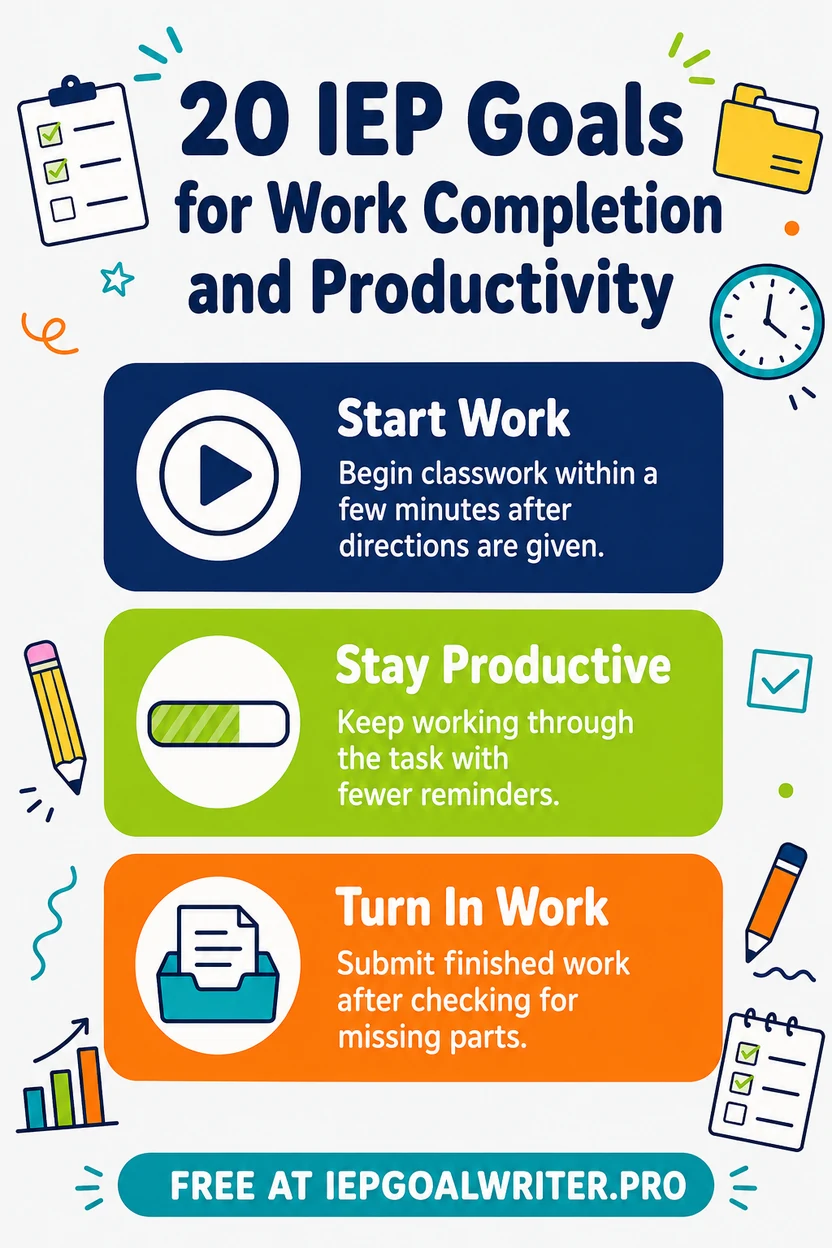
Work-completion IEP goals should target the barrier shown in baseline data—starting, pacing, organizing, persisting, or submitting—not a broad demand to finish all work. For example: By [date], [student] will use a first-step card to begin the assigned work within three minutes in 4 of 5 opportunities, as measured by task-initiation data.
“Work completion” is an outcome, not a skill. Before writing a goal, identify why work is incomplete: unclear directions, language access, reading difficulty, motor access, task initiation, executive functioning, avoidance of a nonpreferred task, pace, or missing accommodations. These 20 examples separate those teachable skills so the goal can be fair and measurable. Keep supports that provide access in place; a student should not have to lose needed accommodations to prove progress. Use baseline data from a consistent task and setting, not a general impression that the student is unproductive.
Starting Promptly
- 1.By [date], [student] will begin the first required step of an independent assignment within 3 minutes after directions and materials are available in 4 of 5 opportunities, as measured by task-initiation latency data.
- 2.By [date], [student] will identify the first task step from a visual checklist or assignment directions before asking an adult what to do in 4 of 5 opportunities, as measured by first-step independence tally data.
- 3.By [date], [student] will set up all required materials for a routine class task within the individualized preparation interval in 4 of 5 class periods, as measured by materials-readiness checklist data.
- 4.By [date], [student] will use a start cue, timer, or first-then support listed in the IEP and begin work without an additional adult prompt in 80% of opportunities across 3 weeks, as measured by support-use and initiation records.
- 5.By [date], [student] will restart an interrupted task within 2 minutes after the interruption ends by locating the marked next step in 4 of 5 opportunities, as measured by restart latency data.
Sustained Productivity
- 1.By [date], [student] will remain actively engaged with the assigned work for 12 consecutive minutes with no more than 1 redirect in 4 of 5 sessions, as measured by momentary time-sampling data.
- 2.By [date], [student] will complete the teacher-defined work chunk before taking the planned break in 4 of 5 class periods, as measured by work-chunk completion data.
- 3.By [date], [student] will complete at least 80% of the essential assigned items during the individualized work period across 4 of 5 comparable assignments, as measured by work-completion records.
- 4.By [date], [student] will use the taught “mark-and-move” strategy to skip a stuck item and continue productive work on the next item in 4 of 5 opportunities, as measured by productivity strategy tally data.
- 5.By [date], [student] will return from a planned break and resume the marked task step within 2 minutes in 4 of 5 breaks, as measured by break-return latency data.
Turning Work In and Organization
- 1.By [date], [student] will place each completed paper or digital assignment in the correct submission location before leaving class in at least 90% of opportunities across 3 weeks, as measured by submission-location checklist data.
- 2.By [date], [student] will record each assigned task and due date in the established planner or digital system with 90% completeness across 2 consecutive weeks, as measured by planner audit data.
- 3.By [date], [student] will bring the materials needed for the next class using the student’s packing checklist in 4 of 5 transitions, as measured by materials-management checklist data.
- 4.By [date], [student] will identify unfinished work at the end of class and record the exact next completion step in 4 of 5 class periods, as measured by end-of-class work log data.
- 5.By [date], [student] will submit a completed assignment by the stated due point using the class platform or collection routine in at least 80% of assignments across 4 weeks, as measured by learning-platform or teacher submission records.
Self-Checking Before Submission
- 1.By [date], [student] will use a 3-item completion checklist to verify that required parts are present before submitting an assignment with all 3 checks completed in 4 of 5 opportunities, as measured by completed checklist data.
- 2.By [date], [student] will compare finished work with the assignment rubric and identify one missing or incomplete requirement in 4 of 5 teacher-selected samples, as measured by rubric self-check data.
- 3.By [date], [student] will correct at least 80% of errors the student independently identifies during the self-check routine across 5 work samples, as measured by before-and-after work-sample analysis.
- 4.By [date], [student] will verify the student’s name, required attachments, and final submission status before ending a digital task in 4 of 5 assignments, as measured by digital submission checklist data.
- 5.By [date], [student] will rate the completed assignment as ready/not ready using the taught criteria and match the teacher’s readiness score with 80% agreement across 10 assignments, as measured by student-teacher readiness comparison data.
A Worked Example: One Student, PLAAFP to Data Plan
Present levels: Malik completes most assigned math accurately during class and can explain the school’s digital submission process. Across the last 15 assignments, he finished the academic work on 13 but successfully submitted only 6 by the deadline. In five direct observations, he independently opened the learning-platform checklist once; with one teacher prompt to use the checklist, he uploaded the correct file in 4 of 4 opportunities. The educational impact is missing grades and incomplete evidence of learning caused by a breakdown in the final submission routine, not lack of math skill or motivation.
Annual goal derived from that baseline: By [date], after completing an assignment, Malik will independently use the established submission checklist to verify the file, upload/turn in the work, and confirm submission by the deadline in 4 of 5 assignments across 3 consecutive weeks, as measured by platform records and a submission-routine checklist. Specially designed instruction should explicitly teach the final-work chain, use visual cues at first, rehearse common errors, and fade adult reminders while keeping the checklist available.
Goal versus accommodation: A posted checklist, assignment-management app, reduced number of platforms, or teacher-provided due-date calendar may be accommodations. The annual goal is Malik’s independent use of the system. A broad goal such as “will complete 80% of assignments” would hide that he already completes the academic content and specifically needs instruction in submission.
Data plan: Track the point of breakdown—setup, start, sustained work, completion, organization, submission, or self-check—rather than one global completion percentage. For Malik, platform timestamps provide the outcome while a short checklist captures prompt level and which step failed. If submission becomes independent but overdue work remains, reassess whether planning or time management is a separate need.
How These Goals Change by Grade Band
For young students, use one visible first step, a short work cycle, and a consistent finished-work location. Goals may target beginning after the cue, returning after a break, placing finished work in one location, or checking off a two-step routine. The progression should be easy to observe and reinforce.
In grades 3–5, add planning a work chunk, tracking required parts, using folders or digital platforms, turning work in, and checking one or two criteria before submission. Teach the workflow explicitly rather than assuming “organization” will emerge from reminders.
In middle and high school, separate complex productivity demands: prioritizing across classes, breaking long assignments into milestones, using a calendar, monitoring missing work, submitting through multiple systems, and deciding when to ask for help. Older students need systems that can travel to college, training, or employment. Progression should move toward independent system use while accommodations remain available; it should not simply increase the volume of work the student must finish.
Collecting Data Without Adding a Full-Time Job
Track the point in the work chain where completion breaks down: setup, start latency, sustained work, break return, amount completed, organization, submission, or self-checking. A single “percent assignments completed” measure can hide whether the student never starts, works too slowly, finishes but loses the paper, or submits the wrong file.
Use existing artifacts whenever possible: platform timestamps, missing-work reports, saved drafts, planner entries, or checklists. Pair the outcome with prompt-level data so a 100% submission rate driven by daily adult reminders is not mistaken for independent mastery. Sample across more than one class if generalization is part of the goal.
Build a decision rule around the broken step. If initiation improves but completion does not, examine sustained productivity or task difficulty. If work is complete but not submitted, keep instruction on the submission chain. If the student meets criterion only in one platform, teach the same self-check routine in the second platform before raising the overall expectation.
Personalization warning: Do not use a work-completion goal as a catch-all for low grades. First determine whether the barrier is academic skill, initiation, attention, processing speed, organization, perfectionism, submission, unclear assignments, or inadequate access. The annual goal should target the specific skill requiring specialized instruction, while accommodations address barriers that do not need to become goals.
FAQ
Paste your assessment data and generate an IDEA-compliant, individualized goal in seconds.
Try it free →