10 IEP Goals for Other Health Impairment (OHI)
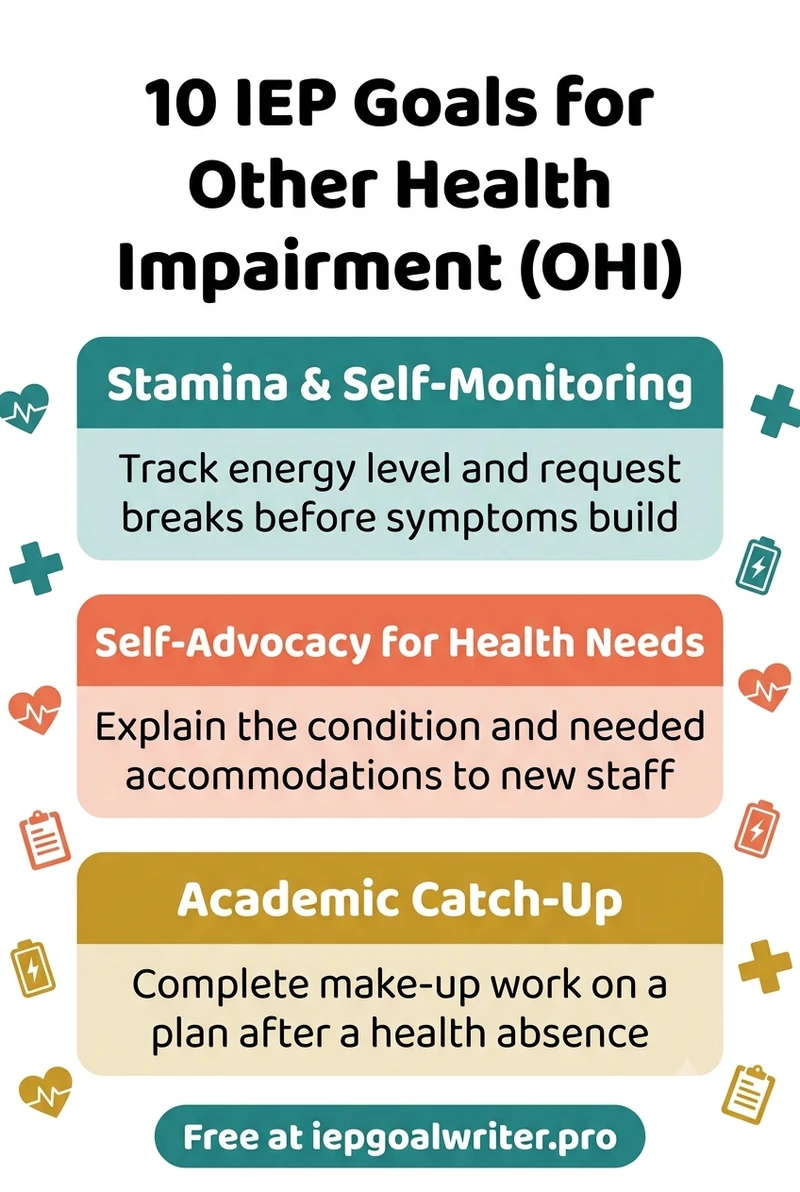
IEP goals for Other Health Impairment should target how the specific health condition affects access to instruction — stamina, self-monitoring, attendance-related academic gaps, or self-advocacy — rather than the medical condition itself, since OHI covers a wide range of chronic and acute conditions with very different classroom impacts.
Other Health Impairment (OHI) is a broad IDEA category covering chronic or acute health conditions — including epilepsy, diabetes, asthma, sickle cell disease, heart conditions, and Tourette syndrome — that limit a student's strength, vitality, or alertness enough to affect educational performance. ADHD is also commonly served under OHI, but it has its own dedicated goal list on this site, so the goals below are written for the wider range of OHI conditions rather than duplicating that page.
Stamina & Self-Monitoring
- 1.By [date], [student] will identify and report early signs of fatigue or symptom flare-up to an adult before it affects task completion, in 4 of 5 observed opportunities.
- 2.By [date], [student] will use a self-monitoring checklist to track energy level across the school day and request a scheduled rest break when needed, in 4 of 5 school days.
- 3.By [date], [student] will complete a full class period of seated work with no more than one health-related break, as measured by teacher log data across 4 of 5 days.
Self-Advocacy for Health Needs
- 1.By [date], [student] will independently explain their health condition and needed accommodations to a substitute teacher or new staff member with 80% accuracy in a role-play scenario.
- 2.By [date], [student] will initiate a request for a needed accommodation (medication access, rest, modified PE) without prompting, in 4 of 5 observed opportunities.
- 3.By [date], [student] will locate and use their emergency health plan information independently when asked, in 4 of 5 trials.
Academic Catch-Up After Absences
- 1.By [date], [student] will independently identify missed assignments after a health-related absence and create a completion plan with adult support, in 4 of 5 opportunities.
- 2.By [date], [student] will complete make-up work within an agreed timeline following an absence, with no more than 1 reminder, across 4 of 5 instances.
Attention & Task Engagement
- 1.By [date], [student] will remain engaged with an assigned task for 15 minutes with no more than 2 redirections, as measured by teacher observation across 4 of 5 sessions.
- 2.By [date], [student] will use a visual timer or checklist to independently return to a task after a health-related interruption, in 4 of 5 observed opportunities.
Why OHI Goals Focus on Access, Not Diagnosis
A medical diagnosis by itself is never the IEP goal. The evaluation and present levels should describe exactly how the condition shows up in the classroom — missed instructional time, reduced stamina by the afternoon, difficulty self-monitoring symptoms — and the goal targets that specific access barrier. Two students with the same diagnosis can need very different goals depending on how the condition actually affects their school day.
FAQ
Paste your assessment data and generate an IDEA-compliant, individualized goal in seconds.
Try it free →