12 IEP Goals for Speech or Language Impairment (Articulation, Fluency, Language)
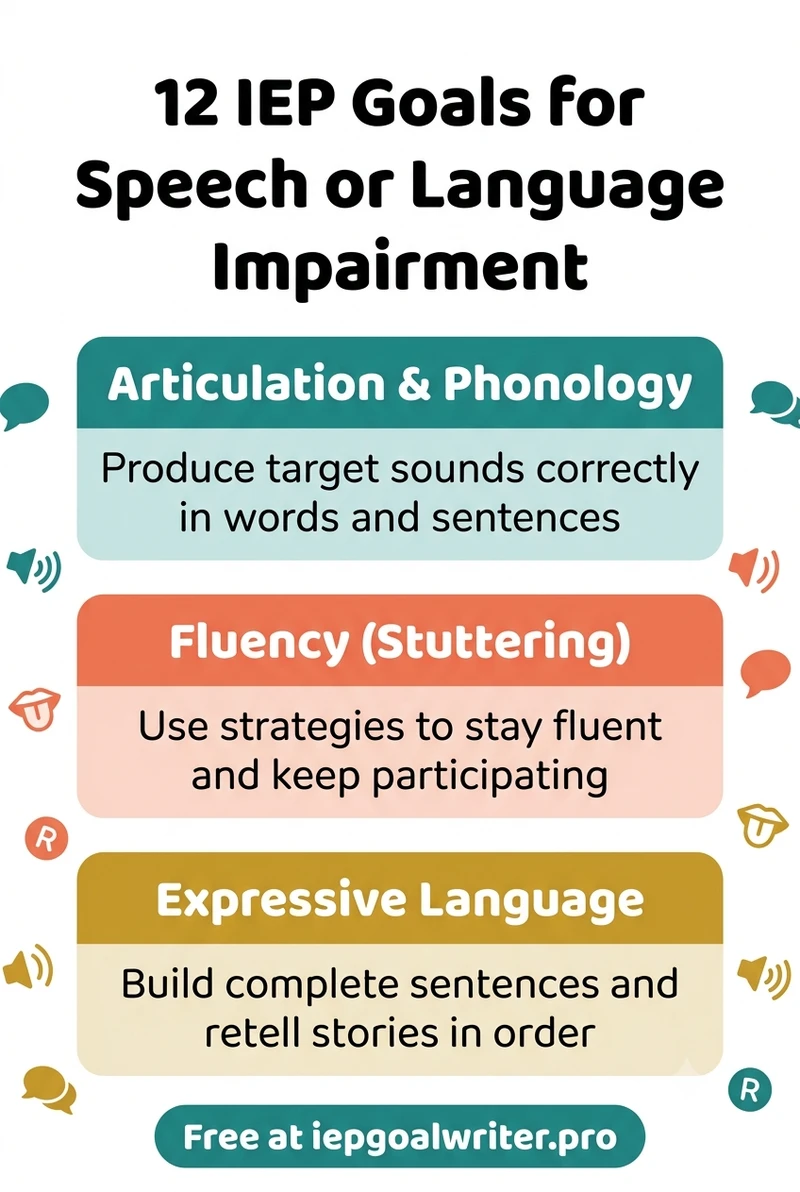
IEP goals for Speech or Language Impairment should target the specific area identified in the evaluation — articulation, fluency, expressive language, or receptive language — since the category covers four distinct types of communication difficulty that call for different goals, not one generic 'communication' target.
Speech or Language Impairment (SLI) is one of the largest disability categories under IDEA, but it isn't one thing — a student's SLI eligibility can be built on an articulation disorder, a fluency disorder like stuttering, an expressive language delay, a receptive language delay, or some combination. Pull the specific area from the speech-language evaluation before choosing goals below, rather than assuming every SLI student needs the same kind of goal.
Articulation & Phonology
- 1.By [date], [student] will correctly produce the /r/ sound in the initial position of words with 80% accuracy across 4 of 5 trials, as measured by SLP data collection.
- 2.By [date], [student] will correctly produce target sounds in structured sentences with 80% accuracy across 3 consecutive sessions, as measured by SLP probe data.
- 3.By [date], [student] will self-correct at least 3 misarticulated sounds during a 5-minute conversational sample with minimal adult prompting.
Fluency (Stuttering)
- 1.By [date], [student] will use a taught fluency-shaping strategy (such as easy onset or light contact) during structured speaking tasks in 4 of 5 opportunities, as measured by SLP observation.
- 2.By [date], [student] will maintain classroom participation (raising a hand, answering aloud) despite moments of disfluency, in 4 of 5 observed opportunities.
Expressive Language
- 1.By [date], [student] will use grammatically complete sentences of at least 5 words to describe a picture or event with 80% accuracy across 4 of 5 trials.
- 2.By [date], [student] will retell a short story in correct sequence, including a beginning, middle, and end, with 80% accuracy across 3 of 4 trials.
- 3.By [date], [student] will use age-appropriate vocabulary to request, comment, and ask questions in structured classroom activities in 4 of 5 observed opportunities.
Receptive Language
- 1.By [date], [student] will follow 2-step directions containing spatial or temporal concepts (such as 'before' or 'behind') with 80% accuracy across 4 of 5 trials.
- 2.By [date], [student] will answer 'wh-' comprehension questions about a grade-level passage read aloud with 80% accuracy across 4 of 5 trials.
SLI as a Primary Category vs. a Secondary Impairment
Speech or Language Impairment can be a student's sole disability category, or it can appear as a secondary impairment alongside a primary category like autism or a specific learning disability. When SLI is secondary, speech-language goals should still be written specifically to the evaluation data rather than folded vaguely into a broader 'communication' goal under the primary category — the IEP team decides how goals are organized, but the specific, measurable target for each area of need should not get lost either way.
FAQ
Paste your assessment data and generate an IDEA-compliant, individualized goal in seconds.
Try it free →