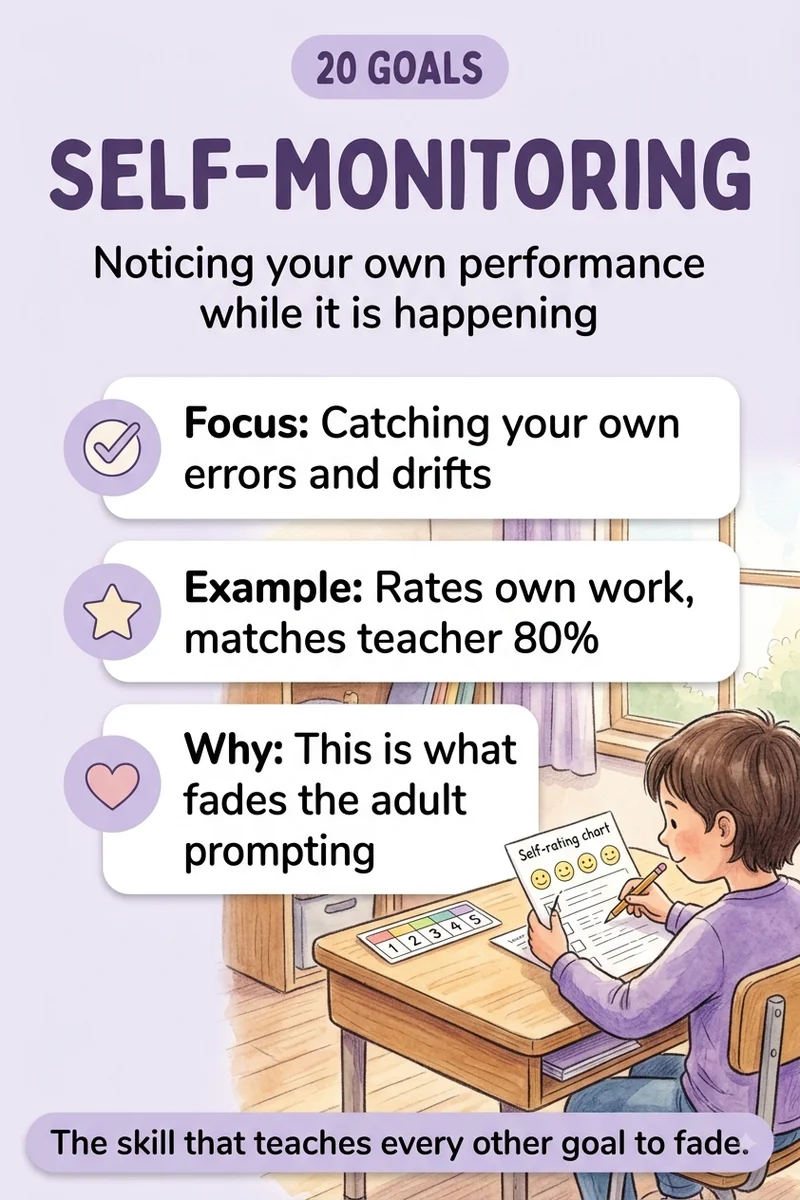
20 Self-Monitoring IEP Goals, Preschool Through High School
Self-monitoring is what lets a student catch an error, notice they have drifted off task, or realise they do not understand — without an adult pointing it out. It is the skill that makes every other goal fade its own prompting, which is why it is worth writing even when it is not the referral concern.
Free · no email required · opens your browser's print dialog
Kindergarten – 2nd
- 1[student] will rate their own behavior on a simple visual scale at 2 checkpoints during the day, with 80% agreement with the teacher's rating, across 4 of 5 school days.
- 2[student] will identify whether an example behavior is “expected” or “unexpected” for the setting, with 80% accuracy across 4 of 5 trials.
- 3[student] will self-correct a behavior when given a nonverbal cue from an adult, without additional verbal prompting, in 4 of 5 observed opportunities.
- 4[student] will use a behavior chart or token system to track their own points throughout the day, with no more than 1 reminder, across 3 consecutive days.
- 5[student] will check their own work against a simple checklist (name, date, all questions answered) before turning it in, with 1 or fewer reminders, across 4 of 5 assignments.
- 6[student] will identify when they've made a mistake and attempt to fix it, with adult prompting, in 4 of 5 observed opportunities.
3rd – 5th Grade
- 7[student] will complete a self-monitoring checklist at [X] points during the day, with 80% agreement with staff observation, across 4 of 5 school days.
- 8[student] will independently use a calm-down space or strategy without adult prompting when self-identified as escalating, in 4 of 5 documented opportunities.
- 9[student] will chart their own behavior data with adult support fading toward independence, across 4 of 5 data collection periods.
- 10[student] will use a self-checking strategy (rereading, checking work against a rubric) before submitting an assignment, with 1 or fewer reminders, across 4 of 5 assignments.
- 11[student] will identify whether they understood a lesson or need help, and ask for it, in 4 of 5 observed opportunities.
- 12[student] will rate their own effort or focus during a task, with 80% agreement with a teacher's rating, across 4 of 5 sessions.
6th – 8th Grade
- 13[student] will complete a daily self-monitoring form or point sheet with 80% agreement with staff ratings, across 4 of 5 school days, with adult prompting fading.
- 14[student] will independently access a calm-down pass or space and return to class within [X] minutes without additional incident, in 4 of 5 observed opportunities.
- 15[student] will identify the function of their own target behavior (attention, escape, sensory, tangible) when discussing it with staff, with 80% accuracy across 4 of 5 discussions.
- 16[student] will self-monitor their own understanding during a lesson and ask a clarifying question when needed, in 4 of 5 observed opportunities.
- 17[student] will review and self-correct an assignment before submission using a rubric or checklist, with 1 or fewer reminders, across 4 of 5 assignments.
- 18[student] will reflect on what study or organization strategy worked or didn't after a test or project, identifying at least 1 change, across 4 of 5 reflections.
- 19[student] will explain how a peer might perceive their own words or actions in a given scenario, with 80% accuracy across 4 of 5 trials.
- 20[student] will self-monitor their own social behavior in a group setting using a checklist, with 80% agreement with staff observation, across 4 of 5 sessions.
How to teach self-monitoring in the classroom
Self-monitoring is taught by making the target behavior concrete and then handing the tracking to the student. Define the behavior in observable terms the student helps write ("I am looking at my work or the speaker"), and show a model and a non-model so the line is clear. Begin with adult cueing — a timer, a tap, a tone — and a simple card where the student marks yes or no when the cue sounds. Check their rating against yours and talk through any gap without penalty; matching is its own skill. As agreement gets reliable, fade the external cue toward student-initiated checks, then toward an end-of-period reflection. Tie the data to something that matters to the student (a goal they set, a graph they fill in) so the recording is not busywork. Over weeks, thin the frequency: from every few minutes, to once a task, to a quick self-check they run on their own. The endpoint is a student who notices they have drifted before an adult does.
How to measure it
Use a matching procedure: the student rates themselves, the teacher rates independently, and the score is how often the two agree within one point. That measures accuracy of self-perception, which is the actual skill, rather than measuring whether the student filled in a form.
Where these goals come from
Each goal above is drawn from a grade-band goal bank, where you can see it alongside the other targets it is usually paired with: Behavior goals, 3rd – 5th Grade; Behavior goals, 6th – 8th Grade; Behavior goals, Kindergarten – 2nd Grade; Executive Function goals, 3rd – 5th Grade; Executive Function goals, 6th – 8th Grade; Executive Function goals, Kindergarten – 2nd Grade; Social Skills goals, 6th – 8th Grade.
Related skills
A flat following-directions goal is often really a breakdown in one of these skills. If the data does not move, check whether the real target is here instead:
- Impulse Control IEP goals — the pause between the urge and the action
- Emotional Regulation IEP goals — recognising a feeling and doing something about it before it escalates
- Self-Advocacy IEP goals — asking for what you need, from an adult who does not already know
Common questions
At what age can a student start self-monitoring?
Many students can self-monitor a single, clearly defined behavior by first or second grade with adult-cued checks and a simple yes/no card. Younger or more involved students can still participate with a picture rating and more support. The skill scales with the student — what changes is how concrete the behavior is and how often an adult cues the check.
What if the student's self-ratings don't match the teacher's?
That is expected early and is itself part of the instruction. Compare ratings without penalty, talk through the gap, and reinforce accurate matching — not just the target behavior. Agreement usually improves within a few weeks and is a sign the student is actually noticing their own behavior.
Does self-monitoring work for academic behaviors or just conduct?
Both. Students can self-monitor on-task behavior, work completion, strategy use, or number of problems attempted. Academic self-monitoring often produces faster gains because the target is concrete and the payoff (finished work) is immediate.
Further reading
Need a goal built from your student's baseline? Generate one for your student →