20 IEP Goals for Childhood Apraxia of Speech
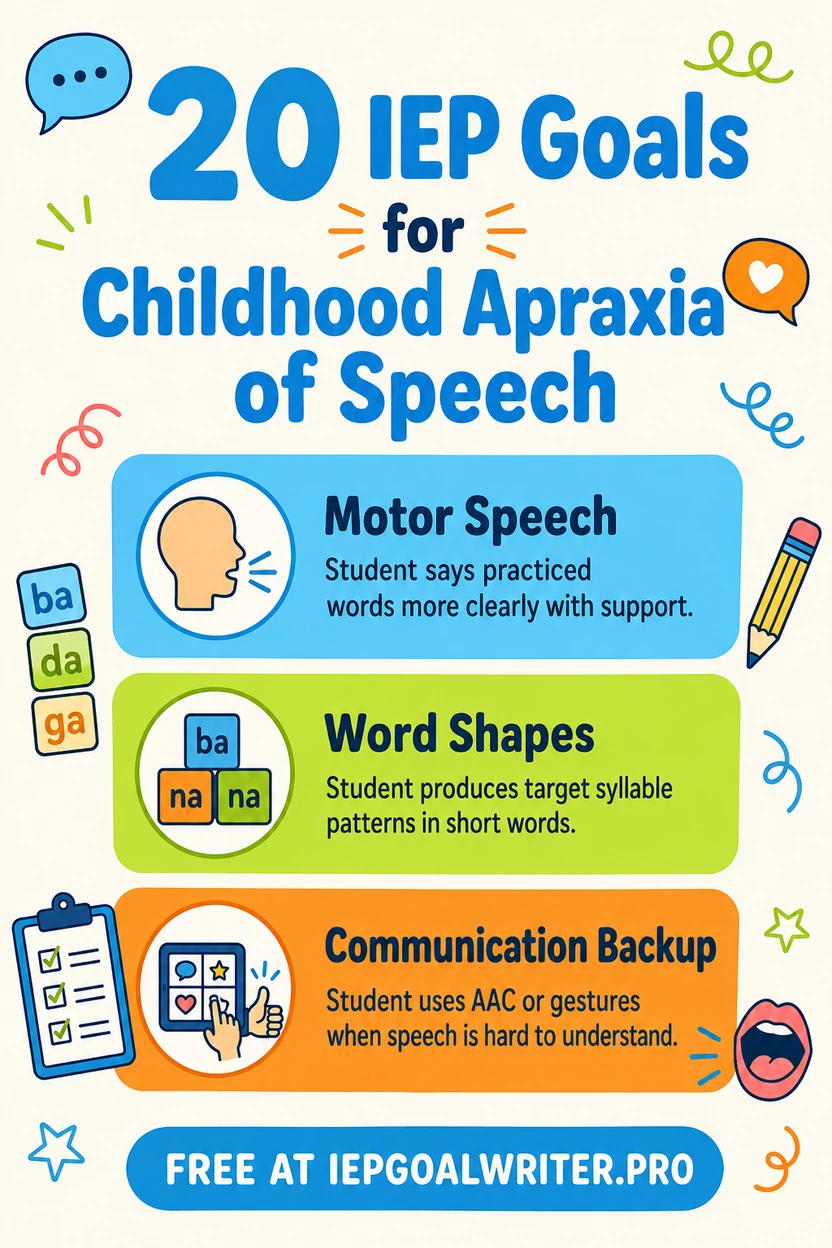
IEP goals for childhood apraxia of speech should target a speech pattern documented in the SLP’s probes, not a broad goal to speak more clearly. For example: By [date], [student] will produce practiced consonant-vowel-consonant words with accurate movement sequences in 80% of trials across 3 sessions, as measured by SLP probe data.
Childhood apraxia of speech is a clinical term; in school, a student may receive special education under Speech or Language Impairment when the evaluation shows an educational impact and need for specialized instruction. These goals organize motor-speech practice into observable targets: movement sequences, word shapes, prosody, and functional communication. Use the SLP’s baseline probes to choose sounds, syllable shapes, cueing, and generalization contexts rather than copying every goal below.
Motor Speech Accuracy
- 1.By [date], [student] will produce a practiced set of 10 functional consonant-vowel or vowel-consonant movement sequences using the individualized motor-speech cueing hierarchy with at least 80% accurate movement transitions across 3 consecutive probes, as measured by SLP motor-speech probe data.
- 2.By [date], [student] will produce 8 individualized functional words with accurate articulatory movement from the first sound through the final sound in 4 of 5 trials across 3 sessions, as measured by SLP word-level probe data.
- 3.By [date], [student] will maintain accurate movement sequencing when the same target word is produced in 3 different short carrier phrases with 80% accuracy across 2 consecutive sessions, as measured by SLP phrase probe data.
- 4.By [date], [student] will produce a trained speech target after the SLP fades from simultaneous production to delayed imitation with 4 of 5 accurate productions at the least intrusive cue level reached, as measured by dynamic cueing records.
- 5.By [date], [student] will generalize 5 mastered motor-speech targets from therapy practice to a classroom or home communication sample with at least 70% accurate productions across 2 settings, as measured by SLP-language sample and teacher tally data.
Syllable and Word Shapes
- 1.By [date], [student] will produce 10 two-syllable words with the practiced syllable shape while preserving all planned syllables with 80% accuracy across 3 consecutive sessions, as measured by SLP syllable-shape probes.
- 2.By [date], [student] will produce 8 three-syllable functional words without deleting or adding a syllable in 4 of 5 trials across 3 sessions, as measured by SLP word-shape data.
- 3.By [date], [student] will alternate between two practiced syllable shapes, such as CV-CV and CVC-CV, without losing the target sequence with 80% accuracy across 20 mixed trials, as measured by mixed-practice motor-speech probes.
- 4.By [date], [student] will produce a set of 10 familiar words beginning with different initial consonants while maintaining the practiced vowel shape with 8 of 10 correct productions across 3 probes, as measured by SLP structured probe data.
- 5.By [date], [student] will produce a novel word that matches a mastered syllable pattern after one model in 3 of 4 opportunities across 3 sessions, as measured by generalization-probe data.
Prosody and Intelligibility
- 1.By [date], [student] will mark the stressed syllable correctly in 8 of 10 practiced multisyllabic words or short phrases across 3 consecutive probes, as measured by SLP prosody-rating data.
- 2.By [date], [student] will use an appropriate contrast in loudness or pitch to distinguish a question from a statement in structured practice in 4 of 5 opportunities across 2 sessions, as measured by SLP prosody checklist data.
- 3.By [date], [student] will produce a 3- to 5-word practiced phrase at a rate that preserves intelligible word boundaries with at least 80% intelligibility to a familiar listener across 10 trials, as measured by intelligibility-rating data.
- 4.By [date], [student] will pause at a natural phrase boundary when producing a rehearsed sentence of at least 6 words in 4 of 5 productions across 3 sessions, as measured by speech-sample scoring.
- 5.By [date], [student] will repeat a misunderstood functional message using slower rate, clearer stress, or segmented phrasing after a listener signals difficulty in 4 of 5 repair opportunities, as measured by communication-repair tally data.
Functional Communication and AAC Backup
- 1.By [date], [student] will use the student’s most reliable communication mode to deliver a complete functional message when speech is not understood after one attempt in 4 of 5 communication breakdowns, as measured by SLP and teacher communication tallies.
- 2.By [date], [student] will independently switch to AAC, gesture, writing, or another established backup method for a high-priority message in 80% of opportunities across 3 school routines, as measured by functional communication log data.
- 3.By [date], [student] will initiate a request, protest, comment, or answer using speech and add AAC support when needed for listener understanding in 8 of 10 natural opportunities, as measured by language-sample coding.
- 4.By [date], [student] will teach or show a familiar communication partner how to access one needed message on the student’s AAC system in 4 of 5 structured opportunities, as measured by AAC independence checklist data.
- 5.By [date], [student] will repair a failed message by choosing one of at least 2 taught options—repeat, rephrase, spell, point, or use AAC in 4 of 5 observed breakdowns across 2 settings, as measured by repair-strategy tally data.
A Worked Example: One Student, PLAAFP to Data Plan
Present levels: Eli communicates eagerly with familiar adults and uses gesture plus AAC when speech is not understood. In three 20-item SLP probes, he produced the current consonant-vowel-consonant target set with 38%, 35%, and 40% accuracy during simultaneous imitation. With a delayed model plus one visual cue, accuracy rose to 55%, but he independently repaired only 1 of 6 classroom communication breakdowns with an unfamiliar listener. The educational impact is reduced intelligibility and participation during oral responses, peer interaction, and routines that move quickly.
Annual goal derived from that baseline: By [date], Eli will produce the individualized target word shapes with delayed imitation and no more than one visual cue in 80% of 20-trial probes across 3 sessions, as measured by SLP motor-speech probe data. A linked functional target can measure repair: when a listener does not understand, Eli will repeat, slow, gesture, or use AAC in 4 of 5 observed breakdowns. Specially designed instruction should use a stable target set, systematic cueing, high numbers of correct practice opportunities, and planned opportunities to transfer practiced words into meaningful communication.
Goal versus accommodation: Extra response time, accepting AAC, reducing pressure for rapid oral responding, and allowing an alternative response mode are access supports. The annual speech goal targets a specific motor-speech skill and cueing level; it should never be written as “will talk normally” or as a requirement to stop using AAC.
Data plan: Record target, accuracy, error pattern, and the lowest cue level needed on each probe. Keep motor accuracy separate from functional intelligibility and repair. Every two to four weeks, sample a small set of unpracticed or classroom-relevant words and at least one natural communication routine. If probe accuracy improves without functional transfer, change the generalization instruction rather than simply increasing word-list difficulty.
How These Goals Change by Grade Band
For PreK–2, prioritize a small set of high-value movement sequences and functional words that support play, routines, needs, and early classroom participation. Keep practice brief and frequent, use a consistent cueing hierarchy, and protect access to AAC or other communication modes. Progression comes from more accurate movement and less cueing—not from demanding longer utterances before the motor pattern is ready.
In grades 3–5, targets can expand to multisyllabic curriculum vocabulary, short connected-speech phrases, prosody patterns, and communication-repair routines with less familiar partners. Academic access matters: a student may need both motor-speech instruction and a dependable way to answer grade-level questions without speech rate limiting content knowledge.
In middle and high school, prioritize intelligibility in personally important academic, social, vocational, and self-advocacy contexts. Goals may emphasize strategic repair, choosing when to use speech versus AAC, practicing names/technical terms needed in courses or jobs, and directing listeners to helpful supports. The older student’s autonomy over communication mode should remain central.
Collecting Data Without Adding a Full-Time Job
Use short, repeatable motor-speech probes that hold the target set and scoring rule stable long enough to show a trend. Record both percent accurate and the lowest cue level needed. Eighty percent with simultaneous production is not the same performance as 80% after one delayed model, so do not collapse cueing levels into a single accuracy percentage.
Keep separate data columns for the feature actually being instructed—movement transition, syllable shape, stress/prosody, or another individualized motor-speech target. Add a second measure for functional communication, such as successful message repair or listener understanding in a defined routine. A brief audio sample can help when local policy and consent procedures allow it; otherwise use an SLP scoring rubric applied consistently.
Include a generalization check. After several improving probes on practiced targets, sample a few related but unpracticed items and one natural classroom routine. If the practiced list improves while transfer stays flat, the instructional decision is to teach transfer and vary contexts—not automatically to raise the motor target. If accuracy stalls, review target complexity and cueing before adding more words.
Personalization warning: Childhood apraxia of speech is a clinical diagnosis, not an IDEA eligibility category. Do not copy a generic motor-speech target, cueing hierarchy, or dosage from a goal bank. The school team should base goals on the student’s evaluation, current speech repertoire, functional communication needs, AAC access, and SLP plan.
FAQ
Paste your assessment data and generate an IDEA-compliant, individualized goal in seconds.
Try it free →