20 IEP Goals for Conversation and Pragmatic Language
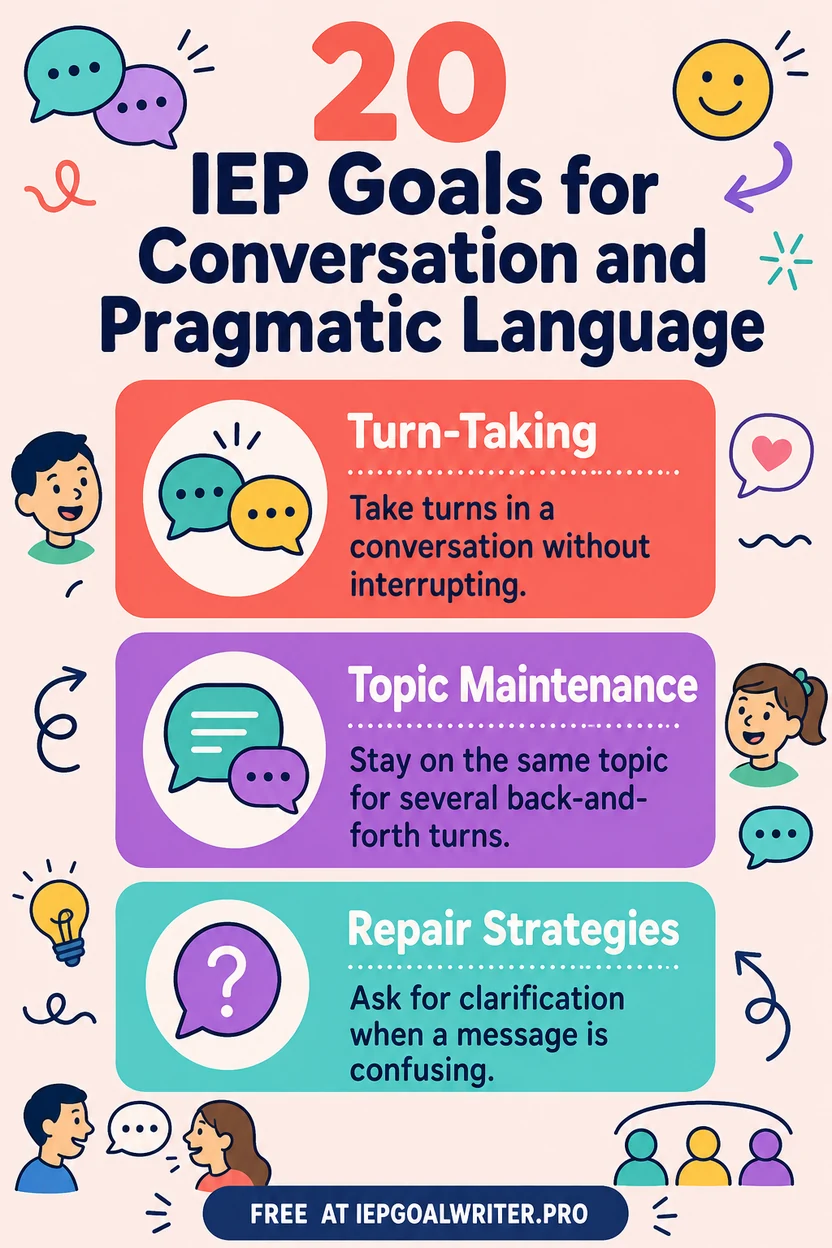
Conversation and pragmatic-language IEP goals should teach a specific communication action in a defined context, not require a student to act socially typical. For example: By [date], [student] will maintain a peer-selected topic for three reciprocal turns using an agreed support in 4 of 5 observed conversations, as measured by a pragmatic-language rubric.
Pragmatic-language goals should make communication more accessible and effective for the student, not mask identity or enforce eye contact, tone, or social style. Start with the student’s strengths, communication mode, culture, sensory needs, and real participation goals. These 20 examples target observable skills: turn-taking, topic maintenance, repair after a breakdown, interpreting another perspective when relevant, and choosing language for context. Use communication partners and settings that matter to the student, then collect data that includes supports and prompts.
Topic Maintenance and Turn-Taking
- 1.By [date], [student] will participate in a 4-turn conversation with a peer by alternating speaker turns without interrupting more than once in 4 of 5 structured samples, as measured by SLP conversation-sample rubric data.
- 2.By [date], [student] will maintain the shared topic for at least 3 consecutive relevant turns before introducing a new topic in 4 of 5 conversation samples, as measured by topic-maintenance coding.
- 3.By [date], [student] will ask one relevant follow-up question after a peer shares information in 4 of 5 opportunities across 2 settings, as measured by peer-conversation tally data.
- 4.By [date], [student] will add one relevant comment that connects to the partner’s previous message rather than only shifting to a preferred topic in 4 of 5 structured or natural opportunities, as measured by pragmatic-language rubric data.
- 5.By [date], [student] will use an agreed turn-taking cue during a small-group discussion and contribute at least 2 relevant messages in 4 of 5 group sessions, as measured by group participation event recording.
Communication Repair
- 1.By [date], [student] will identify that a listener did not understand a message after a verbal or nonverbal breakdown cue in 4 of 5 observed breakdowns, as measured by SLP repair-awareness tally data.
- 2.By [date], [student] will repeat or rephrase a misunderstood message using one taught repair strategy in 4 of 5 communication breakdowns, as measured by communication-repair event recording.
- 3.By [date], [student] will add a missing person, place, time, or key detail after a listener asks for clarification in 4 of 5 opportunities, as measured by language-sample rubric data.
- 4.By [date], [student] will ask the listener what part was unclear before repeating a long explanation in 4 of 5 structured repair opportunities, as measured by repair-strategy checklist data.
- 5.By [date], [student] will switch to writing, AAC, gesture, or another established mode when repeating the spoken message does not resolve the breakdown in 4 of 5 applicable opportunities, as measured by multimodal repair tally data.
Perspective-Taking and Listener Awareness
- 1.By [date], [student] will state one fact the speaker knows and one fact the listener may not know before giving an explanation in 4 of 5 perspective-taking tasks, as measured by listener-awareness rubric data.
- 2.By [date], [student] will choose from 3 options the amount of background information a listener needs in a familiar scenario with 80% accuracy across 15 items, as measured by pragmatic reasoning probes.
- 3.By [date], [student] will identify how a peer’s likely perspective differs from the student’s own perspective in a structured school scenario in 4 of 5 opportunities, as measured by social-cognition rubric data.
- 4.By [date], [student] will modify a message by adding context after identifying that the listener was not present for the original event in 4 of 5 structured language samples, as measured by SLP narrative-pragmatic data.
- 5.By [date], [student] will check listener understanding using a taught question or observation cue during an explanation of at least 3 steps in 4 of 5 opportunities, as measured by listener-check tally data.
Register and Context
- 1.By [date], [student] will select an appropriate greeting, request, or closing for a peer, teacher, unfamiliar adult, or workplace-style scenario with 80% accuracy across 15 scenarios, as measured by register-selection probe data.
- 2.By [date], [student] will revise an overly casual or overly formal message so it fits the assigned school context in 4 of 5 structured examples, as measured by pragmatic language work-sample rubric data.
- 3.By [date], [student] will adjust volume, proximity, or message length to match the classroom, hallway, lunchroom, or small-group setting in 4 of 5 observed opportunities, as measured by context-use checklist data.
- 4.By [date], [student] will use a direct but respectful self-advocacy statement with an adult rather than relying on hints the listener may miss in 4 of 5 opportunities, as measured by self-advocacy communication rubric data.
- 5.By [date], [student] will identify whether a message should be sent privately, in a group, or not shared based on the taught school-context rules with 80% accuracy across 15 scenarios, as measured by context-decision probe data.
A Worked Example: One Student, PLAAFP to Data Plan
Present levels: Jordan has strong factual vocabulary and contributes enthusiastically in robotics club. Across four 10-minute structured peer conversations, Jordan completed an average of 1.3 reciprocal turns after the opening comment, asked a relevant follow-up question in 2 of 12 opportunities, and used a repair strategy in 1 of 5 communication breakdowns. When given a visual card with “comment–question–check,” Jordan sustained three reciprocal turns in 6 of 8 practice trials. The educational impact is reduced participation in collaborative learning and difficulty repairing misunderstandings, not a need to make Jordan’s communication style look more typical.
Annual goal derived from that baseline: By [date], during a structured or natural collaborative activity, Jordan will use the student’s communication system to contribute a relevant comment or response, complete at least 3 reciprocal turns around the shared topic, and use a taught clarification/repair strategy when a breakdown occurs in 4 of 5 sampled interactions, as measured by a pragmatic-language rubric. Specially designed instruction should explicitly teach the conversation structure, model multiple acceptable ways to enter/exit a topic, practice repair, and fade visual prompts across increasingly natural contexts.
Goal versus accommodation: Advance notice of group roles, a visual conversation cue, extra processing time, AAC, or permission to communicate in writing can be accommodations. The annual goal targets a functional participation or repair skill. Eye contact, typical facial expression, suppressing stimming, or “sounding normal” should not be used as proxy measures of pragmatic competence.
Data plan: Sample short interactions rather than scoring the entire day. Code the exact target—relevant turn, follow-up question, interruption, topic shift, repair, listener check, or register adjustment—and note prompt level and partner familiarity. If Jordan performs well in structured probes but not robotics club, teach the speed and complexity of the natural setting rather than increasing artificial worksheet difficulty.
How These Goals Change by Grade Band
For younger students, teach simple reciprocal routines through play and classroom activities: request/respond, comment/respond, wait for a turn, repair a missed message, and end an interaction. Use visuals, AAC, scripts, or modeling as needed, and accept multiple valid social styles.
In grades 3–5, add sustaining a shared topic, asking relevant questions, clarifying messages, negotiating group roles, recognizing when a listener lacks information, and adjusting a message for classroom versus peer contexts. The progression should increase flexibility and independence, not demand performance of arbitrary social behaviors such as constant eye contact.
In middle and high school, prioritize authentic communication across seminars, group projects, clubs, work-based learning, community settings, and self-advocacy. Goals may involve entering a conversation, repairing a misunderstanding, disagreeing respectfully, shifting register with teachers versus peers, or explaining communication preferences. Older students should have input into which interaction goals matter to them and which supports feel acceptable.
Collecting Data Without Adding a Full-Time Job
Use brief conversation samples and code the exact behavior being taught: relevant turns, interruptions, follow-up questions, topic shifts, repair attempts, listener checks, or context adjustments. Avoid broad scores such as “appropriate social skills,” which can hide meaningful differences and invite subjective judgments.
Separate communication effectiveness from neurotypical appearance. Do not score eye contact, facial expression, body posture, or suppression of self-regulatory behavior unless the team has an unusually specific, defensible educational reason and the student’s autonomy is respected. A successful interaction can look different across students and cultures.
Pair structured probes with natural-context samples. If a student uses a repair script with the SLP but not with peers, note whether the barrier is speed, unfamiliar partners, group noise, vocabulary, or recognizing the breakdown. Use that information to change instruction. Once a skill is stable with one partner/context, probe a second context before raising complexity.
Personalization warning: Pragmatic-language goals should target a communication barrier that affects educational participation, not personality, masking, or conformity. Consider the student’s communication mode, culture, sensory needs, preferences, and own goals. Choose functional skills such as clarification, reciprocal information exchange, self-advocacy, or context awareness rather than teaching one rigid version of “normal” social behavior.
FAQ
Paste your assessment data and generate an IDEA-compliant, individualized goal in seconds.
Try it free →