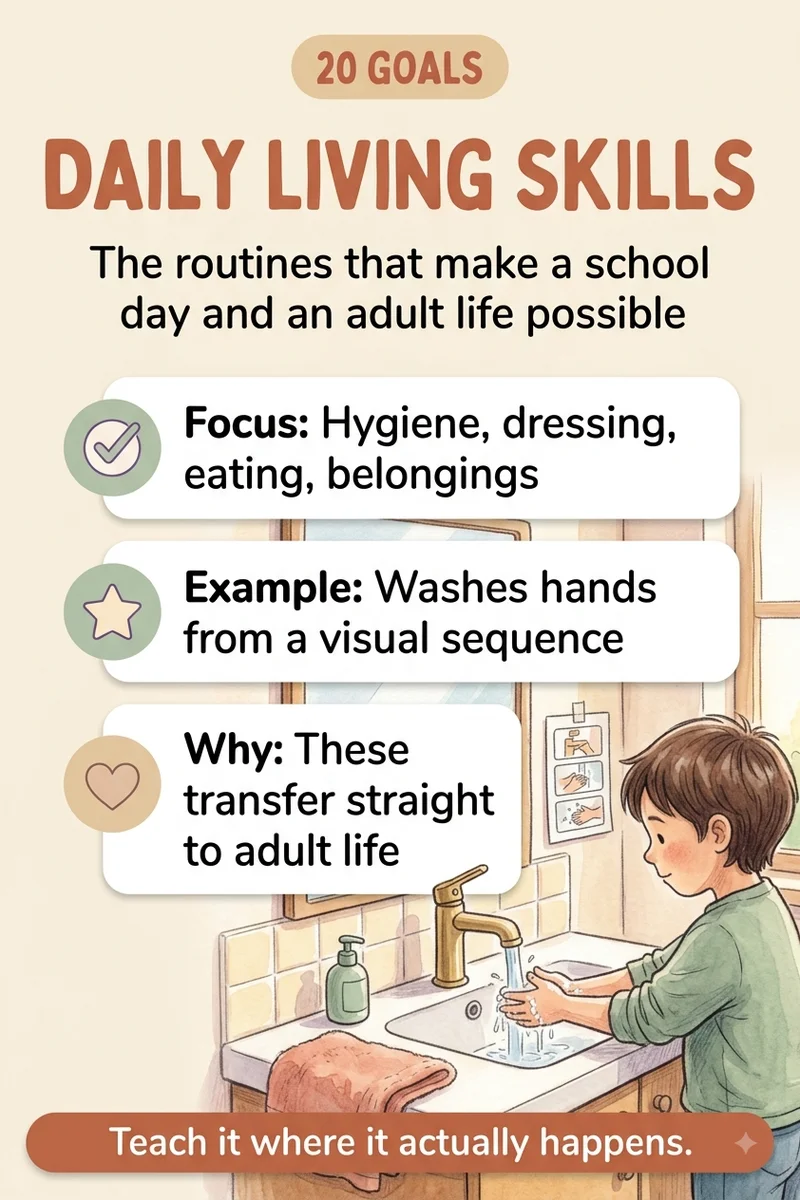
20 Daily Living Skills IEP Goals, Preschool Through High School
Daily living goals cover hygiene, dressing, eating, managing belongings, and later cooking, money, and transportation. The trap is teaching them in a therapy room and assuming they transfer — a student who completes a hand-washing sequence perfectly with a visual support in one setting often cannot do it in the cafeteria.
Free · no email required · opens your browser's print dialog
Preschool & Pre-K
- 1[student] will wash and dry their hands independently following a visual sequence, with 80% accuracy across 4 of 5 trials.
- 2[student] will complete a simple toileting routine (pull pants down/up, flush, wash hands) with no more than 1 physical prompt, across 4 of 5 opportunities.
- 3[student] will use a tissue to wipe their nose and dispose of it independently, in 4 of 5 observed opportunities.
- 4[student] will put on and take off a simple clothing item (jacket, shoes) with 80% independence, across 4 of 5 trials.
Kindergarten – 2nd
- 5[student] will manage clothing fasteners (buttons, zippers, snaps) independently, with 80% accuracy across 4 of 5 trials.
- 6[student] will open and close common containers (a zip-top bag, a screw-top bottle) independently, in 4 of 5 observed opportunities.
- 7[student] will tie a shoe or use an adapted fastening method independently, with adult support fading, across 4 of 5 trials.
- 8[student] will type their name or a short word using both hands on a keyboard or tablet, in 4 of 5 observed opportunities.
- 9[student] will complete a fine motor task (bead stringing, a lacing card) for [X] minutes with sustained attention, across 4 of 5 trials.
- 10[student] will complete a full handwashing routine (wet, soap, scrub 20 seconds, rinse, dry) independently, with 90% accuracy across 4 of 5 trials.
- 11[student] will independently manage clothing fasteners (buttons, zippers, velcro) needed for the school day, with 80% accuracy across 4 of 5 trials.
- 12[student] will complete an independent toileting routine start to finish, in 4 of 5 observed opportunities.
- 13[student] will brush their teeth following a visual or verbal sequence, with 80% accuracy across 4 of 5 trials.
3rd – 5th Grade
- 14[student] will independently manage all clothing fasteners needed for the school day, in 4 of 5 observed opportunities.
- 15[student] will independently open packaging, containers, and utensils needed at mealtime, in 4 of 5 observed opportunities.
- 16[student] will organize small materials (paper clips, game pieces, manipulatives) into a container without spilling, with 80% success across 4 of 5 trials.
- 17[student] will complete a fine motor task requiring sustained attention (a craft, a building set) for [X] minutes independently, across 4 of 5 trials.
- 18[student] will independently complete a full personal hygiene routine using a checklist, with 80% accuracy across 4 of 5 trials.
- 19[student] will select weather- and activity-appropriate clothing independently, with 80% accuracy across 4 of 5 trials.
- 20[student] will manage personal materials (organize a backpack, locate needed items) with no more than 1 reminder, across 4 of 5 observed checks.
How to teach daily living skills in the classroom
Daily living skills are taught through direct instruction on the real task, in the place and at the time it actually happens. Break the routine into a written or picture task analysis — every step, in order — and teach to that list rather than to a verbal reminder. Decide on a prompting approach up front: either full support faded step by step (most-to-least) or a light prompt added only where the student stalls (least-to-most), and stay consistent so progress is readable. Build in natural cues (the bell means pack up) so the behavior does not depend on an adult standing there. Practice in the natural setting when possible, and keep the same materials and sequence each time until it is fluent, then vary them so the skill generalizes. Track independence per step, not just "did the task," so you can see exactly where the routine breaks and teach that piece.
How to measure it
Write the setting into the goal and vary it. Task analysis works well here: break the routine into steps, score steps completed independently, and report the step count rather than a percentage so progress is visible even when the whole routine is not yet mastered.
Where these goals come from
Each goal above is drawn from a grade-band goal bank, where you can see it alongside the other targets it is usually paired with: Fine Motor goals, 3rd – 5th Grade; Fine Motor goals, Kindergarten – 2nd Grade; Adaptive/Life Skills goals, 3rd – 5th Grade; Adaptive/Life Skills goals, Kindergarten – 2nd Grade; Adaptive/Life Skills goals, Preschool & Pre-K.
Related skills
A flat following-directions goal is often really a breakdown in one of these skills. If the data does not move, check whether the real target is here instead:
- Independent Functioning IEP goals — doing the routine without an adult standing there
- Transitions IEP goals — moving between activities, settings, and a whole new routine without losing the day to it
- Self-Advocacy IEP goals — asking for what you need, from an adult who does not already know
Common questions
Do daily living skills belong in an IEP if they aren't academic?
Yes, when the skill affects access to education or post-school outcomes and the team documents the need. Functional skills — managing belongings, personal care, following a routine, using money or time — are a recognized area of special education instruction, especially as students approach transition age.
Where should daily living skills be taught?
In the setting and at the time the skill actually occurs whenever possible — packing up at the end of the day, washing hands before lunch, checking a schedule in the morning. Skills taught only in a pull-out session often fail to show up in the real routine.
How is progress on a daily living goal measured?
Track independence step by step against a task analysis — how many steps the student completes without a prompt — rather than a single "completed the task" yes/no. Step-level data shows exactly where the routine breaks so instruction can target that piece.
Need a goal built from your student's baseline? Generate one for your student →