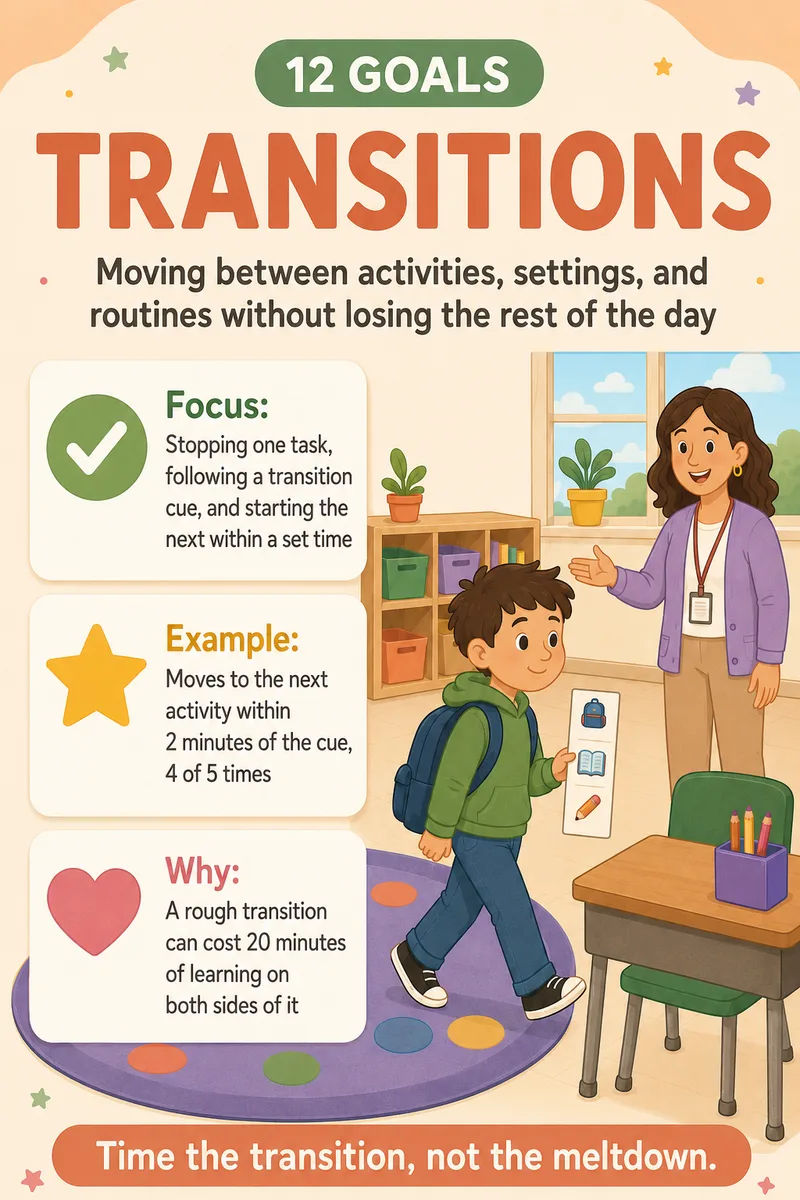
12 Transitions IEP Goals, Preschool Through High School
A transition goal targets the gap between one activity ending and the next one actually starting — walking to a new room, switching subjects, or handling a schedule that changed without warning. This is the skill that gets hardest right when a new school year starts: new room, new adults, new bell schedule, none of it automatic yet. A student who transitions fine by June can still need real support relearning it in September.
Free · no email required · opens your browser's print dialog
Preschool & Pre-K
- 1During a transition from a preferred activity, [student] will use a visual cue (first/then card) to move to the next activity without a tantrum, in 4 of 5 observed transitions.
- 2[student] will transition from a preferred to a non-preferred activity using a visual or verbal cue, with no more than 1 redirection, across 3 consecutive observations.
- 3[student] will follow a picture or visual daily schedule with no more than 1 redirection per transition, across 3 consecutive observations.
Kindergarten – 2nd
- 4[student] will transition between activities or settings within [X] minutes of the cue, with no more than 1 verbal reminder, across 4 of 5 observed transitions.
- 5[student] will transition between subjects or activities within [X] minutes of the cue, with no more than 1 redirection, across 4 of 5 observed transitions.
3rd – 5th Grade
- 6[student] will transition between settings or activities independently within [X] minutes of the cue, in 4 of 5 observed transitions.
- 7[student] will retain and follow a 2-part instruction given during a classroom transition (e.g., 'get your book and sit at your desk') without needing it repeated, with 80% accuracy across 4 of 5 observed transitions.
- 8[student] will shift between two different types of tasks or subjects without extended difficulty refocusing, across 4 of 5 observed transitions.
6th – 8th Grade
- 9[student] will transition between class periods without incident, with no more than 1 redirection total per day, across 4 of 5 school days.
- 10[student] will transition between the demands of different classes (materials, expectations, routines) without significant difficulty, across 4 of 5 observed transitions.
9th – 12th Grade
- 11[student] will manage a change in schedule or an unexpected transition without engaging in the target behavior, in 4 of 5 documented opportunities.
- 12[student] will demonstrate the behavior expectations of a specific postsecondary or workplace setting named in the transition plan, with 80% consistency across 4 of 5 observed opportunities.
How to teach transitions in the classroom
Transitions get easier when they are predictable, previewed, and practiced. Post a visual schedule and refer to it out loud so the order of the day is never a surprise, and give a concrete warning before a change ("two more minutes, then we clean up") using a timer the student can see. Teach the transition routine itself as a skill — what to do with your hands, where to go, what to carry — with rehearsal during calm times, not only when it is happening. For the hardest transitions, use a transition object, a first-then card, or a short job that gives the student a defined role in the change. Keep your own language and sequence identical each time so the routine carries the load instead of the student's flexibility. Reinforce smooth transitions specifically and immediately, and shrink support as the pattern holds. Note which transitions are hard and why — ending a preferred activity, entering a loud room, unstructured time — because the fix differs for each.
How to measure it
Time the transition with a stopwatch from the cue (bell, verbal prompt, visual card) to the student settled in the next activity, and log the number of prompts needed along the way. Both numbers should trend down over the year even if neither hits zero — a transition that takes 90 seconds with 1 prompt is real progress from 4 minutes and 3 prompts, even though it isn't independent yet.
Where these goals come from
Each goal above is drawn from a grade-band goal bank, where you can see it alongside the other targets it is usually paired with: Behavior goals, Preschool & Pre-K; Executive Function goals, Preschool & Pre-K; Adaptive/Life Skills goals, Preschool & Pre-K; Behavior goals, Kindergarten – 2nd Grade; Executive Function goals, Kindergarten – 2nd Grade; Behavior goals, 3rd – 5th Grade; Executive Function goals, 3rd – 5th Grade; Behavior goals, 6th – 8th Grade; Executive Function goals, 6th – 8th Grade; Behavior goals, 9th – 12th Grade.
Related skills
A flat following-directions goal is often really a breakdown in one of these skills. If the data does not move, check whether the real target is here instead:
- Emotional Regulation IEP goals — recognising a feeling and doing something about it before it escalates
- Impulse Control IEP goals — the pause between the urge and the action
- Daily Living Skills IEP goals — the routines that make a school day and an adult life possible
Common questions
Should transition goals be written fresh at the start of every school year?
Not written fresh, but re-baselined — a student's transition skill can regress over summer even if the annual goal carries over unchanged, so it's worth collecting a few real data points in the first weeks before assuming last spring's progress still holds.
What's the difference between a transition goal and a general compliance goal?
A transition goal is specific to the moment between activities — the cue, the movement, the settling in. A broader compliance goal covers following directions generally, which may overlap but isn't the same narrow, measurable window.
Further reading
Need a goal built from your student's baseline? Generate one for your student →