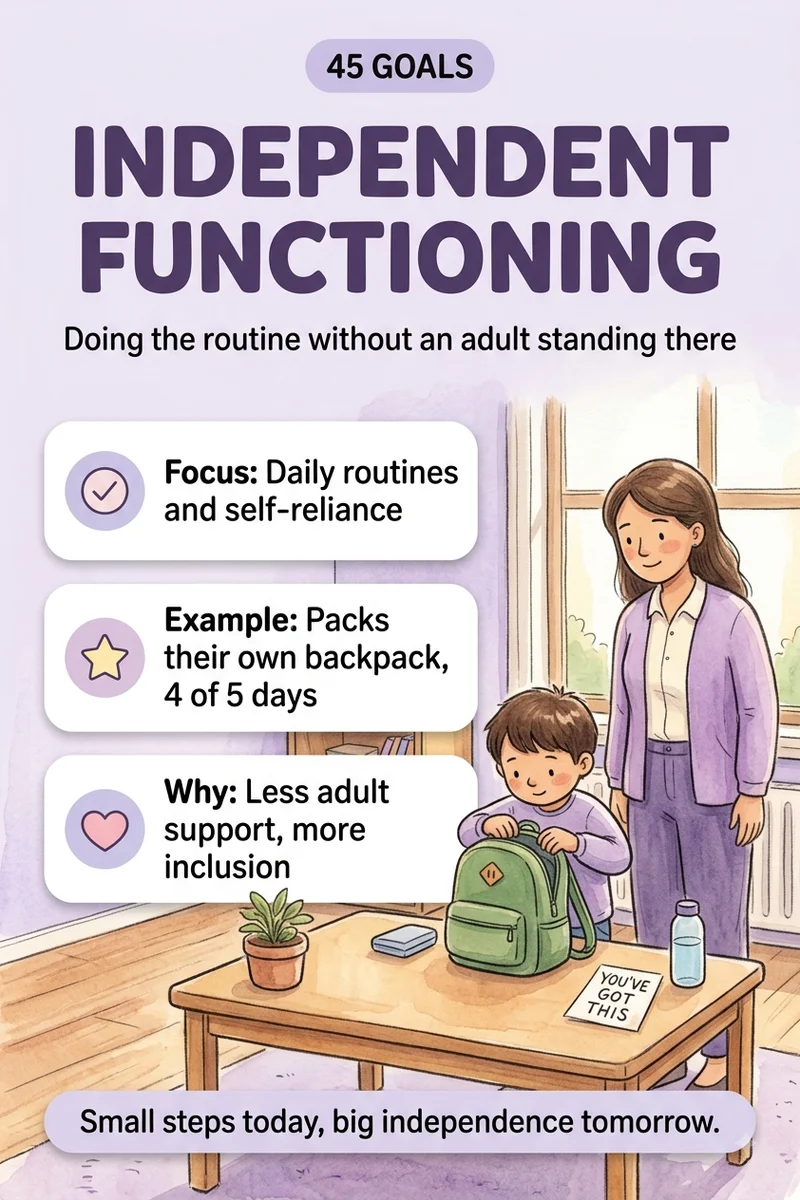
45 Independent Functioning IEP Goals, Preschool Through High School
Independent functioning covers the skills that let a student get through a school day without a dedicated adult: managing belongings, following the routine, moving between settings, and finishing what was assigned. It is the most commonly written goal area in special education and the most commonly written badly, because "will be more independent" cannot be scored by anyone.
Free · no email required · opens your browser's print dialog
Kindergarten – 2nd
- 1[student] will use a graphic organizer or picture plan before writing, with adult support fading, across 4 of 5 writing tasks.
- 2[student] will reread their own writing and fix at least 1 error (capitalization, punctuation, or spelling) with prompting, in 4 of 5 opportunities.
- 3[student] will write independently for [X] minutes without off-task behavior, across 3 consecutive observations.
- 4[student] will use an assistive tool (word bank, letter strip, adapted grip) to complete a writing task with increasing independence, across 4 of 5 trials.
- 5[student] will share their writing with a peer or the class, reading at least 1 sentence aloud, in 4 of 5 opportunities.
3rd – 5th Grade
- 6[student] will type a short response using correct home-row finger placement, at a rate of [X] words per minute with 90% accuracy, across 3 consecutive probes.
- 7[student] will complete an independent writing task for [X] minutes with no more than 1 redirection, across 3 consecutive observations.
- 8[student] will use an assistive writing tool (word prediction, speech-to-text, graphic organizer template) with increasing independence, across 4 of 5 tasks.
6th – 8th Grade
- 9[student] will use a personal coping plan (written or app-based) to self-manage stress during a non-preferred task, without staff initiation, in 4 of 5 observed opportunities.
- 10[student] will accept a change in routine or an unexpected schedule change without engaging in the target behavior, in 4 of 5 documented opportunities.
- 11[student] will independently manage a full personal hygiene and grooming routine appropriate to their developmental stage, with 90% accuracy across 4 of 5 checks.
- 12[student] will select and care for their own clothing (laundry sorting, weather-appropriate choices) with adult support fading, across 4 of 5 observed opportunities.
- 13By [date], [student] will independently apply a taught note-taking or annotation strategy while reading assigned text in 4 of 5 observed opportunities across at least 2 classes.
- 14By [date], [student] will self-monitor comprehension and reread or ask a question when meaning breaks down, in 4 of 5 observed opportunities.
- 15By [date], [student] will use assigned accommodations (audiobook, text-to-speech, highlighted text) independently, without adult prompting, in 4 of 5 opportunities.
- 16By [date], [student] will preview a chapter using headings and questions before reading in 4 of 5 assigned readings.
- 17[student] will independently move through the writing process (plan, draft, revise, edit) for a given assignment, completing each stage, across 4 of 5 assignments.
- 18[student] will incorporate feedback from a teacher or peer conference into a revised draft, making at least [X] targeted changes, across 4 of 5 tasks.
- 19[student] will complete a written assignment within the given class period without significant off-task behavior, across 4 of 5 observed periods.
9th – 12th Grade
- 20[student] will maintain an appropriate conversation with an unfamiliar adult (an interview, a service call) for at least [X] minutes, in 4 of 5 observed opportunities.
- 21[student] will independently request an accommodation or clarification in an unfamiliar setting without adult prompting, in 4 of 5 documented opportunities.
- 22[student] will communicate a personal preference, boundary, or decision clearly and independently in a real-world context, in 4 of 5 observed opportunities.
- 23[student] will complete fine motor tasks required for independent living (meal prep, medication management, personal care) independently, with 90% accuracy across 4 of 5 trials.
- 24[student] will use tools required for household maintenance (basic hand tools, cleaning equipment) safely and effectively, in 4 of 5 observed opportunities.
- 25[student] will demonstrate the specific fine motor skills required for their postsecondary or vocational plan, with 80% consistency across 4 of 5 observed opportunities.
- 26[student] will identify at least 2 fine motor strategies or pieces of adaptive equipment that improve their own task performance, based on self-reflection after a work or school task, once per semester.
- 27[student] will maintain fine motor endurance across a full workday or school day relevant to their transition plan, self-reporting or demonstrating no significant decline, across 4 of 5 observed days.
- 28[student] will complete a full laundry cycle (sorting, washing, drying, folding) independently, with 90% accuracy across 4 of 5 trials.
- 29[student] will prepare a complete simple meal using a recipe and appropriate kitchen safety, with 90% accuracy across 4 of 5 trials.
- 30[student] will maintain a living space (cleaning, organizing, basic upkeep) using a checklist, with adult support fading, across 4 of 5 checks.
- 31[student] will create and follow a monthly budget for a given scenario, tracking income and expenses, with 80% accuracy across 4 of 5 trials.
- 32[student] will demonstrate basic banking skills (using an ATM, reading a bank statement, depositing a check), with 80% accuracy across 4 of 5 trials or simulations.
- 33[student] will compare the cost of a good or service across options and identify the best value, with 80% accuracy across 4 of 5 trials.
- 34[student] will demonstrate the specific independent living skills required for their postsecondary plan (dorm living, supported living, family home), with 80% consistency across 4 of 5 observed opportunities.
- 35[student] will identify and contact an appropriate support person or agency when facing an independent living challenge, in 4 of 5 documented opportunities.
- 36[student] will complete a self-assessment of their own independent living skills and identify at least 2 areas for continued growth, once per semester.
- 37By [date], [student] will interpret a graph or chart from a news article or workplace document with 80% accuracy across 4 of 5 trials.
- 38By [date], [student] will identify misleading elements in a graph (truncated axis, missing scale) with 75% accuracy in 4 of 5 trials.
- 39By [date], [student] will use a calculator or spreadsheet independently to complete a multi-step calculation in 4 of 5 opportunities.
- 40By [date], [student] will request a needed math accommodation from a teacher or employer without prompting in 4 of 5 observed opportunities.
- 41[student] will identify and follow the unwritten social norms (appropriate topics, humor, personal space) of a specific postsecondary or workplace setting named in the transition plan, with 80% consistency across 4 of 5 observed opportunities.
- 42[student] will navigate an unstructured social setting (a break room, a campus common area) without adult support, maintaining appropriate behavior, in 4 of 5 observed opportunities.
- 43[student] will self-monitor their own social performance in a real-world setting using a self-rating tool, with 80% agreement with an outside observer, across 4 of 5 instances.
- 44[student] will complete a writing task of [X] minutes or pages independently, with no more than 1 redirection, across 4 of 5 observed sessions.
- 45Given a timed writing probe, [student] will produce [X] correct writing sequences, increasing from a baseline of [Y], across 3 consecutive probes.
How to teach independent functioning in the classroom
Independent functioning is taught by planning the fade from the start. Break the routine into a written or picture task analysis, then choose a prompting method — most-to-least (full help that shrinks) or least-to-most (a light prompt added only where the student stalls) — and stay consistent so progress is readable. Replace adult prompts with natural cues (the bell, the schedule, a checklist) so the behavior does not depend on someone standing there. Practice in the real setting at the real time, with the same materials, until it is fluent, then vary the conditions so the skill generalizes. Track independence step by step — how many steps done with no prompt — rather than a single "did the task." Resist re-prompting a step the student can do; wait, and let the natural cue work.
How to measure it
Measure the prompt level, not just the outcome. Write the number of prompts into the criterion — "with no more than 1 verbal prompt" — and fade that number across the year. A goal that only says "independently" hides all the progress a student makes going from four prompts to one.
Where these goals come from
Each goal above is drawn from a grade-band goal bank, where you can see it alongside the other targets it is usually paired with: Behavior goals, 6th – 8th Grade; Communication goals, 9th – 12th Grade; Fine Motor goals, 9th – 12th Grade; Adaptive/Life Skills goals, 6th – 8th Grade; Adaptive/Life Skills goals, 9th – 12th Grade; Math goals, 9th – 12th Grade; Reading goals, 6th – 8th Grade; Social Skills goals, 9th – 12th Grade; Writing goals, 3rd – 5th Grade; Writing goals, 6th – 8th Grade; Writing goals, 9th – 12th Grade; Writing goals, Kindergarten – 2nd Grade.
Related skills
A flat following-directions goal is often really a breakdown in one of these skills. If the data does not move, check whether the real target is here instead:
- Daily Living Skills IEP goals — the routines that make a school day and an adult life possible
- Self-Advocacy IEP goals — asking for what you need, from an adult who does not already know
- Time Management IEP goals — estimating how long things take, and acting on that estimate
Common questions
What counts as an independent functioning skill?
Routines a student needs to do without an adult prompting each step: managing materials, following the daily schedule, completing a personal-care or classroom routine, moving between activities, using a checklist. It overlaps with daily living skills and with executive function.
How is independence measured?
Step by step against a task analysis — the number or percentage of steps the student completes with no prompt — rather than a yes/no on the whole task. Step-level data shows exactly where the routine breaks so instruction can target that piece.
Why does my student do the routine with me there but not alone?
The behavior has become prompt-dependent — it is cued by the adult's presence rather than by the natural cue (the bell, the schedule). The fix is to fade the adult systematically and build in a natural or visual cue the student can follow without a person.
Need a goal built from your student's baseline? Generate one for your student →