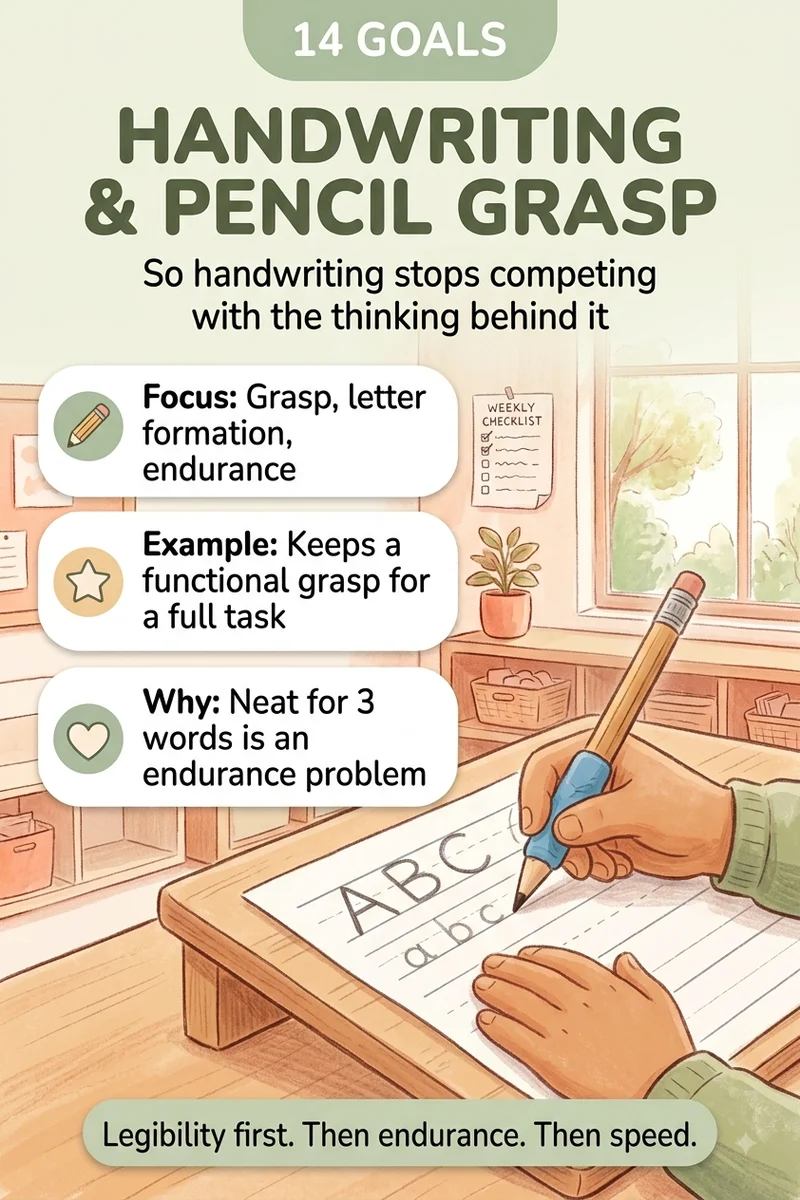
14 Handwriting & Pencil Grasp IEP Goals, Preschool Through High School
Handwriting is a motor skill wearing an academic costume: a student spending all their effort forming each letter has nothing left for spelling, sentence structure, or the idea they were trying to write down. It shows up as "won't write" or "writes so little" when the real barrier is that the mechanics never became automatic.
Free · no email required · opens your browser's print dialog
Preschool & Pre-K
- 1[student] will use a functional grasp (palmar, digital pronate, or tripod) to hold a crayon or marker for a drawing task, in 4 of 5 observed opportunities.
- 2[student] will transition from a fisted to a more mature grasp pattern on a writing tool, with adult modeling, across 4 of 5 trials.
- 3[student] will maintain a grasp on a writing tool for at least [X] minutes of a task without dropping it, across 4 of 5 trials.
Kindergarten – 2nd
- 4[student] will use a mature tripod or adapted grasp to write or color for at least [X] minutes without adult cueing, across 4 of 5 trials.
- 5[student] will maintain appropriate pencil pressure, not too light or too heavy, during a writing task, with 80% consistency across 4 of 5 samples.
- 6[student] will use an appropriately sized or adapted writing tool independently, in 4 of 5 observed opportunities.
- 7[student] will form all uppercase and lowercase letters with correct starting point and formation, with 80% legibility across 4 of 5 writing samples.
- 8[student] will write legibly within a defined line or space, with 80% of letters correctly sized and placed, across 4 of 5 samples.
- 9[student] will copy a sentence from a model with 90% accuracy in letter formation and spacing, across 4 of 5 trials.
3rd – 5th Grade
- 10[student] will maintain a functional, efficient pencil grasp for a full writing task of [X] minutes without a break, across 4 of 5 trials.
- 11[student] will maintain consistent letter size and spacing across a full page of writing, with 80% accuracy across 4 of 5 samples.
- 12[student] will complete a writing task within a standard time frame without fatigue-related decline in legibility, across 4 of 5 trials.
6th – 8th Grade
- 13[student] will maintain legible handwriting through a full class period of note-taking, with 80% legibility across 4 of 5 observed periods.
- 14[student] will complete a timed written assignment (a test, an in-class essay) without a significant decline in legibility or speed due to fatigue, across 4 of 5 trials.
How to teach handwriting & pencil grasp in the classroom
Handwriting is taught with direct instruction on letter formation, in a consistent order, with the motor pattern practiced to automaticity. Teach letters in groups that share a starting stroke rather than alphabetically, model the formation while describing it, and have the student practice with immediate correction before it becomes habit. Check the foundational pieces first — posture, paper position, and a functional pencil grasp — because a page of practice with a poor grasp entrenches the problem. Use paper with clear baseline and midline cues and fade to regular paper as control grows. Keep sessions short and frequent; fatigue produces sloppy repetitions that teach the wrong pattern. Once formation is reliable, shift to legibility at a usable speed in real writing tasks. If handwriting stays effortful after systematic instruction, involve an occupational therapist and consider keyboarding as a parallel path.
How to measure it
Track legibility across a full task, not just the first line. A student who writes three neat words and then degrades into a scrawl has an endurance problem, not a formation problem — the two need different instruction and look identical if you only check the first few letters.
Where these goals come from
Each goal above is drawn from a grade-band goal bank, where you can see it alongside the other targets it is usually paired with: Fine Motor goals, 3rd – 5th Grade; Fine Motor goals, 6th – 8th Grade; Fine Motor goals, Kindergarten – 2nd Grade; Fine Motor goals, Preschool & Pre-K; Writing goals, Kindergarten – 2nd Grade.
Related skills
A flat following-directions goal is often really a breakdown in one of these skills. If the data does not move, check whether the real target is here instead:
- Scissor & Cutting Skills IEP goals — controlling scissors accurately enough that cutting stops needing full attention
- Task Initiation IEP goals — the gap between knowing what to do and starting to do it
- Self-Monitoring IEP goals — noticing your own performance while it is happening
Common questions
Should a handwriting goal target legibility or speed?
Legibility first, then endurance, then speed. A student who writes three neat words and then degrades into a scrawl has an endurance problem, not a formation problem, and the two need different instruction. Score a full writing sample rather than the first line.
When should the team stop remediating handwriting and switch to typing?
There is no fixed age, but by middle school many teams shift the goal from forming letters to producing written work by whatever means is efficient. Keep a handwriting goal only while legible writing is still a realistic and functional target for this student.
Further reading
Need a goal built from your student's baseline? Generate one for your student →