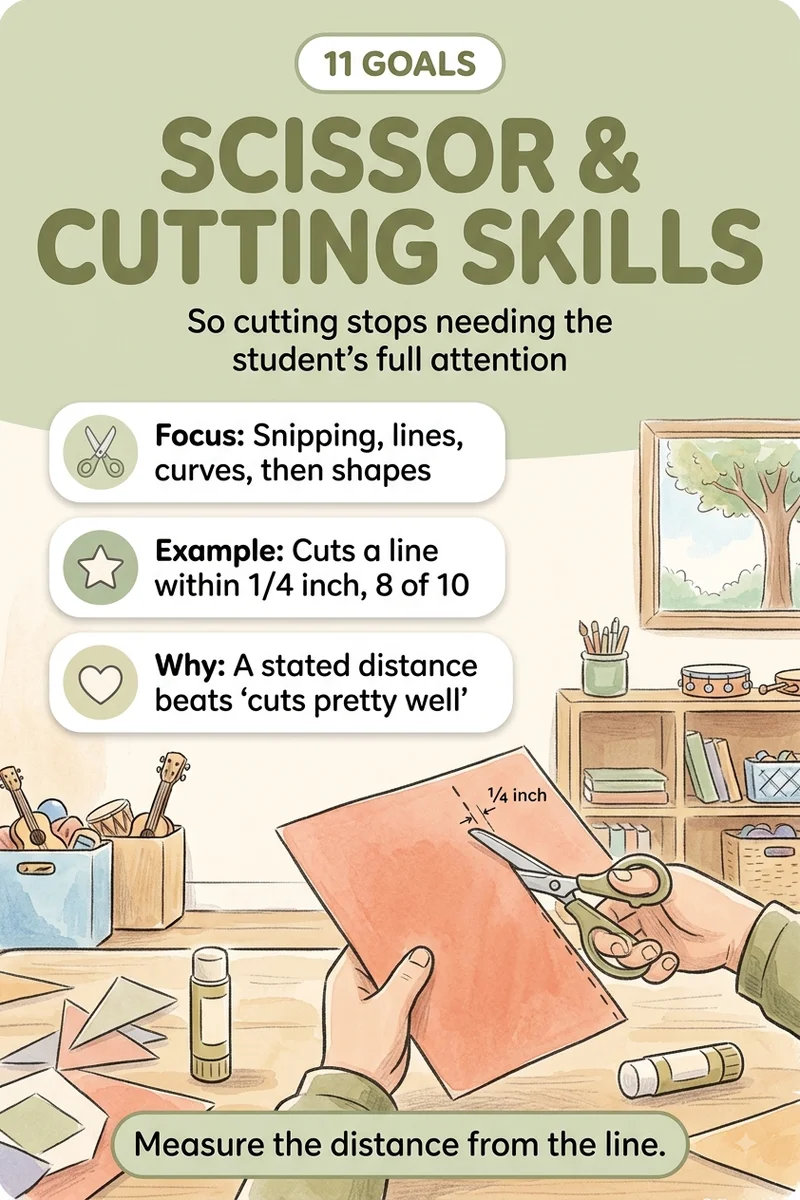
11 Scissor & Cutting Skills IEP Goals, Preschool Through High School
Scissor skills sit underneath a surprising amount of the early classroom day — cutting out shapes, glueing projects, using scissors safely and independently during centers. A student still fighting the tool has no attention left for the art or literacy task the cutting was supposed to support.
Free · no email required · opens your browser's print dialog
Preschool & Pre-K
- 1[student] will hold scissors correctly, thumb up, and open and close them to snip paper, in 4 of 5 observed opportunities.
- 2[student] will use both hands together to stabilize paper while the other hand uses a tool (a crayon, scissors), in 4 of 5 observed opportunities.
- 3[student] will string large beads onto a lace or pipe cleaner, with 80% success across 4 of 5 trials.
Kindergarten – 2nd
- 4[student] will cut along a straight line within 1/4 inch of accuracy, in 8 of 10 trials.
- 5[student] will cut along a curved line and a zigzag line, with 80% accuracy across 4 of 5 trials.
- 6[student] will cut out a simple shape (a square, a circle), staying within 1/4 inch of the line, in 4 of 5 trials.
- 7[student] will cut out a shape with an internal detail (cutting both the outline and an inner line, like a face or a donut), staying within 1/4 inch of the line, in 4 of 5 trials.
3rd – 5th Grade
- 8[student] will cut out a complex shape (a star, a curved multi-part shape), staying within 1/8 inch of the line, in 4 of 5 trials.
- 9[student] will select and use the appropriate scissors (adapted, loop, or spring-assisted) for a cutting task requiring more than 5 minutes of sustained cutting, maintaining accuracy within 1/8 inch of the line, across 4 of 5 trials.
- 10[student] will use a ruler to draw or measure a straight line to the nearest 1/4 inch, with 80% accuracy across 4 of 5 trials.
- 11[student] will use a stapler, a hole punch, and a paper clip appropriately and independently, in 4 of 5 observed opportunities.
How to teach scissor & cutting skills in the classroom
Cutting is taught in a developmental sequence with the right tools and support faded gradually. Start with snipping — single cuts on narrow strips — then cutting across a wider strip, then straight lines, then curves, then simple shapes, adding the next step only when the current one is controlled. Check scissor fit and orientation (thumb up, loops the right size) and the helper hand's job of turning the paper, which is half of cutting. Use lines that are thick and high-contrast, and stiffer paper at first because it is easier to control than thin paper. Provide support at the student's hand or the paper and reduce it as accuracy grows. Keep sessions short; cutting fatigues small hands fast. Practice on real tasks once basic control is there. If progress stalls, an occupational therapist can check grasp, strength, and bilateral coordination.
How to measure it
Score accuracy against a stated distance from the line (within 1/4 inch, within 1/8 inch) rather than a subjective “cuts well.” Increasing precision — straight line, then curve, then complex shape with an internal detail — gives you a progression to move through, not just a single pass/fail skill.
Where these goals come from
Each goal above is drawn from a grade-band goal bank, where you can see it alongside the other targets it is usually paired with: Fine Motor goals, 3rd – 5th Grade; Fine Motor goals, Kindergarten – 2nd Grade; Fine Motor goals, Preschool & Pre-K.
Related skills
A flat following-directions goal is often really a breakdown in one of these skills. If the data does not move, check whether the real target is here instead:
- Handwriting & Pencil Grasp IEP goals — forming and producing letters reliably enough that handwriting stops competing with the thinking behind it
- Following Directions IEP goals — doing what was asked, the first time, without it being repeated
- Task Initiation IEP goals — the gap between knowing what to do and starting to do it
Common questions
Should a scissor goal specify the type of scissors?
Name them when the equipment is part of the target. If the student uses loop or spring-assisted scissors, write that into the condition so the next teacher knows what the score was measured with — a result achieved with adapted scissors and one achieved with standard scissors are not the same.
How do you make a cutting goal measurable?
State the distance from the line rather than a subjective judgement: within 1/4 inch, then within 1/8 inch. Progressing through straight line, then curve, then a shape with an internal detail gives you a sequence to move through instead of a single pass-or-fail skill.
Further reading
Need a goal built from your student's baseline? Generate one for your student →