11 Time Management IEP Goals, Preschool Through High School
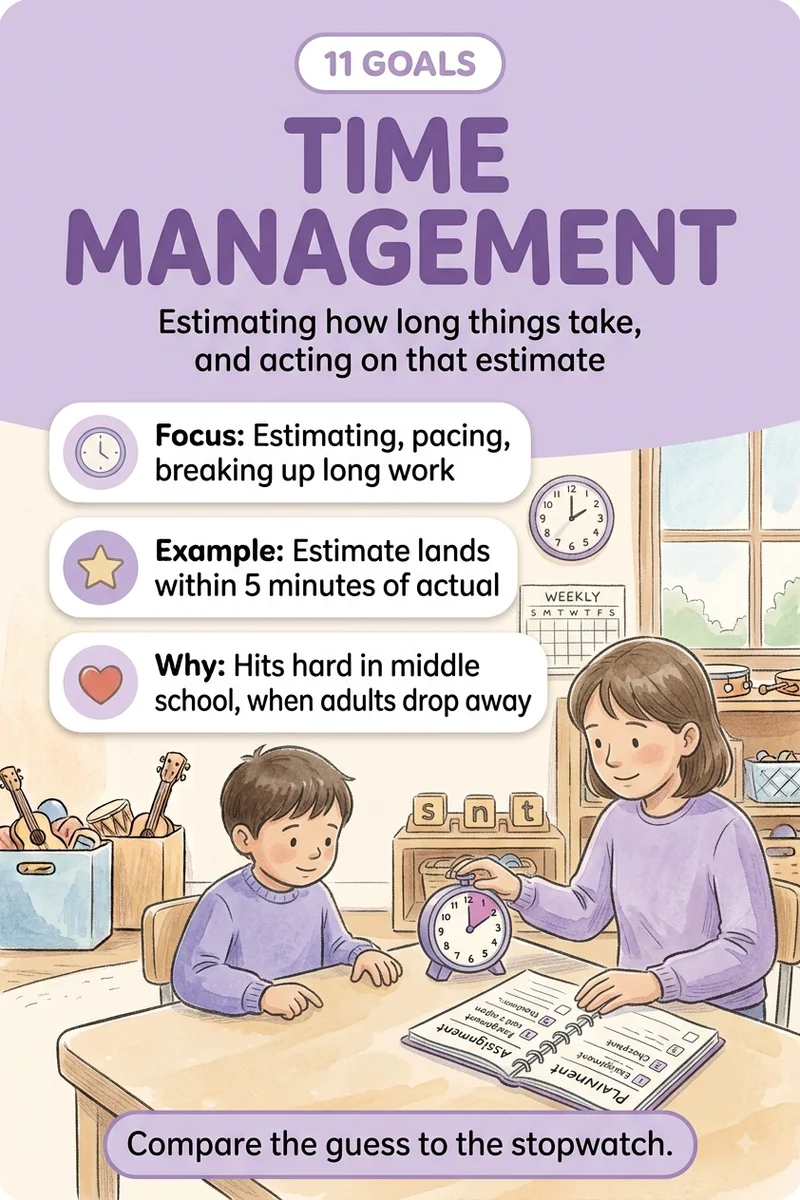
Time management shows up late — usually when a student hits middle school and the number of adults tracking their deadlines drops from one to six. It covers estimating duration, pacing within a period, and breaking a long assignment into checkpoints.
Free · no email required · opens your browser's print dialog
3rd – 5th Grade
- 1[student] will estimate how long a task will take and compare it to the actual time, with the estimate within [X] minutes of accuracy, across 4 of 5 trials.
- 2[student] will complete an assignment within an allotted time period, pacing their work across the available time, in 4 of 5 observed opportunities.
- 3[student] will pause before responding or acting to reduce careless errors, decreasing error rate from a documented baseline, across 4 of 5 assignments.
- 4[student] will manage frustration when a task is difficult by using a taught strategy before giving up, in 4 of 5 observed opportunities.
- 5[student] will use a checklist or planner to complete a multi-step routine independently, across 4 of 5 days.
- 6[student] will read an analog and digital clock to manage a personal schedule, with 90% accuracy across 4 of 5 trials.
6th – 8th Grade
- 7[student] will use a planner or digital calendar to track assignments and personal commitments across a full school day, with adult support fading, across 4 of 5 school days.
- 8[student] will estimate how long a task will take and complete it within that estimate, with 80% accuracy across 4 of 5 trials.
9th – 12th Grade
- 9[student] will independently manage a personal calendar or planner across academic, work, and personal commitments, with adult support fading, across 4 of 5 weeks.
- 10[student] will prioritize competing tasks and deadlines and create a realistic plan to complete them, with 80% accuracy across 4 of 5 trials.
- 11[student] will independently begin and complete a long-term project (a research paper, an application) on a self-created timeline, across 4 of 5 projects.
How to teach time management in the classroom
Time management is taught by making time visible and estimation a routine. Use a timer the student can see counting down, and label chunks of the day so "a while" becomes "fifteen minutes." Before a task, have the student predict how long it will take, then compare the prediction to the actual — the gap is the lesson, and it narrows with practice. Break assignments into timed segments with a planned checkpoint, so a long task becomes a series of short ones. Teach backward planning for anything with a deadline: name the due date, then work back to what has to happen today. Use a consistent planner with a fixed time to update it rather than relying on memory. Start with heavy support — an adult sets the segments and checkpoints — and hand those decisions to the student in steps.
How to measure it
Compare the student's estimate to the actual time as the measure. "Estimates how long a task will take within 5 minutes of actual, in 4 of 5 opportunities" produces a number and teaches the skill at the same time.
Where these goals come from
Each goal above is drawn from a grade-band goal bank, where you can see it alongside the other targets it is usually paired with: Executive Function goals, 3rd – 5th Grade; Executive Function goals, 9th – 12th Grade; Adaptive/Life Skills goals, 3rd – 5th Grade; Adaptive/Life Skills goals, 6th – 8th Grade.
Related skills
A flat following-directions goal is often really a breakdown in one of these skills. If the data does not move, check whether the real target is here instead:
- Task Initiation IEP goals — the gap between knowing what to do and starting to do it
- Organization IEP goals — knowing where things are and having them when you need them
- Independent Functioning IEP goals — doing the routine without an adult standing there
Common questions
Why is my student always surprised by time running out?
Time estimation is a specific skill, and many students with executive function needs consistently underestimate how long tasks take. The fix is practice with feedback: predict the duration, do the task, compare — the gap narrows over weeks. Making time visible with a countdown timer also helps.
What does a time management goal actually measure?
Common measures include accuracy of time estimates (predicted vs actual within a set margin), independent use of a planner or checklist across a week, or completion of task segments by their checkpoints. Pick one concrete behavior rather than "manages time better."
Is this the same as a task completion goal?
Related but different. Task completion is about finishing; time management is about estimating, pacing, and planning backward from a deadline. A student can finish work and still have no sense of how long it took or when to start the next thing.
Further reading
Need a goal built from your student's baseline? Generate one for your student →