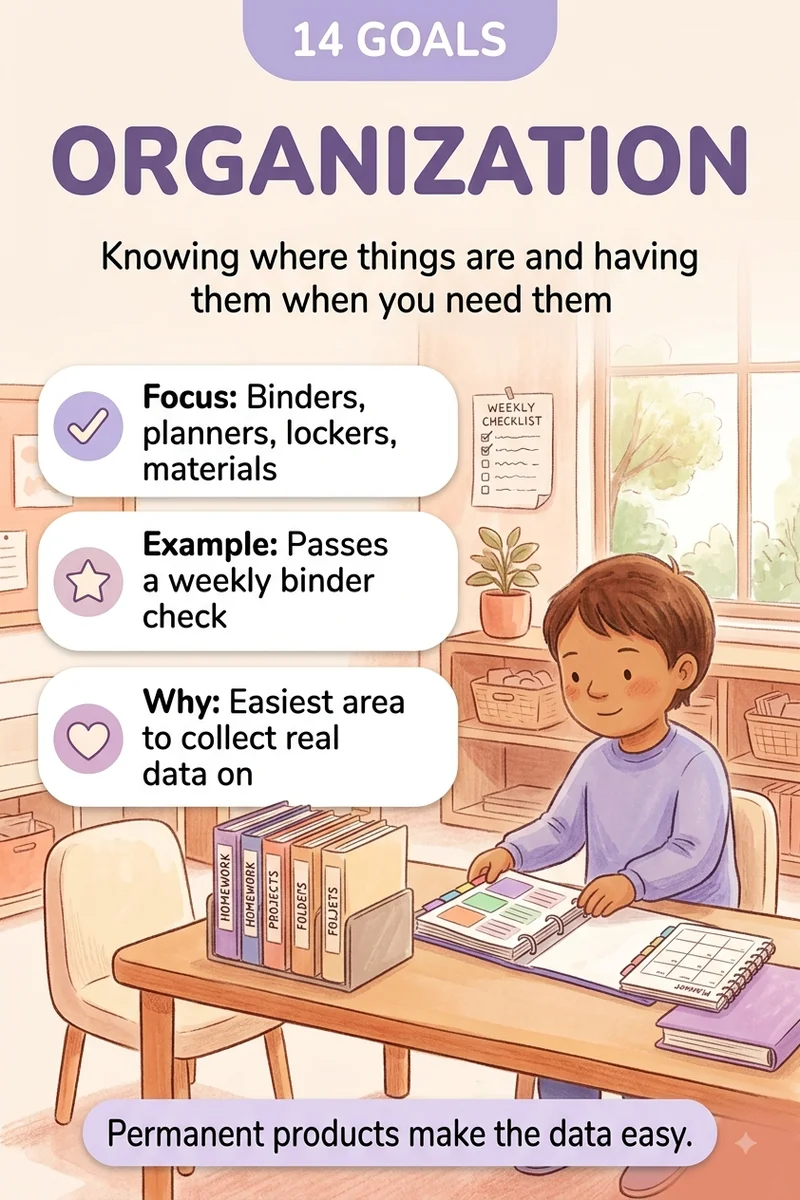
14 Organization IEP Goals, Preschool Through High School
Organization is the easiest goal area to collect real data on, because almost all of it produces a permanent product: a binder, a planner, a locker, a submitted assignment. That makes it a good first goal for a team that has struggled to sustain data collection.
Free · no email required · opens your browser's print dialog
Preschool & Pre-K
- 1[student] will find and retrieve a familiar item from a consistent, labeled location, in 4 of 5 observed opportunities.
- 2[student] will put away materials in their designated spot after an activity, with 1 or fewer reminders, across 4 of 5 observed opportunities.
- 3[student] will complete a 2-3 step visual routine (a first/then/then board) with decreasing adult prompting, across 4 of 5 trials.
Kindergarten – 2nd
- 4[student] will organize materials needed for a task (pencil, paper, book) before starting, with 1 or fewer reminders, across 4 of 5 observed opportunities.
- 5[student] will use a simple visual schedule or checklist to complete a multi-step task independently, across 4 of 5 trials.
- 6[student] will keep their workspace or desk organized enough to find needed materials, with 1 or fewer reminders, across 4 of 5 checks.
3rd – 5th Grade
- 7[student] will use a planner or assignment log to record and track homework and due dates, with adult support fading, across 4 of 5 school days.
- 8[student] will break a multi-step assignment into smaller steps using a graphic organizer or checklist, with 80% accuracy across 4 of 5 trials.
- 9[student] will maintain an organized binder or folder system, locating a needed item within [X] minutes, across 4 of 5 checks.
6th – 8th Grade
- 10[student] will maintain an organization system, digital or physical, across all classes, locating a needed item within [X] minutes, across 4 of 5 checks.
- 11[student] will adjust their approach to a task or assignment when the first strategy isn't working, with 1 adult prompt or fewer, in 4 of 5 observed opportunities.
- 12[student] will transition between the demands of different classes (materials, expectations, routines) without significant difficulty, across 4 of 5 observed transitions.
9th – 12th Grade
- 13[student] will maintain an organization system that works across academic, work, and personal settings, locating a needed item within [X] minutes, across 4 of 5 checks.
- 14[student] will independently use assistive technology or an executive function tool (a reminder app, a task manager) to manage responsibilities, across 4 of 5 weeks.
How to teach organization in the classroom
Organization is taught as a set of concrete systems the student practices, not a personality trait. Decide where each thing lives — one folder, one bin, one place in the backpack — and keep it identical every day so putting things away is automatic rather than a fresh decision. Build short, scheduled routines: a two-minute desk reset before transitions, a locker check at a fixed time, a Friday backpack clean-out. Use visual supports — a labeled folder, a checklist taped inside the binder, a photo of what "organized" looks like — so the standard does not depend on an adult reminding. Teach one system at a time until it holds before adding another. Reinforce the routine happening, not just a tidy result. Fade the adult prompt toward a self-check, then toward the student running the routine alone.
How to measure it
Use permanent products and a checklist. A weekly binder check against a stated standard takes two minutes and produces a defensible number, with no observation time at all.
Where these goals come from
Each goal above is drawn from a grade-band goal bank, where you can see it alongside the other targets it is usually paired with: Executive Function goals, 3rd – 5th Grade; Executive Function goals, 6th – 8th Grade; Executive Function goals, 9th – 12th Grade; Executive Function goals, Kindergarten – 2nd Grade; Executive Function goals, Preschool & Pre-K.
Related skills
A flat following-directions goal is often really a breakdown in one of these skills. If the data does not move, check whether the real target is here instead:
- Time Management IEP goals — estimating how long things take, and acting on that estimate
- Task Initiation IEP goals — the gap between knowing what to do and starting to do it
- Working Memory IEP goals — holding information in mind long enough to act on it
Common questions
Can you actually teach organization, or is it just how someone is?
It is teachable, because organization in a classroom is a set of concrete systems — where the folder goes, when the backpack gets cleaned out, what the checklist says — not a fixed trait. Students learn the systems through direct instruction and scheduled practice, the same as any other routine.
How do you measure an organization goal?
Track the routine and the result: percentage of days the student has required materials at the start of class, independent completion of a desk or locker reset at set times, or a weekly organization check scored against a rubric. Measure the system running, not just neatness.
Should the goal cover physical materials or digital files or both?
Match it to where the student struggles and what the grade level demands. Younger students usually need physical systems (folder, backpack, desk); older students often need digital organization too (files, assignment tracker). Write the goal around the specific system being taught.
Further reading
Need a goal built from your student's baseline? Generate one for your student →