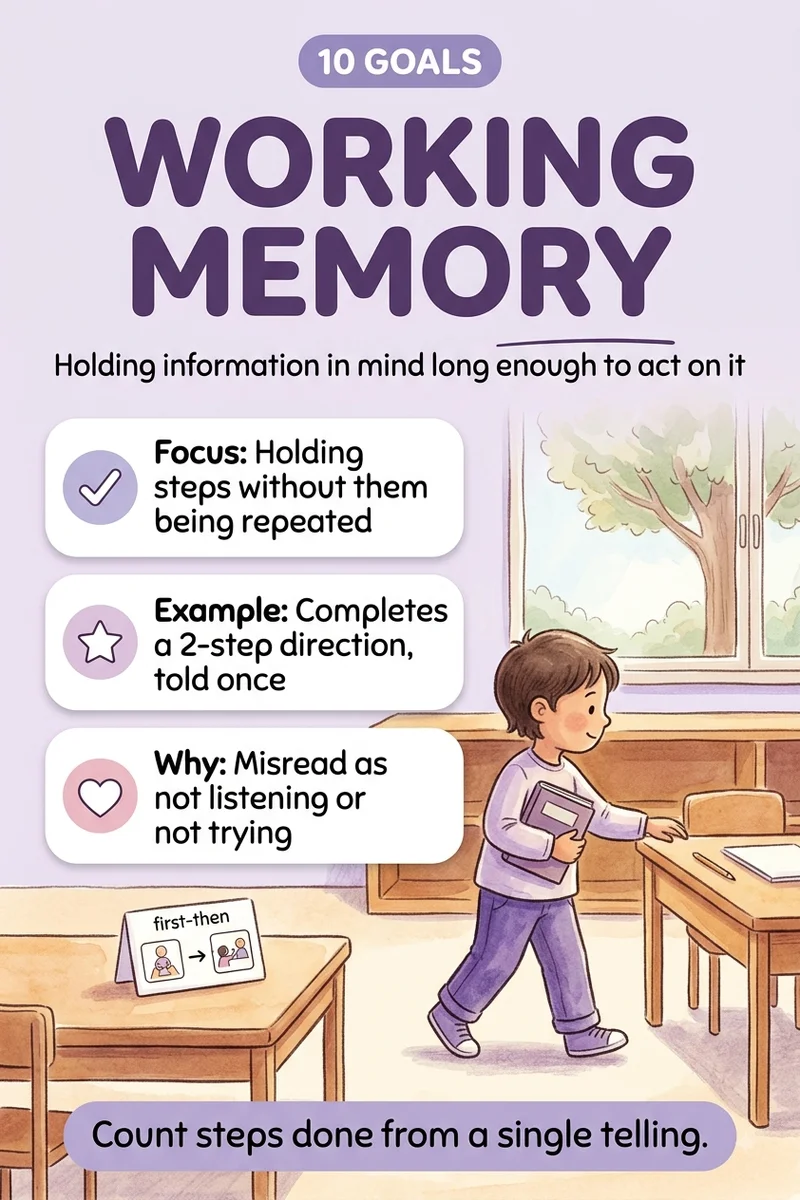
10 Working Memory IEP Goals, Preschool Through High School
Working memory is what lets a student keep a multi-step direction, a math problem's steps, or a sentence they are about to write in mind while they work — without it, a 3-step instruction effectively becomes three separate one-step instructions, each needing to be re-given. It gets misread as not listening or not trying, when the information genuinely did not stay available long enough to use.
Free · no email required · opens your browser's print dialog
Preschool & Pre-K
- 1[student] will hold a 2-step direction in mind long enough to complete both parts without it being repeated, with 80% accuracy across 4 of 5 trials.
- 2[student] will remember and complete a familiar 2-step routine (wash hands, then sit down) without a reminder, in 4 of 5 observed opportunities.
Kindergarten – 2nd
- 3[student] will complete all 3 steps of a direction given only once, without needing any step repeated, with 80% accuracy across 4 of 5 trials.
- 4[student] will recall and use information from earlier in a lesson (a rule, a step) later in the same task, with 75% accuracy across 4 of 5 trials.
3rd – 5th Grade
- 5[student] will hold and complete a 3-4 step direction without needing it repeated, with 80% accuracy across 4 of 5 trials.
- 6[student] will mentally hold a math problem's steps (regrouping, order of operations) while solving it, with 80% accuracy across 4 of 5 trials.
- 7[student] will retain and follow a 2-part instruction given during a classroom transition (e.g., 'get your book and sit at your desk') without needing it repeated, with 80% accuracy across 4 of 5 observed transitions.
6th – 8th Grade
- 8[student] will follow multi-step verbal instructions embedded in a lecture without needing individual repetition, with 80% accuracy across 4 of 5 trials.
- 9[student] will maintain attention and take usable notes during a full class period, with 80% of key content captured, across 4 of 5 observed periods.
- 10[student] will apply a previously taught rule, formula, or vocabulary term to a new task without being re-taught, with 75% accuracy across 4 of 5 opportunities.
How to teach working memory in the classroom
Working memory grows from reducing the load first, then slowly adding it back. Start by shortening what has to be held: give one step, wait for it to be done, then give the next, and only chain steps once single steps are reliable. Pair every verbal direction with something external the student can look back at — a written list, a picture sequence, fingers held up for each step — so the direction survives longer than the sentence. Teach the student to repeat the direction back in their own words before starting; the act of restating it moves it from a fading echo into something they have actually processed. During multi-step academic work, let them jot a quick note or keep a manipulative in view rather than holding partial answers in their head. As accuracy climbs, stretch the delay between direction and action, fade the written support, and add a step. The goal is not a bigger memory span overnight — it is a student who knows to write it down, ask for it once, or check the board instead of guessing.
How to measure it
Count steps completed from a single telling, not accuracy on a worksheet. "Completes 3 of 3 steps from one instruction, without repetition, in 4 of 5 trials" isolates the memory demand from the academic skill sitting underneath it.
Where these goals come from
Each goal above is drawn from a grade-band goal bank, where you can see it alongside the other targets it is usually paired with: Executive Function goals, 3rd – 5th Grade; Executive Function goals, 6th – 8th Grade; Executive Function goals, Kindergarten – 2nd Grade; Executive Function goals, Preschool & Pre-K.
Related skills
A flat following-directions goal is often really a breakdown in one of these skills. If the data does not move, check whether the real target is here instead:
- Task Initiation IEP goals — the gap between knowing what to do and starting to do it
- Following Directions IEP goals — doing what was asked, the first time, without it being repeated
- Self-Monitoring IEP goals — noticing your own performance while it is happening
Common questions
Is a working memory IEP goal the same as a memory or recall goal?
No. A recall goal is about retrieving something learned earlier — last week's spelling words, a fact from yesterday. A working memory goal is about holding information for the few seconds it takes to use it right now: keeping the steps of a direction, or the parts of a math problem, in mind while doing the work. They are measured differently and taught differently.
Can you improve working memory, or just work around it?
Both, and the compensation matters more day to day. Brain-training programs show limited transfer to classwork, so the durable gains come from strategy instruction — writing steps down, chunking, asking for a direction once, checking an external list — plus reducing the load in how tasks are given. The goals on this page target the strategy and the classroom result, not raw span.
What accuracy criterion is reasonable for a working memory goal?
Most teams write 80% across 4 of 5 trials or opportunities, measured during the same activity twice a week. The exact number should come from the student's baseline — if they currently follow a 2-step direction 2 of 5 times, jumping straight to 90% on a 4-step direction is not attainable in one IEP year.
Further reading
Need a goal built from your student's baseline? Generate one for your student →