21 Following Directions IEP Goals, Preschool Through High School
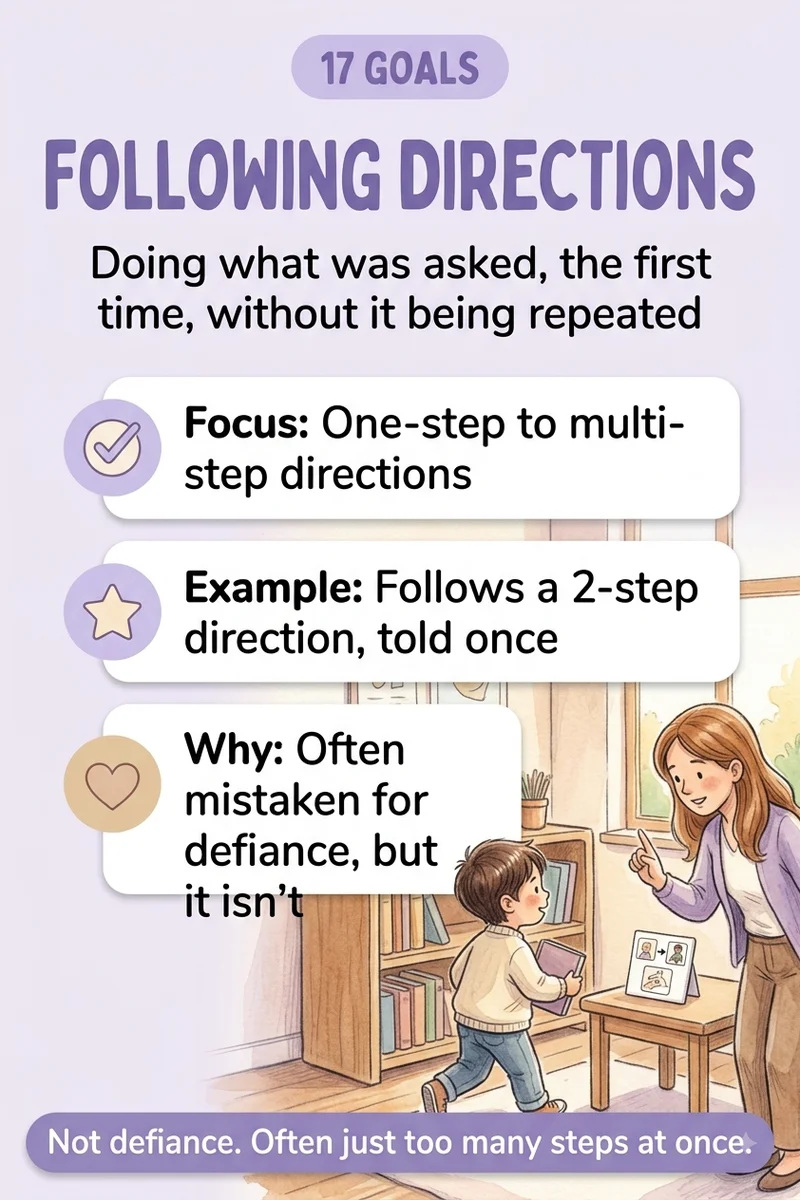
Following directions looks like one skill but is really three: hearing the direction, holding it in mind, and acting on it — a breakdown in any one of them looks identical from the front of the room. It is also the skill most often mistaken for defiance, because a student who is still processing step one looks the same as a student who is ignoring the adult.
Free · no email required · opens your browser's print dialog
Preschool & Pre-K
- 1[student] will follow a 1-step direction from an adult within 10 seconds without physical prompting, in 4 of 5 opportunities.
- 2[student] will complete a 2-step direction (“put away the toy and sit down”) with no more than 1 verbal reminder, in 4 of 5 opportunities.
- 3[student] will follow the classroom's daily visual schedule with 1 or fewer redirections per activity, across 3 consecutive days.
- 4[student] will transition between activities within 2 minutes of the transition cue, in 4 of 5 observed transitions.
- 5[student] will follow a 1-step direction given without a gesture cue, in 4 of 5 trials.
- 6[student] will follow a 2-step related direction (“get your coat and sit down”), with 80% accuracy across 4 of 5 trials.
- 7[student] will point to or identify [X] common objects or pictures when named, with 80% accuracy across 4 of 5 trials.
Kindergarten – 2nd
- 8[student] will comply with an adult direction within 30 seconds of the first request, with no more than 1 additional prompt, in 8 of 10 observed opportunities.
- 9[student] will follow a multi-step direction (3 or more steps) given once, with 80% accuracy across 4 of 5 trials.
- 10[student] will transition between activities or settings within [X] minutes of the cue, with no more than 1 verbal reminder, across 4 of 5 observed transitions.
- 11[student] will follow a 2-step unrelated direction (“touch your nose, then clap”) with 80% accuracy across 4 of 5 trials.
- 12[student] will follow a direction involving a spatial concept (under, behind, next to), with 80% accuracy across 4 of 5 trials.
- 13[student] will follow a direction given to the whole class without individual repetition, in 4 of 5 observed opportunities.
3rd – 5th Grade
- 14[student] will follow a multi-step direction (4 or more steps) given once, without needing it repeated, with 80% accuracy across 4 of 5 trials.
- 15[student] will follow written directions on a worksheet or assignment independently, without needing them read aloud, in 4 of 5 observed assignments.
- 16[student] will begin a multi-step task within 1 minute of a direction given during whole-class instruction, with no more than 1 additional prompt, in 4 of 5 observed opportunities.
- 17[student] will follow a direction given with a time delay (e.g., "in five minutes, put your materials away") without needing a reminder, in 4 of 5 observed opportunities.
6th – 12th Grade
- 18[student] will follow written multi-step directions on an assignment, lab, or job task independently, without asking for them to be re-explained, in 4 of 5 observed opportunities.
- 19[student] will begin the task named in a whole-class or whole-group direction within 2 minutes, with no more than 1 individual prompt, in 4 of 5 observed opportunities.
- 20[student] will accept a redirection or correction from an adult and adjust their behavior without arguing or stopping work, in 4 of 5 observed opportunities.
- 21[student] will follow a procedural or safety direction (lab, shop, CTE, or work-based learning setting) on the first request, in 4 of 5 observed opportunities.
How to teach following directions in the classroom
Following directions improves when the direction is made catchable and the student is taught to catch it. Get attention before speaking, give one clear instruction at a time, and keep early directions to one or two steps until success is reliable. Pair the words with a visual or gesture, and have the student repeat the direction back before acting — the restating turns a fading sentence into a plan. For multi-step directions, teach the student to break them into numbered parts and check off each one. Watch for the real cause when directions are missed: working memory, attention, processing speed, or not knowing a step is expected — the fix differs for each. Use pre-correction before predictable direction-heavy moments. Reinforce first-time following specifically, and fade the repetition, the visual, and the check-back as the pattern holds.
How to measure it
Score compliance within a set window (for example, 30 seconds of the first request) rather than eventual compliance, and note how many times the direction had to be repeated. A goal that only checks whether the task got done eventually hides how much re-directing it actually took.
Where these goals come from
Each goal above is drawn from a grade-band goal bank, where you can see it alongside the other targets it is usually paired with: Behavior goals, 9th – 12th Grade; Behavior goals, 6th – 8th Grade; Behavior goals, 3rd – 5th Grade; Behavior goals, Kindergarten – 2nd Grade; Behavior goals, Preschool & Pre-K; Communication goals, Kindergarten – 2nd Grade; Communication goals, Preschool & Pre-K.
Related skills
A flat following-directions goal is often really a breakdown in one of these skills. If the data does not move, check whether the real target is here instead:
- Working Memory IEP goals — holding information in mind long enough to act on it
- Task Initiation IEP goals — the gap between knowing what to do and starting to do it
- Self-Monitoring IEP goals — noticing your own performance while it is happening
- Transitions IEP goals — moving between activities, settings, and a whole new routine without losing the day to it
- Impulse Control IEP goals — the pause between the urge and the action
Common questions
How many steps should a following-directions goal target?
Match the student's current baseline plus one. If they reliably follow 2-step directions, write the goal for 3 — jumping straight to 4 or 5 usually produces a year of flat data. Count steps completed from a single telling, not after the direction has been repeated.
Is not following directions a behaviour goal or a language goal?
It depends where the breakdown happens. A student who cannot hold the direction in mind needs a working memory or receptive language goal; a student who understood it and chose not to act needs a behaviour goal. A speech evaluation or an FBA tells you which — guessing usually produces the wrong goal.
How do you write a following-directions goal for an AAC or minimally verbal student?
Keep the target the same — respond to a spoken direction within a set window — but change what counts as the response. Following a 1-step direction by carrying out the action, pointing to the named object, or selecting the matching symbol on a device are all valid evidence. The preschool and K-2 communication goal banks have versions written this way.
Need a goal built from your student's baseline? Generate one for your student →