Resource Library
Free printables
The paperwork special education case managers actually do every week — free to download, free to share with your team.
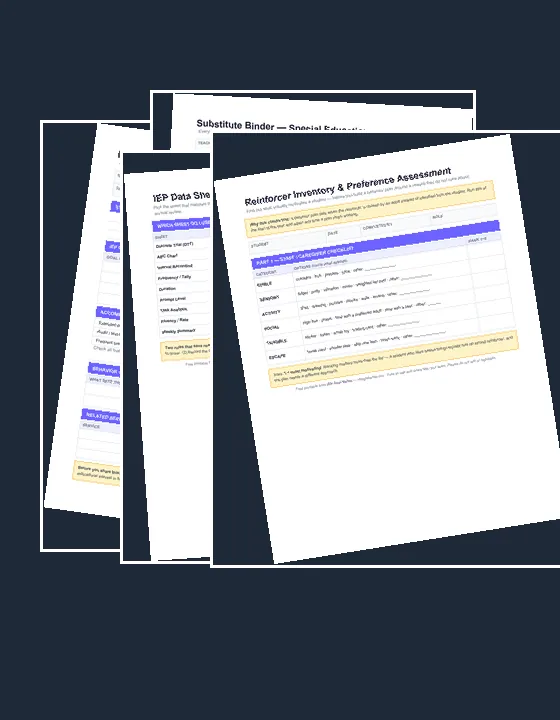
Complete Editable Bundle — all 7 in Word
Every template below as a fully editable Word file — add your school logo, change the wording, delete what you don't use. Plus a bonus caseload master list and beginning-of-year checklist.
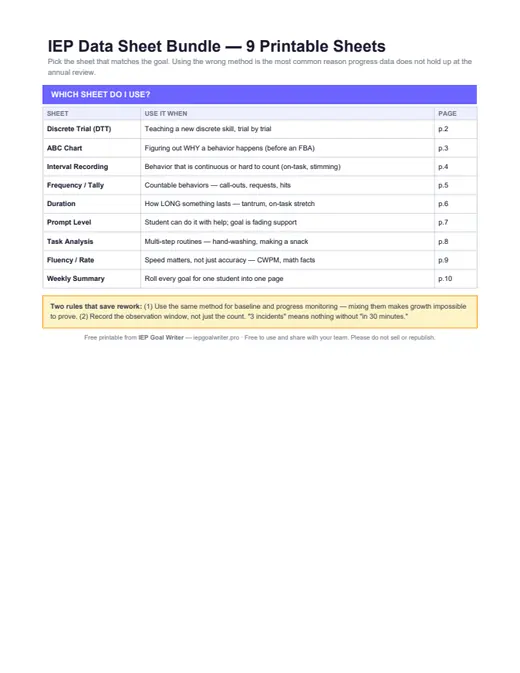
IEP Data Sheets — editable Word
All nine data sheets in one editable file. Retype the column headers, resize the tables, and make it match how your district actually tracks progress.
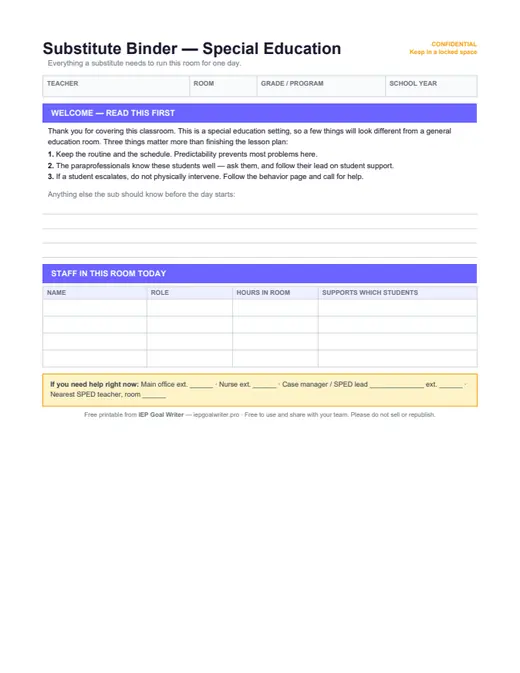
SPED Substitute Binder — editable Word
Fill it in once in September, update only what changes. Editable so next year you start from your version instead of a blank page.
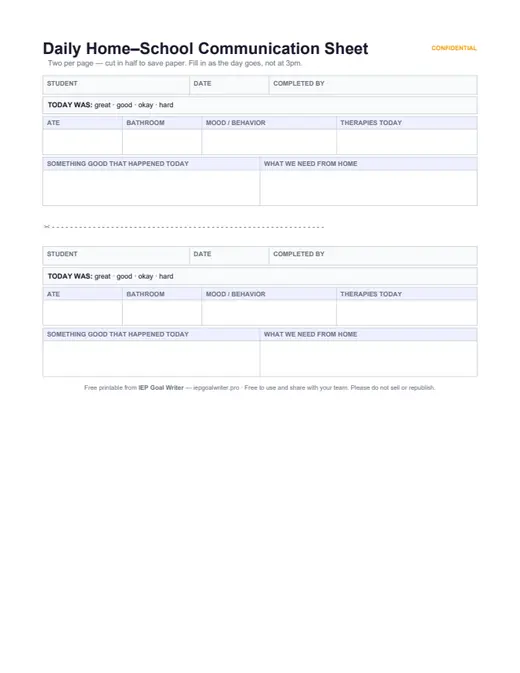
Parent Communication Set — editable Word
Daily note home, weekly summary, and the dated log that becomes your documentation record — editable to match your school's format.
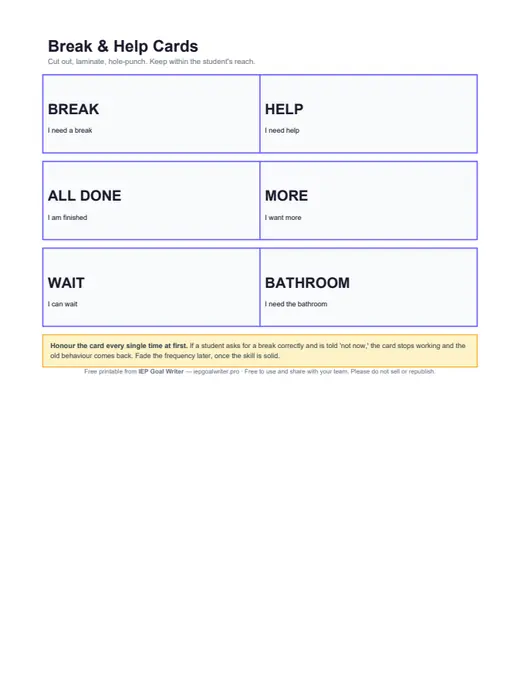
Visual Supports Pack
Token boards (3/5/10), first–then board, break and help cards, schedule strips, choice board, and a 1–5 feelings scale. Print, laminate, done for the year.
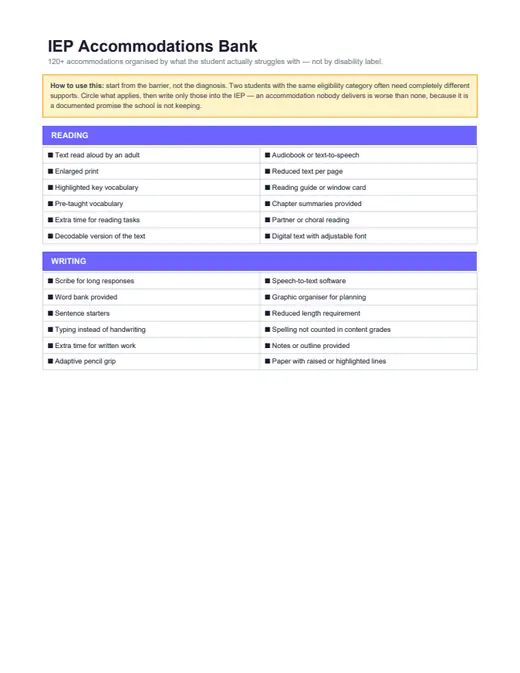
IEP Accommodations Bank — 120+
Organized by the barrier, not the diagnosis: reading, writing, math, attention, behavior, assessment, communication, physical and sensory.
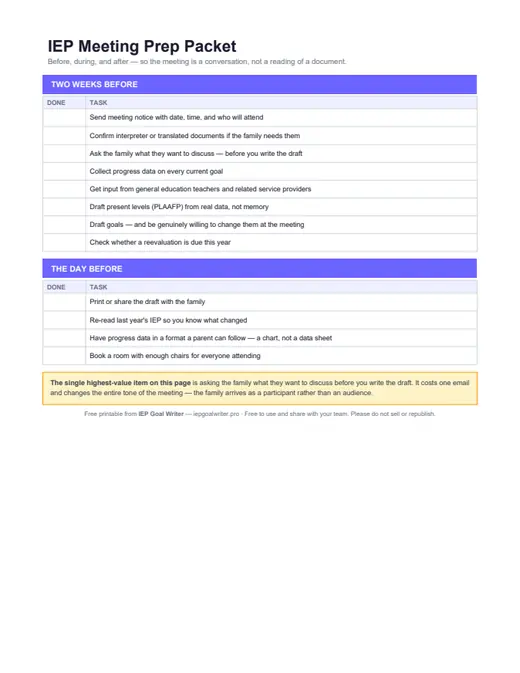
IEP Meeting Prep Packet
Two-week prep checklist, time-boxed agenda, attendance sheet, meeting notes with an options-considered box for PWN, and the 5-day follow-up list.
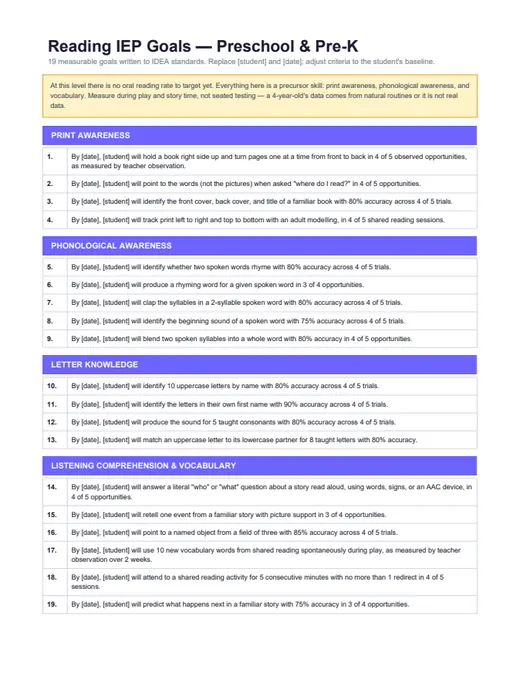
Reading Goals — Preschool & Pre-K
19 precursor reading goals: print awareness, phonological awareness, letters, and listening comprehension — measured during play.
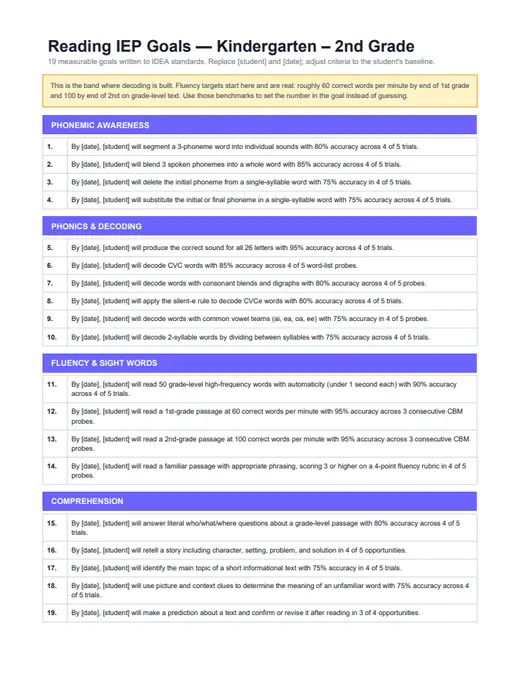
Reading Goals — K to 2nd Grade
19 decoding-focused reading goals with real CBM fluency benchmarks — phonemic awareness, phonics, fluency, and comprehension.
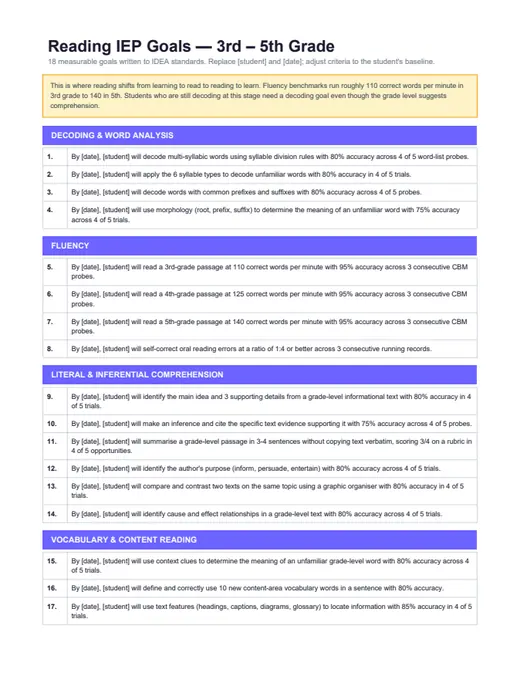
Reading Goals — 3rd to 5th Grade
18 reading goals for the reading-to-learn years: multi-syllabic decoding, fluency, inferential comprehension, and content vocabulary.
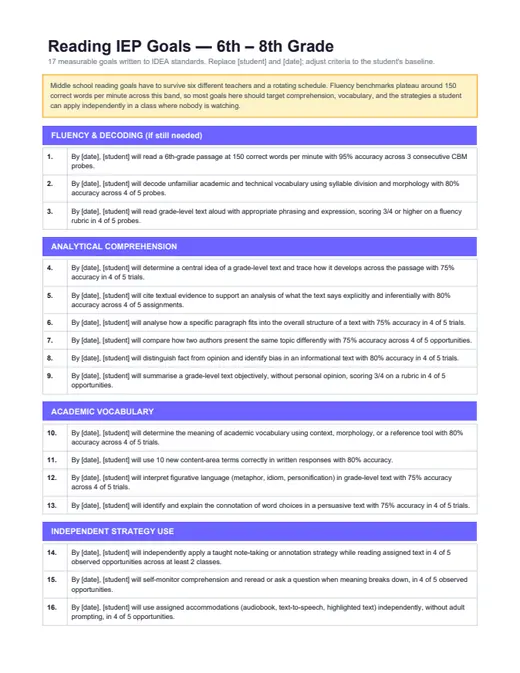
Reading Goals — Middle School
17 reading goals built to survive six teachers: analytical comprehension, academic vocabulary, and independent strategy use across classes.
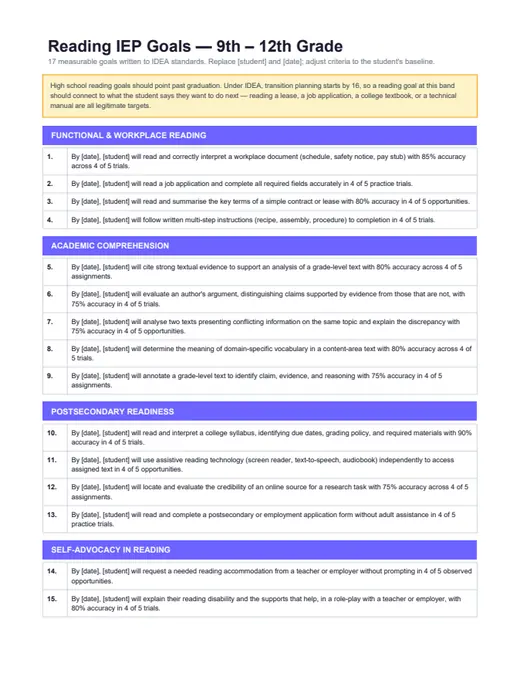
Reading Goals — High School
17 transition-tied reading goals: functional and workplace reading, academic comprehension, postsecondary readiness, and self-advocacy.
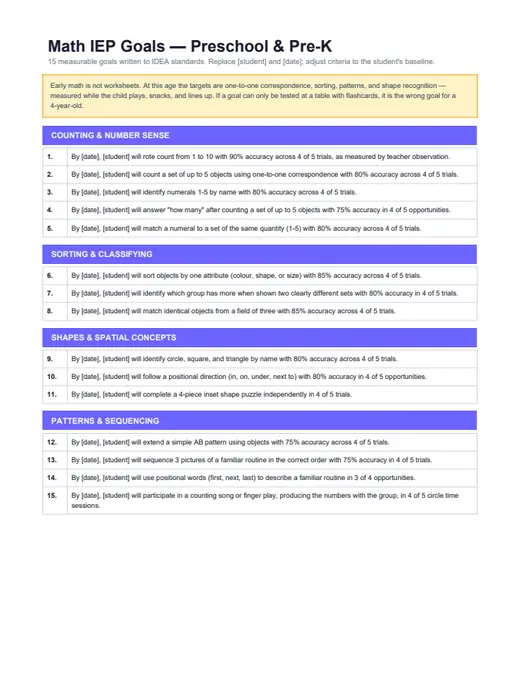
Math Goals — Preschool & Pre-K
15 early math goals measured during play: counting, one-to-one correspondence, sorting, shapes, and patterns. No computation goals yet.
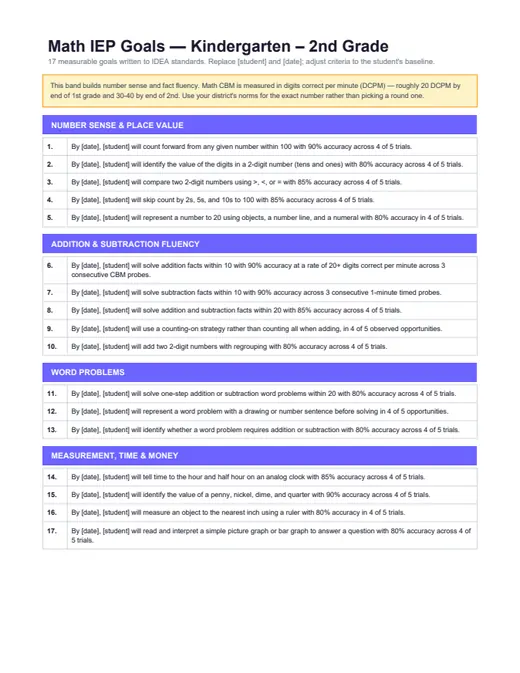
Math Goals — K to 2nd Grade
17 math goals with real fluency benchmarks: number sense, place value, addition/subtraction fluency, word problems, time, and money.
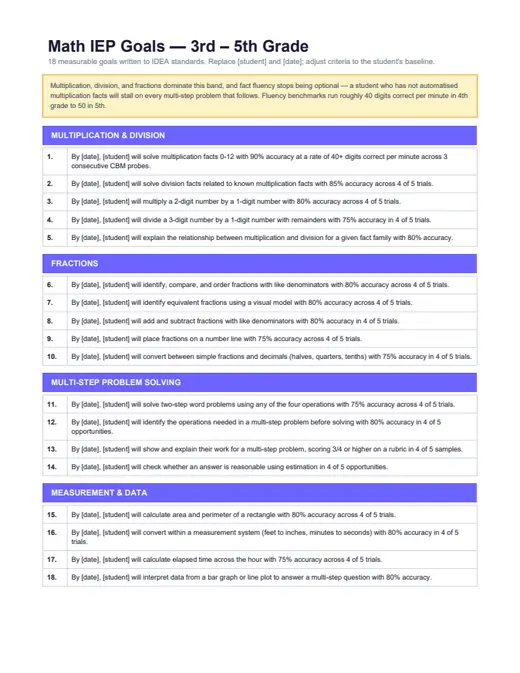
Math Goals — 3rd to 5th Grade
18 math goals: multiplication and division fluency, fractions, multi-step problem solving, and measurement — where fact fluency stops being optional.
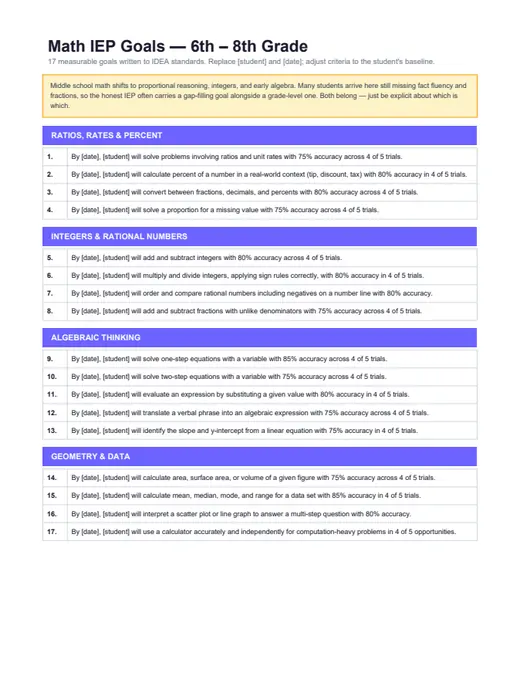
Math Goals — Middle School
17 math goals: ratios and percent, integers, early algebra, geometry and data — with an honest gap-filling goal alongside the grade-level one.
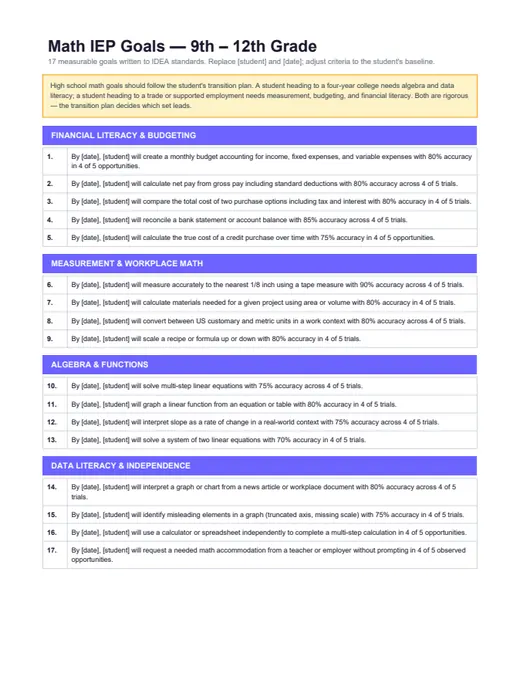
Math Goals — High School
17 transition-tied math goals: financial literacy, workplace math, algebra, and data literacy — the plan decides which path leads.
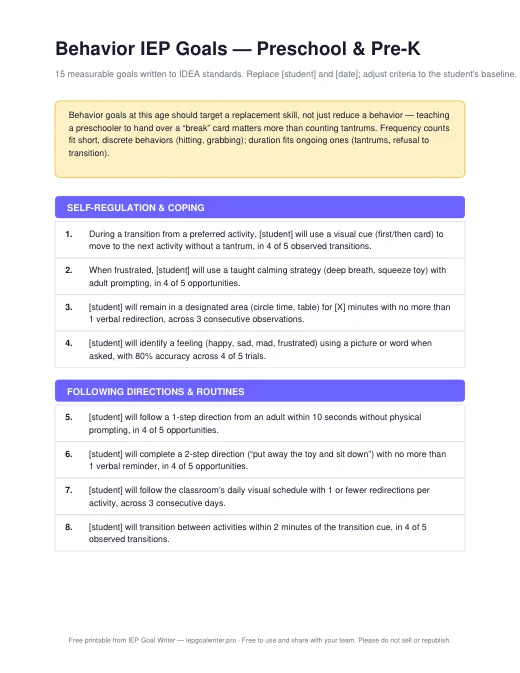
Behavior Goals — Preschool & Pre-K
15 behavior goals built around replacement skills, not just reduced tantrums: calming strategies, following directions, and requesting instead of grabbing.
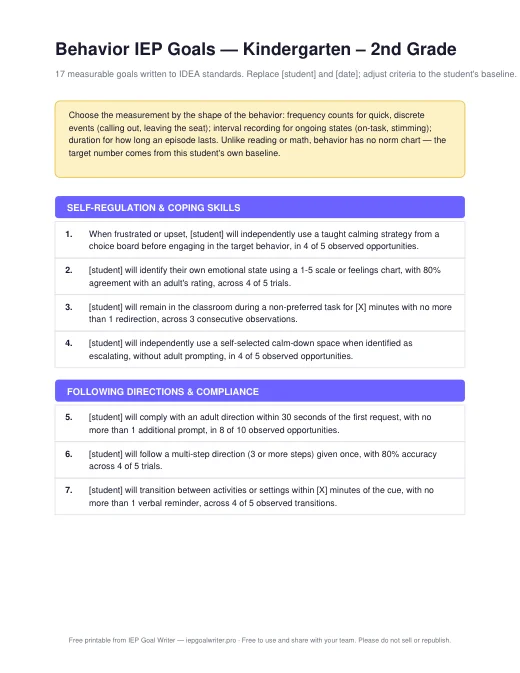
Behavior Goals — K to 2nd Grade
17 behavior goals for self-regulation, following directions, functional communication, and self-monitoring — criteria set from baseline, not a benchmark chart.
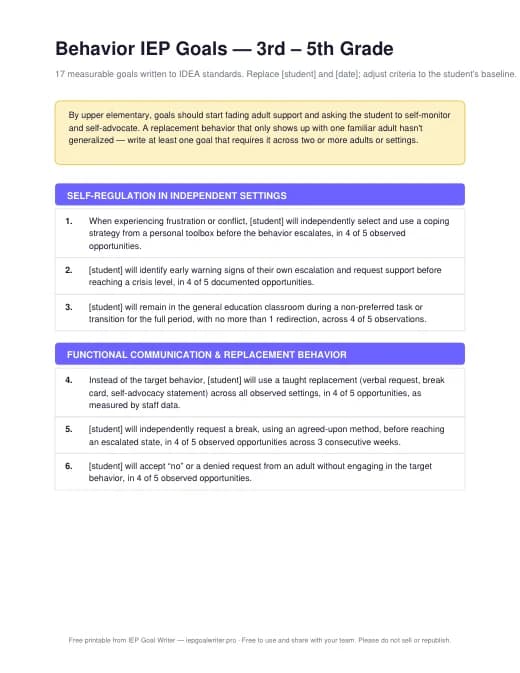
Behavior Goals — 3rd to 5th Grade
17 behavior goals that start fading adult support: self-monitoring checklists, independent calm-down use, and replacement behaviors that generalize across settings.
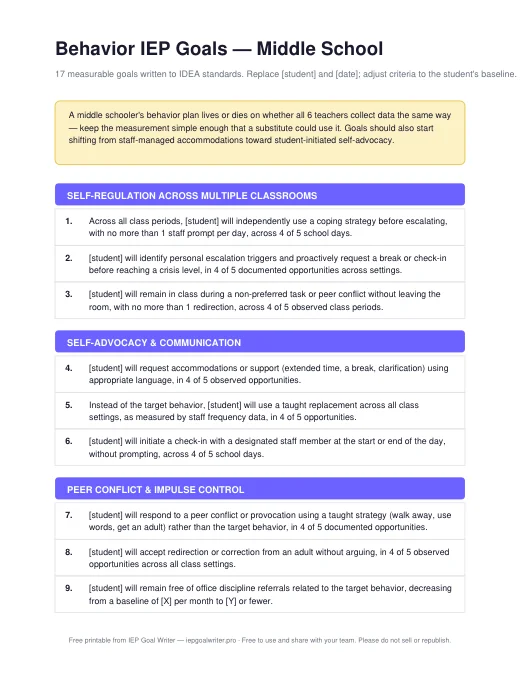
Behavior Goals — Middle School
17 behavior goals built for a 6-period day: consistent data across teachers, self-advocacy, peer conflict, and reducing target behaviors across classes.
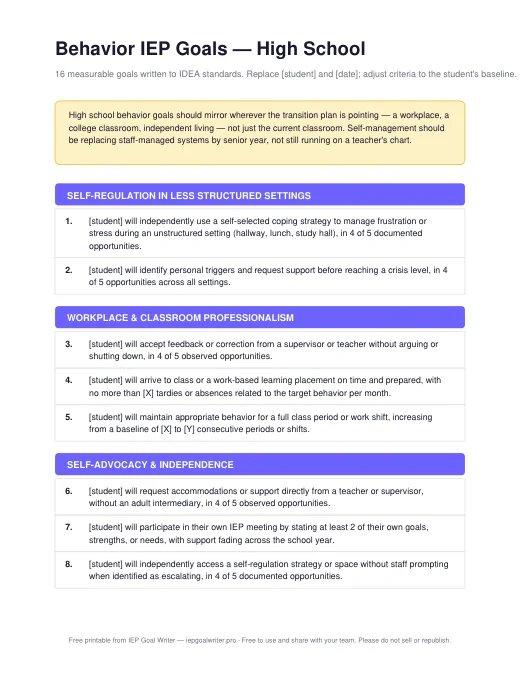
Behavior Goals — High School
16 transition-tied behavior goals: workplace professionalism, self-advocacy, and a self-management system that replaces the staff-run chart.
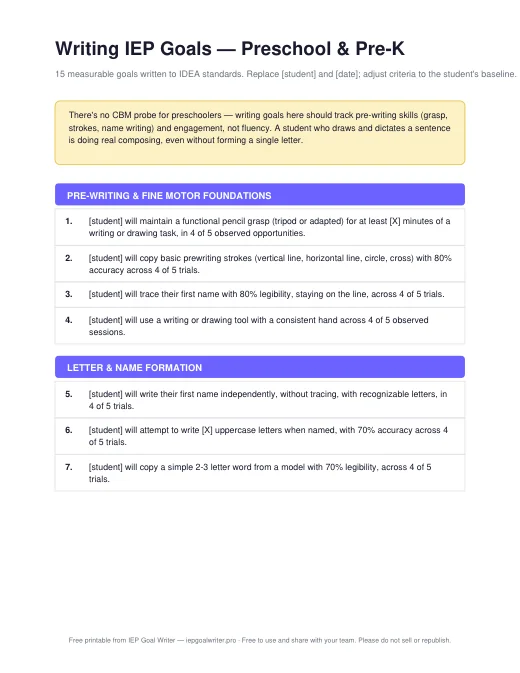
Writing Goals — Preschool & Pre-K
15 writing goals built around pre-writing skills and engagement, not fluency: pencil grasp, prewriting strokes, name writing, and composing through dictation.
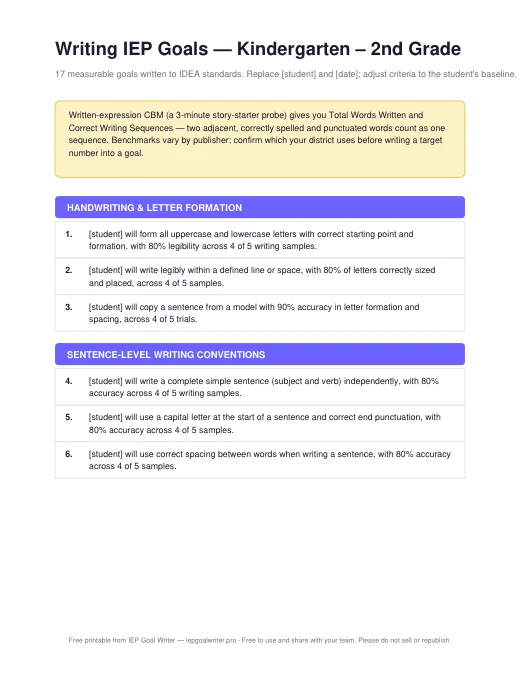
Writing Goals — K to 2nd Grade
17 writing goals with real CBM written-expression measures: handwriting, sentence conventions, correct writing sequences, spelling, and the writing process.
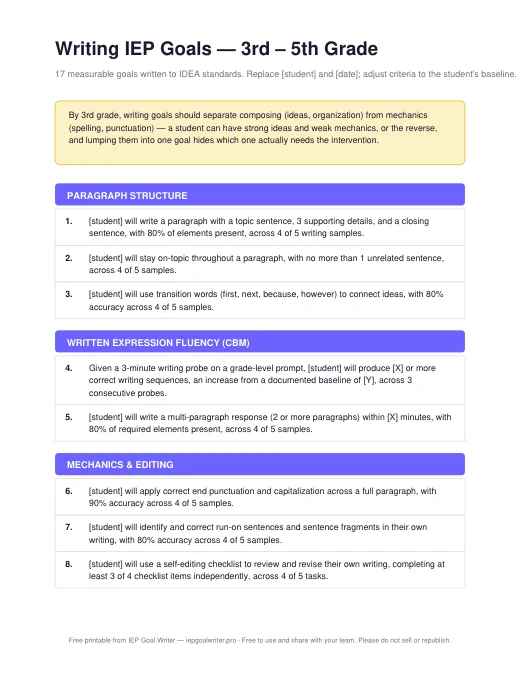
Writing Goals — 3rd to 5th Grade
17 writing goals that split ideas from mechanics on purpose: paragraph structure, CBM fluency, editing checklists, spelling, and narrative and opinion writing.
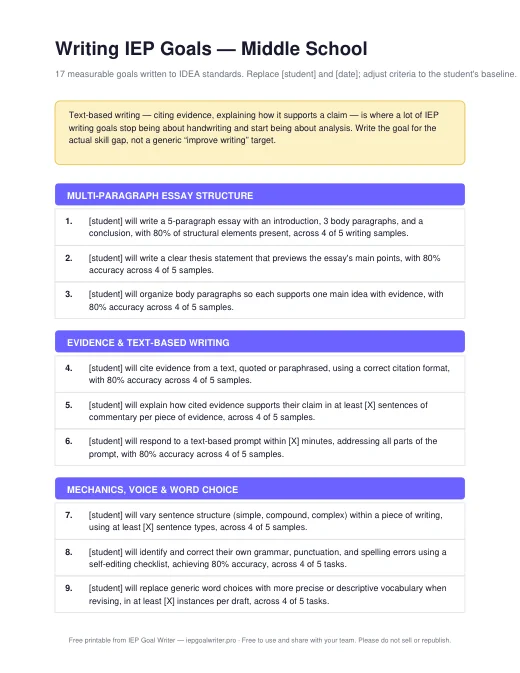
Writing Goals — Middle School
17 writing goals where mechanics gives way to analysis: essay structure, citing evidence, sentence variety, note-taking, and typing fluency.
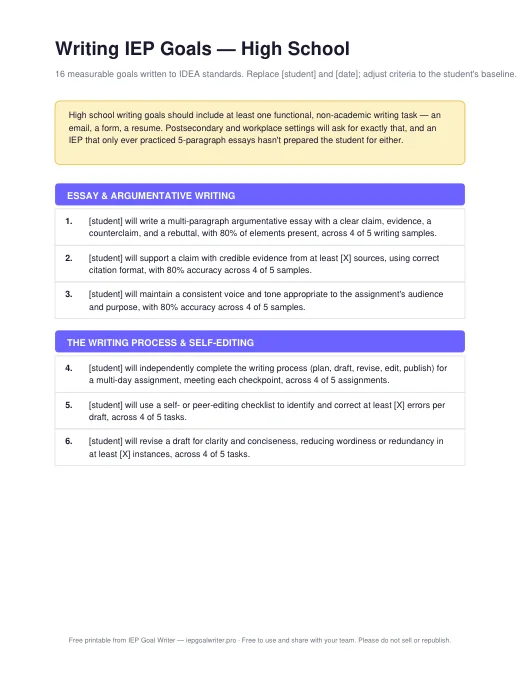
Writing Goals — High School
16 transition-tied writing goals: argumentative essays, professional email and applications, resume drafts, and typing fluency.
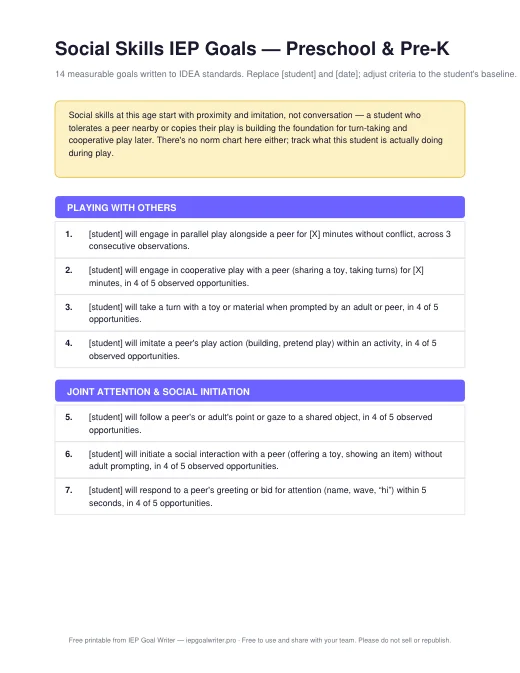
Social Skills Goals — Preschool & Pre-K
14 social skills goals starting with proximity and imitation, not conversation: parallel and cooperative play, joint attention, and recognizing emotions.
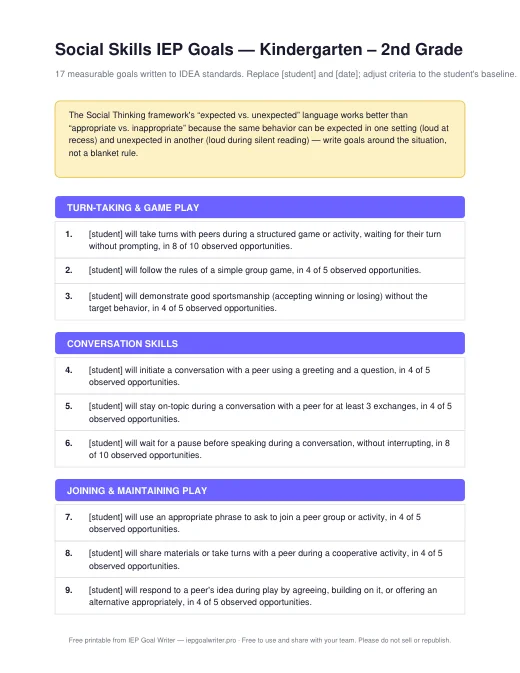
Social Skills Goals — K to 2nd Grade
17 social skills goals using the Social Thinking “expected vs. unexpected” framework: turn-taking, conversation, joining play, and friendship.
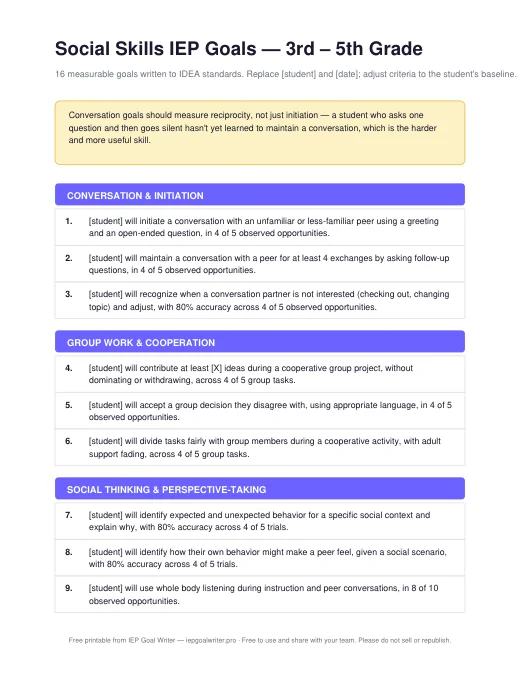
Social Skills Goals — 3rd to 5th Grade
16 social skills goals that measure conversation by reciprocity: group work, perspective-taking, conflict resolution, and friendship.
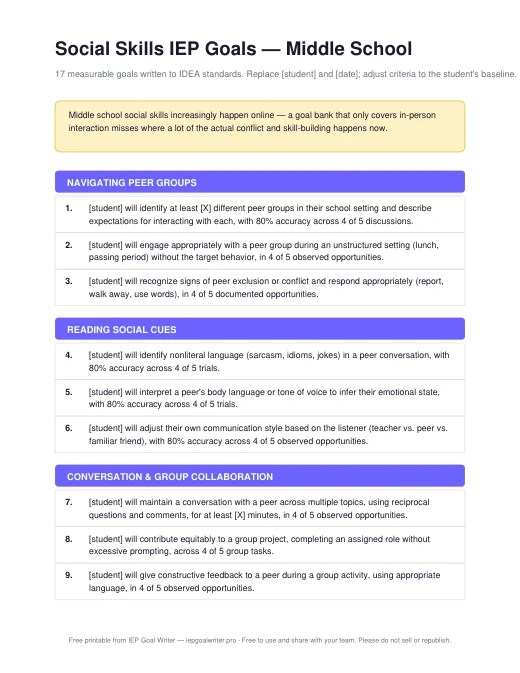
Social Skills Goals — Middle School
17 social skills goals including a section most goal banks skip: digital and online social skills, alongside peer groups and friendship.
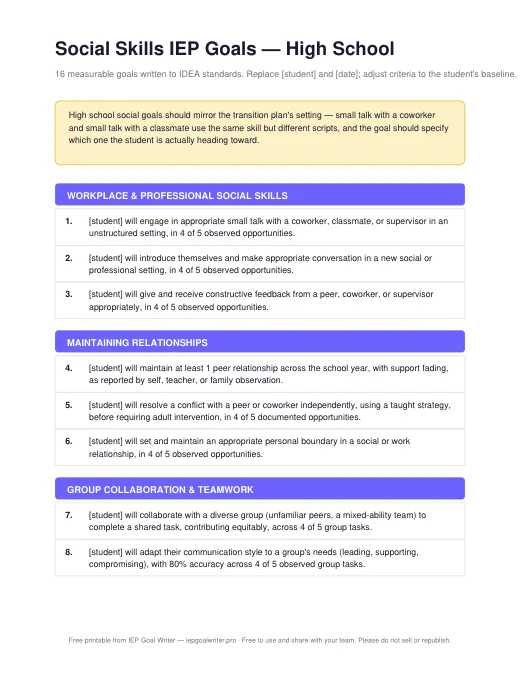
Social Skills Goals — High School
16 transition-tied social skills goals: workplace small talk, teamwork with diverse groups, self-advocacy, and unstructured settings.
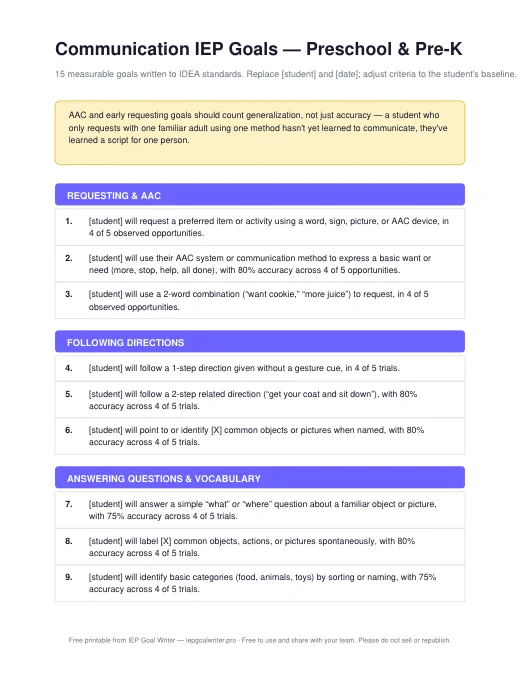
Communication Goals — Preschool & Pre-K
15 communication goals that count generalization, not just accuracy: requesting, AAC, following directions, and early expressive language.
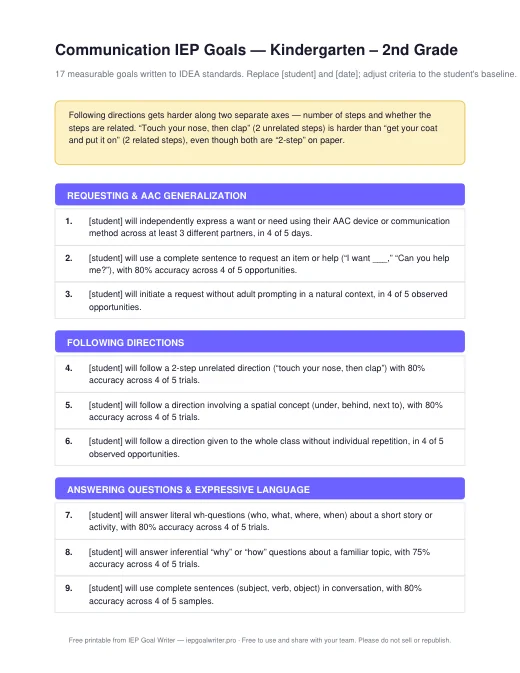
Communication Goals — K to 2nd Grade
17 communication goals that separate direction difficulty into two dials: AAC, wh-questions, grammar, articulation, and narrative retell.
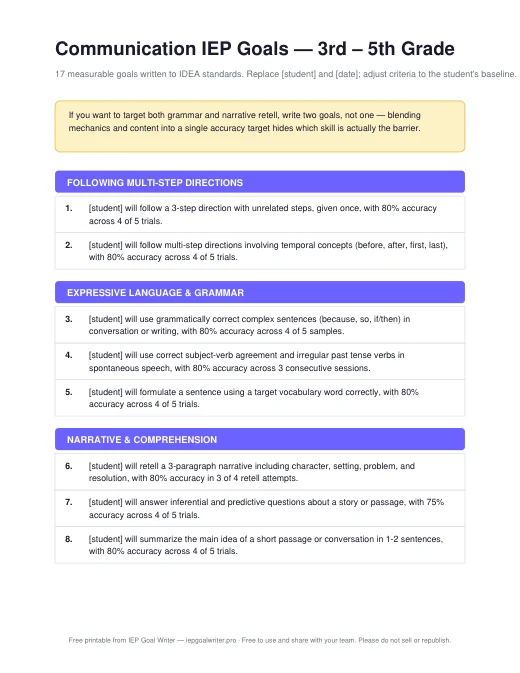
Communication Goals — 3rd to 5th Grade
17 communication goals that split mechanics from content: multi-step directions, grammar, narrative retell, articulation, and AAC use.
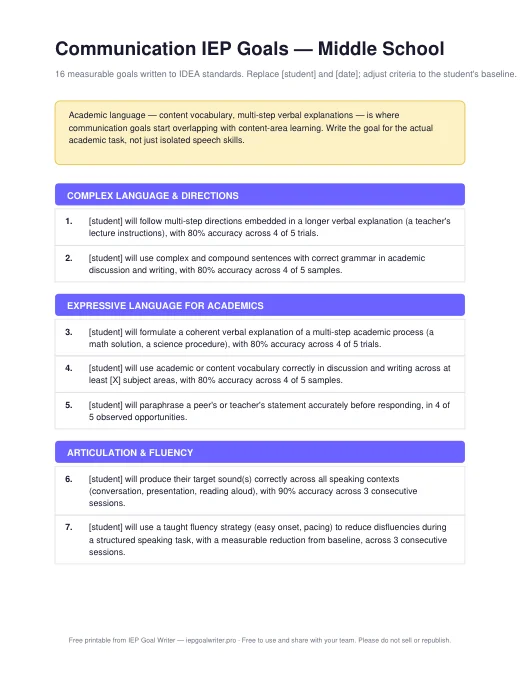
Communication Goals — Middle School
16 communication goals targeting the actual academic task: content vocabulary, fluency, figurative language, and AAC independence.
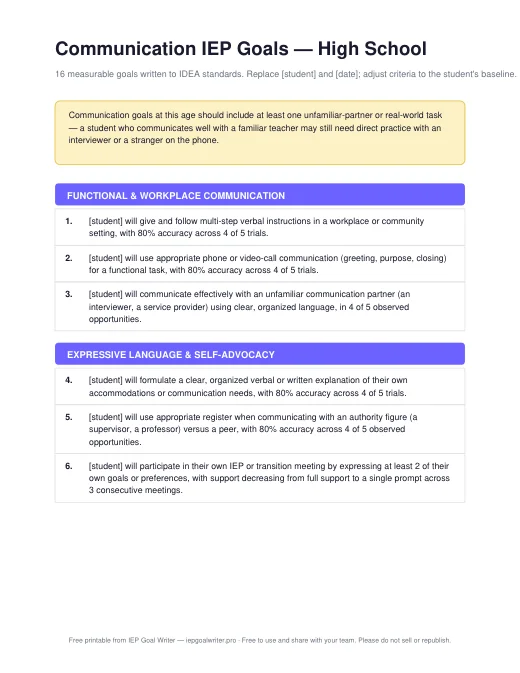
Communication Goals — High School
16 transition-tied communication goals: workplace phone calls, unfamiliar partners, self-advocacy, and AAC training.
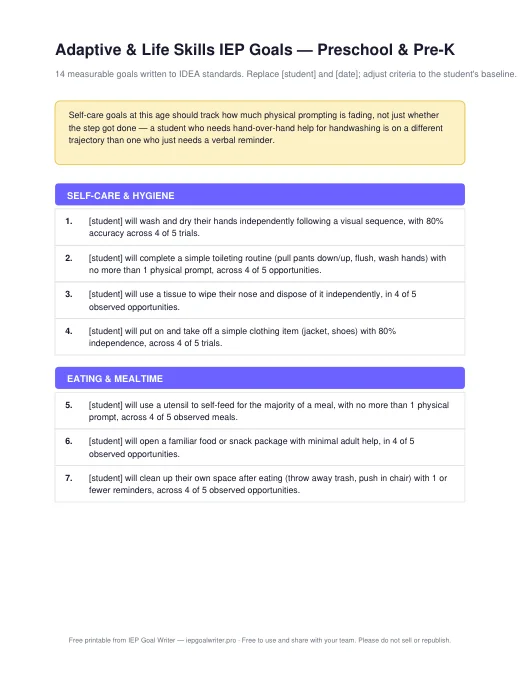
Life Skills Goals — Preschool & Pre-K
14 life skills goals that track how much prompting is fading, not just whether the step got done: self-care, mealtime, routines, and safety.
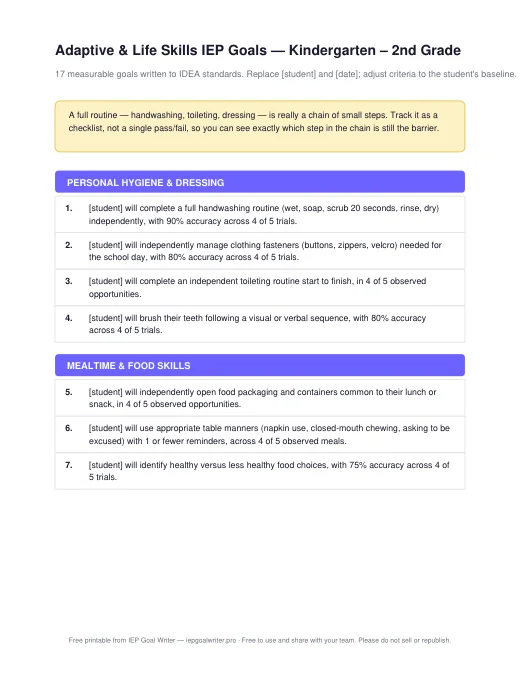
Life Skills Goals — K to 2nd Grade
17 life skills goals that break routines into a checklist of small steps: hygiene, mealtime, money and time, chores, and safety.
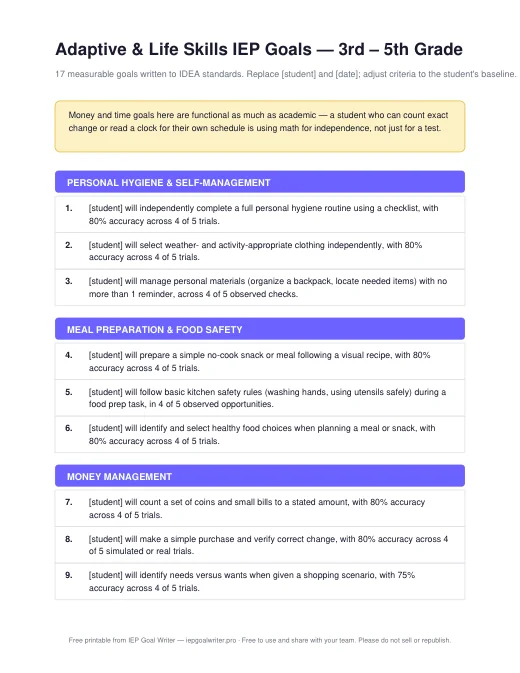
Life Skills Goals — 3rd to 5th Grade
17 life skills goals where money and time are functional as much as academic: hygiene, meal prep, budgeting basics, and safety.
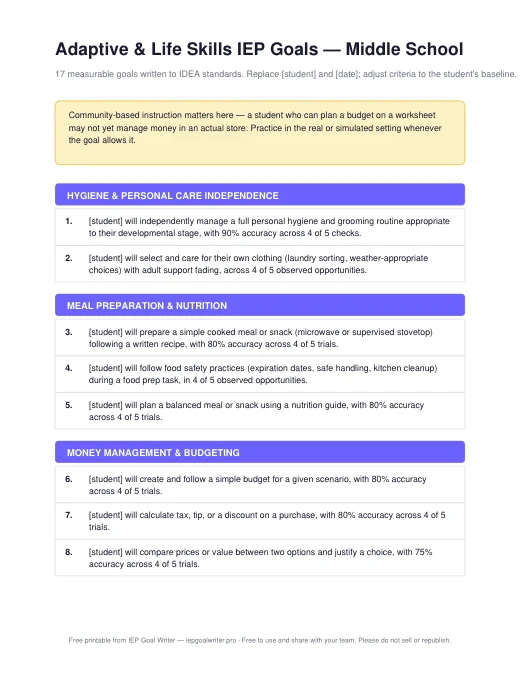
Life Skills Goals — Middle School
17 life skills goals pushed toward real or simulated settings: meal prep, budgeting, transportation, and digital life skills.
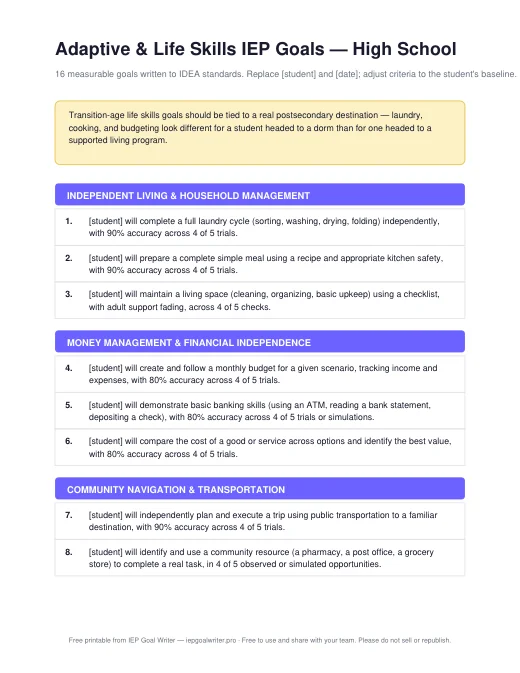
Life Skills Goals — High School
16 transition-tied life skills goals: laundry and cooking, budgeting and banking, transportation, health, and job readiness.
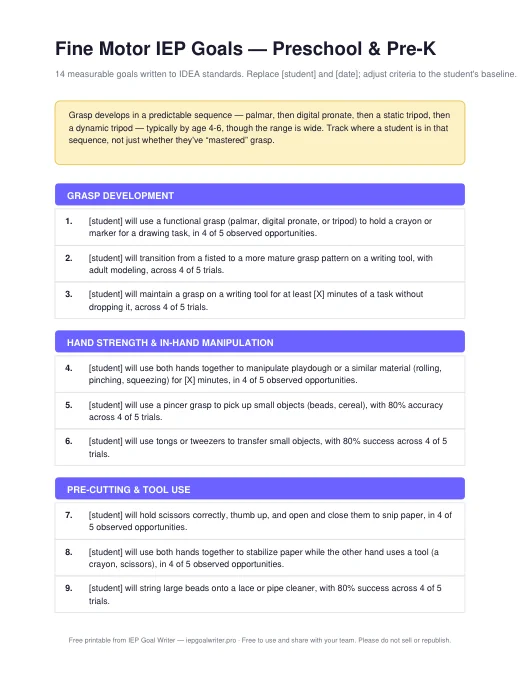
Fine Motor Goals — Preschool & Pre-K
14 fine motor goals that track where a student is in the real grasp-development sequence: hand strength, pre-cutting, and visual-motor skills.
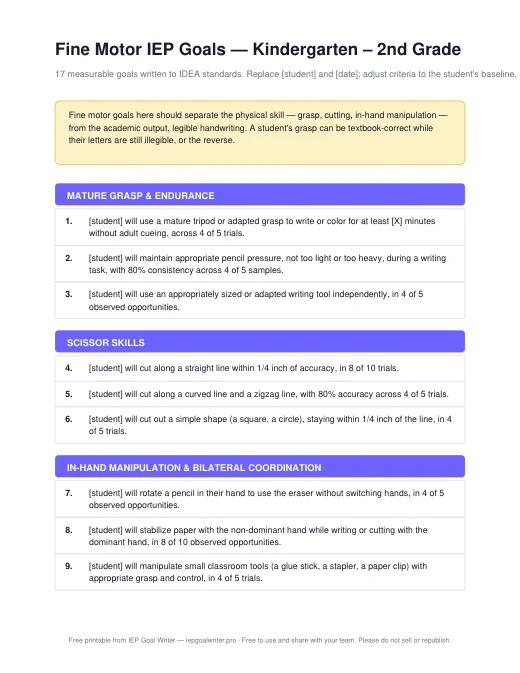
Fine Motor Goals — K to 2nd Grade
17 fine motor goals that separate grasp from handwriting output: scissor skills, in-hand manipulation, visual-motor tasks, and daily living.
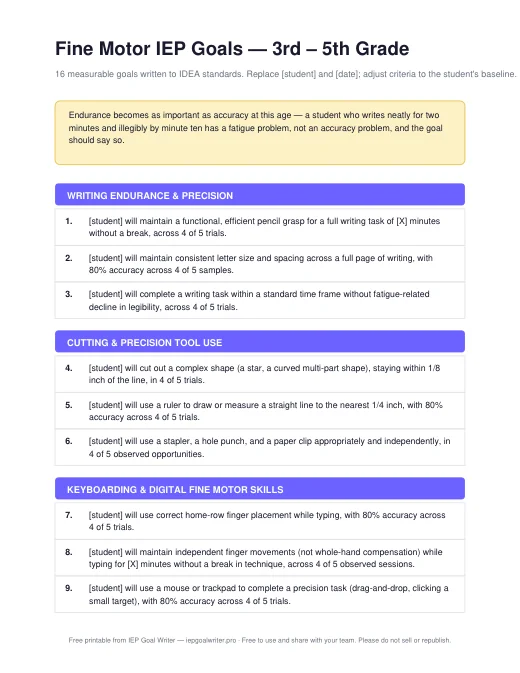
Fine Motor Goals — 3rd to 5th Grade
16 fine motor goals where endurance matters as much as accuracy: writing stamina, cutting precision, keyboarding, and visual-motor skills.
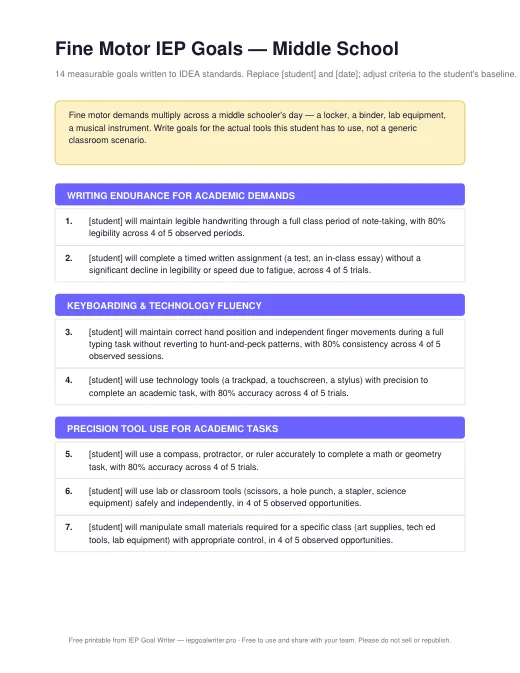
Fine Motor Goals — Middle School
14 fine motor goals written for a middle schooler's actual tools: note-taking endurance, keyboarding, lab equipment, and ergonomics.
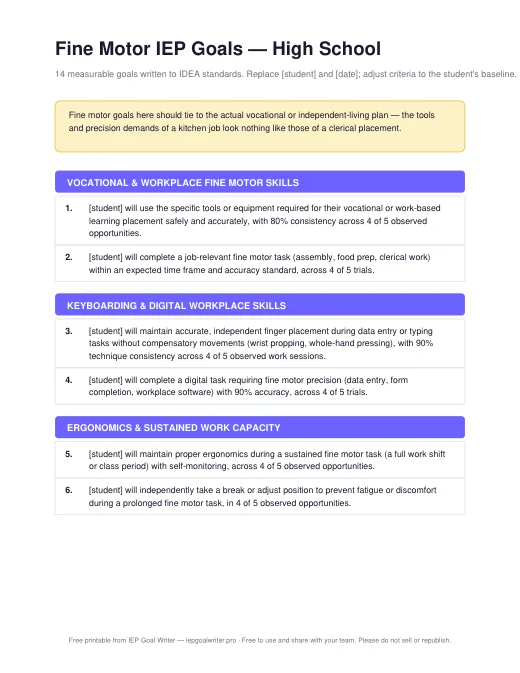
Fine Motor Goals — High School
14 transition-tied fine motor goals: vocational tools, workplace keyboarding, ergonomics, adaptive equipment, and independent living.
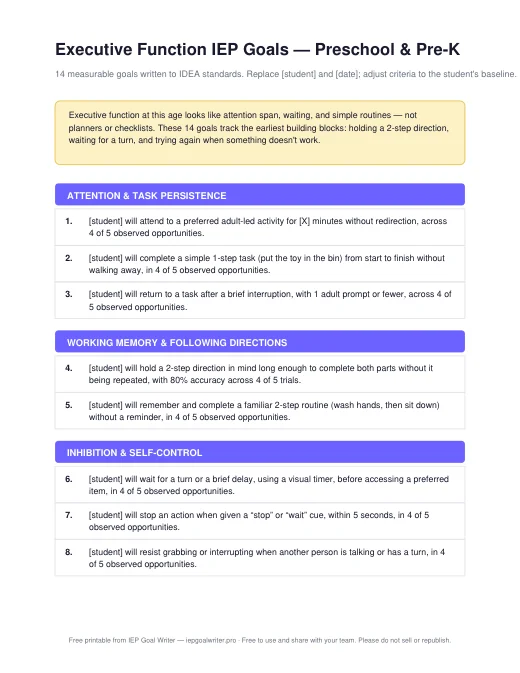
Executive Function Goals — Preschool & Pre-K
14 executive function goals tracking the earliest building blocks: attention span, holding a 2-step direction, waiting, and trying again.
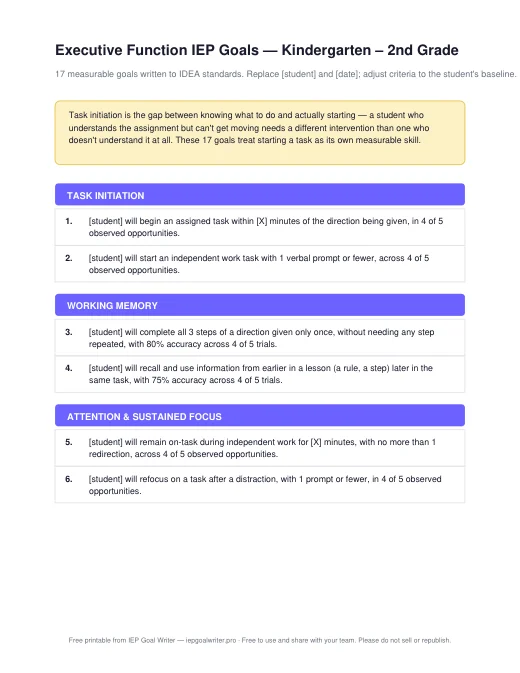
Executive Function Goals — K to 2nd Grade
17 executive function goals that treat task initiation as its own skill: working memory, organization, self-monitoring, and impulse control.
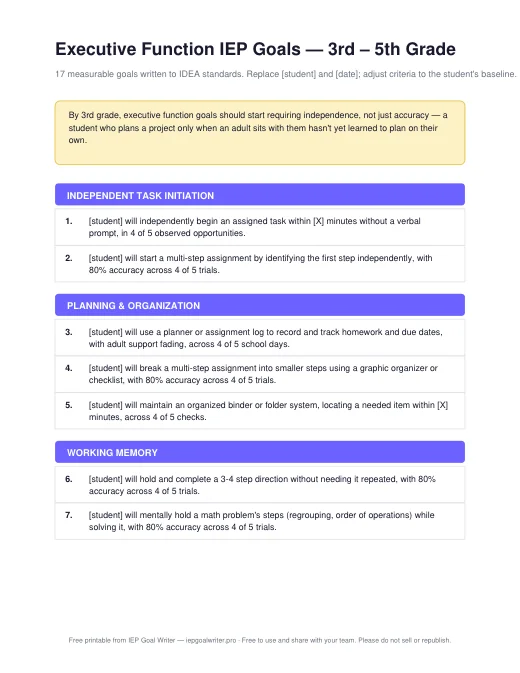
Executive Function Goals — 3rd to 5th Grade
17 executive function goals that push toward independence, not just accuracy: planning, working memory, flexibility, and time management.
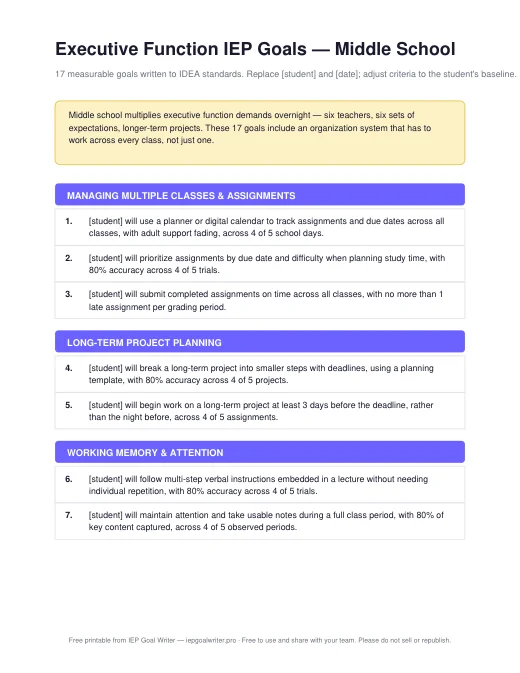
Executive Function Goals — Middle School
17 executive function goals built for a 6-class schedule: multi-class organization, long-term projects, and self-advocacy.
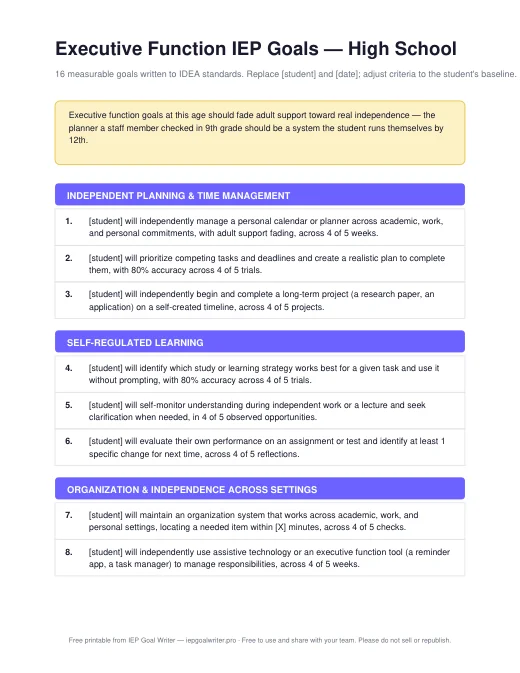
Executive Function Goals — High School
16 transition-tied executive function goals: independent planning, self-regulated learning, and fading adult support toward real independence.
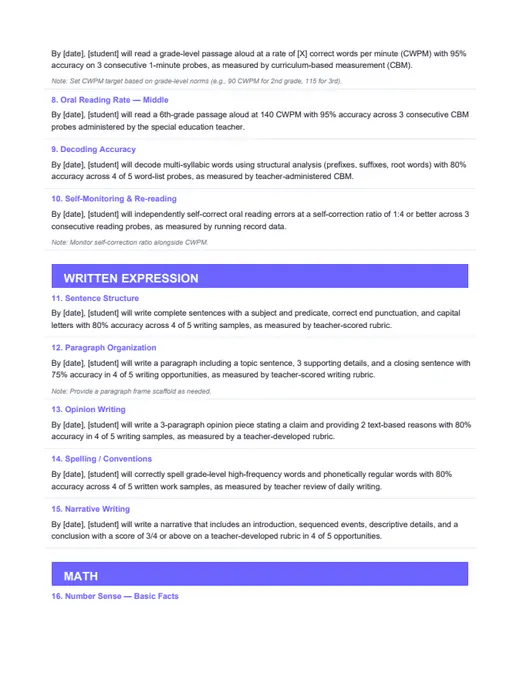
IEP Goal Bank — 45+ measurable goals
Goals across reading, math, writing, behavior, social skills, communication, and transition — each written to IDEA standards with criteria and an evaluation method.
IEP Data Sheet Bundle — 9 sheets
Discrete trial, ABC, interval, frequency, duration, prompt level, task analysis, fluency, and weekly summary — plus a guide on which sheet fits which goal.
Substitute Binder for SPED
A sub binder written for special education rooms — staff assignments, student quick reference with a "do NOT do this" column, behavior page, and 5 no-prep activities.
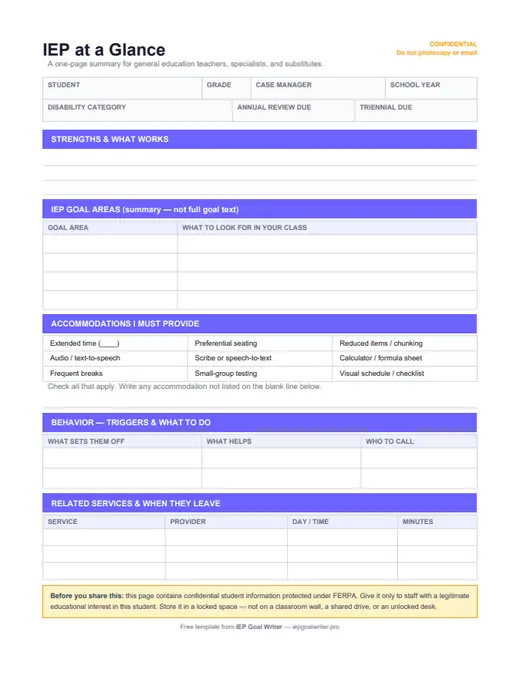
IEP at a Glance
The one-page student summary you hand to general education teachers, specials teachers, and subs instead of a 20-page IEP.
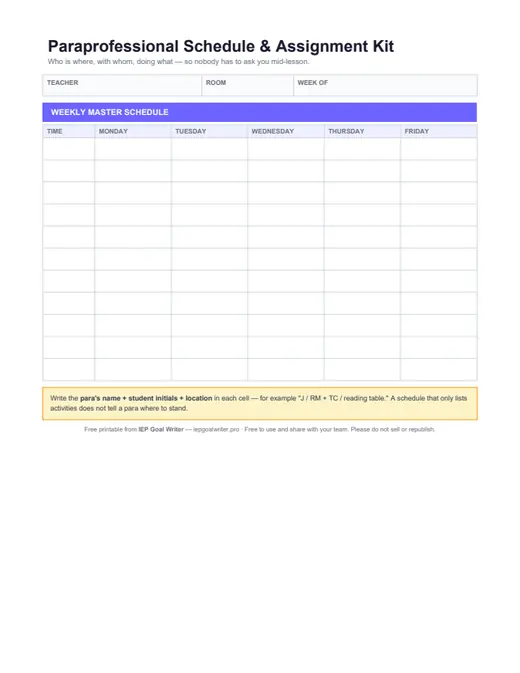
Paraprofessional Schedule Kit
Weekly master grid, daily assignment grid, cut-out station cards, and a one-page expectations sheet that prevents most para friction.
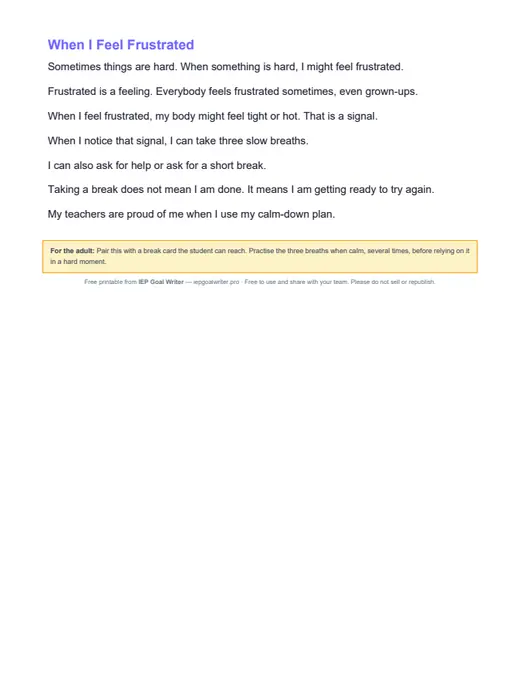
Social Stories: Big Feelings
9 social stories for frustration, anger, loud sounds, waiting, and calming down — first person, positive, with a teacher note on each.
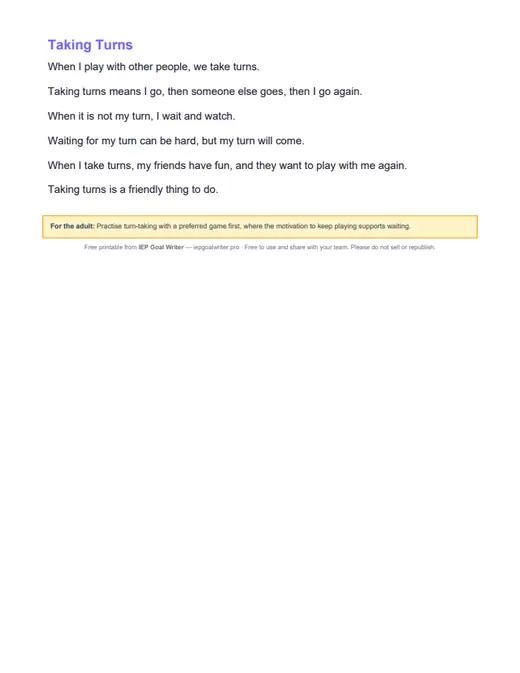
Social Stories: Getting Along
9 social stories for taking turns, losing a game, sharing, personal space, and kind words — including the hardest one, losing calmly.
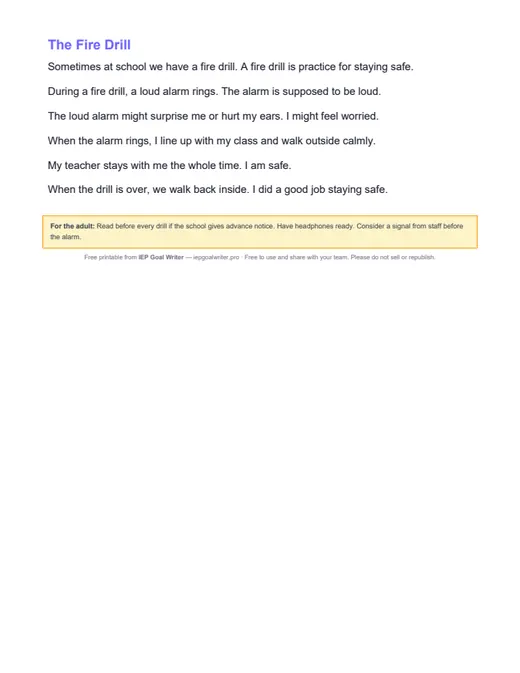
Social Stories: School Routines
9 social stories for fire drills, substitutes, schedule changes, field trips, and transitions — the unpredictable parts of the day.
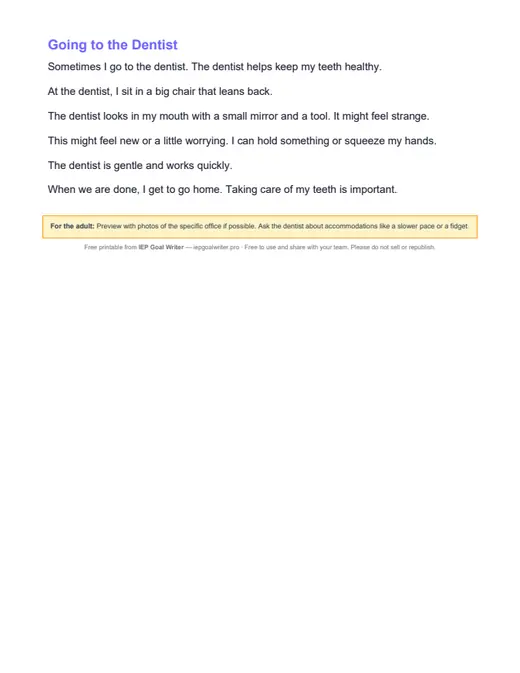
Social Stories: Body & Self-Care
9 social stories for the dentist, haircut, doctor, shots, and hygiene — appointments that involve new people and being touched.
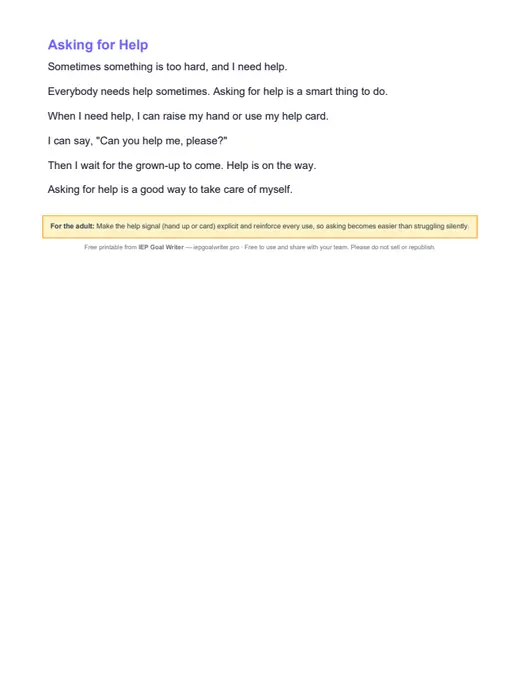
Social Stories: Speaking Up
9 social stories for asking for help, requesting a break, saying no politely, and self-advocacy — the skill that outlives the IEP.
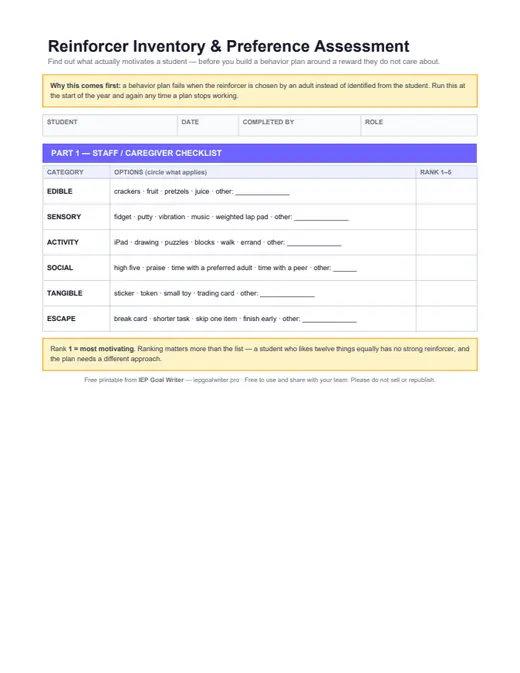
Reinforcer Inventory & Preference Assessment
Staff checklist, student interview, forced-choice trials, and a top-5 preference hierarchy — run this before writing a behavior plan.
Parent Communication Set
Daily home–school sheet, weekly summary, and the dated communication log that serves as your documentation record in a dispute.
Save each student once, then generate goals, PLAAFPs, progress notes, and parent updates from the same data — instead of retyping it onto the seventh form of the week.
Try it free — 20 generations