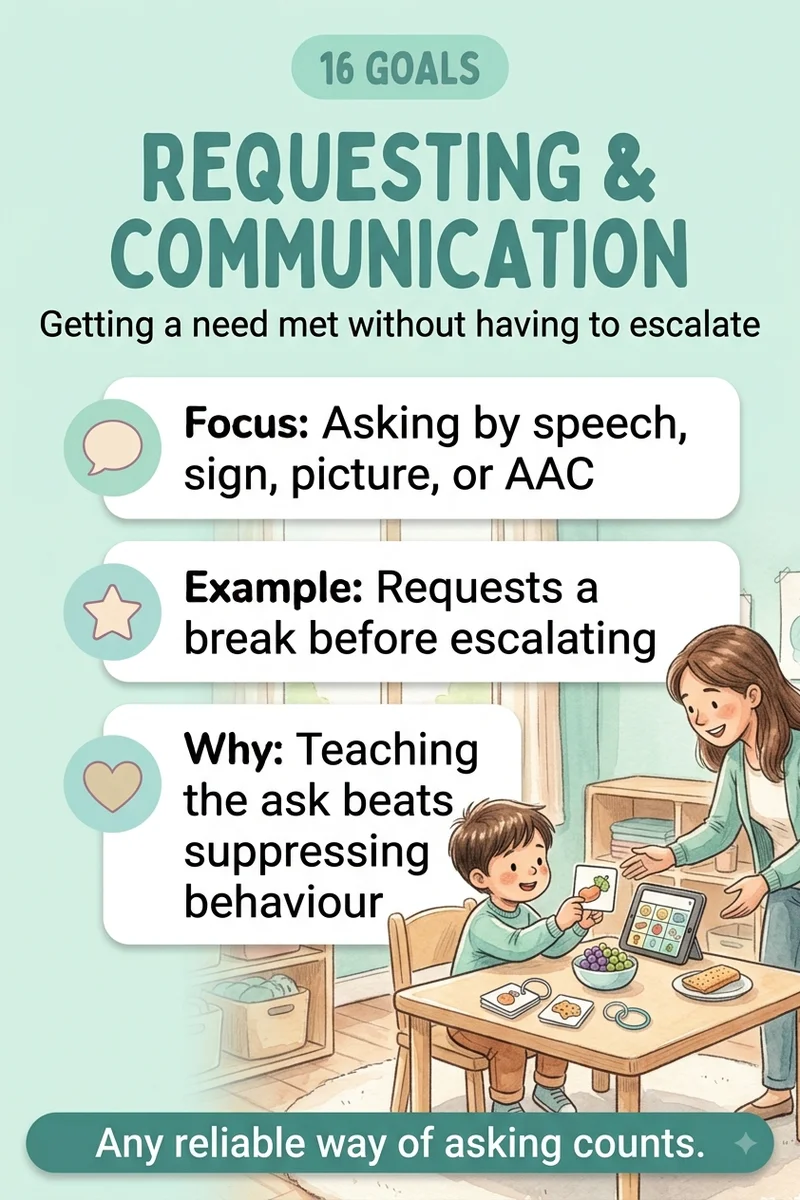
16 Requesting & Functional Communication IEP Goals, Preschool Through High School
Requesting is the highest-leverage communication goal in special education, because a student with no efficient way to ask will find an inefficient one — and that inefficient one is usually what gets written up as a behaviour. Teaching the request is faster than suppressing the behaviour.
Free · no email required · opens your browser's print dialog
Preschool & Pre-K
- 1[student] will request a preferred item or activity using a word, sign, picture, or AAC device, in 4 of 5 observed opportunities.
- 2[student] will use their AAC system or communication method to express a basic want or need (more, stop, help, all done), with 80% accuracy across 4 of 5 opportunities.
- 3[student] will use a 2-word combination (“want cookie,” “more juice”) to request, in 4 of 5 observed opportunities.
Kindergarten – 2nd
- 4Instead of the target behavior, [student] will use a taught replacement (raising a hand, requesting a break, asking for help) in 4 of 5 opportunities, as measured by staff frequency data.
- 5[student] will request a break using an agreed-upon signal before escalating, in 4 of 5 observed opportunities across 3 consecutive weeks.
- 6[student] will ask an adult for help when stuck on a task, rather than engaging in the target behavior, in 4 of 5 observed opportunities.
- 7[student] will independently express a want or need using their AAC device or communication method across at least 3 different partners, in 4 of 5 days.
- 8[student] will use a complete sentence to request an item or help (“I want ___,” “Can you help me?”), with 80% accuracy across 4 of 5 opportunities.
- 9[student] will initiate a request without adult prompting in a natural context, in 4 of 5 observed opportunities.
3rd – 5th Grade
- 10Instead of the target behavior, [student] will use a taught replacement (verbal request, break card, self-advocacy statement) across all observed settings, in 4 of 5 opportunities, as measured by staff data.
- 11[student] will independently request a break, using an agreed-upon method, before reaching an escalated state, in 4 of 5 observed opportunities across 3 consecutive weeks.
- 12[student] will accept “no” or a denied request from an adult without engaging in the target behavior, in 4 of 5 observed opportunities.
- 13[student] will use their AAC device to participate in classroom discussions or group work, initiating at least [X] comments, across 4 of 5 sessions.
- 14[student] will independently troubleshoot or request support for their AAC device (low battery, navigation) when needed, in 4 of 5 documented opportunities.
- 15[student] will use their communication system across academic and social contexts with at least 80% independence, across 4 of 5 observed settings.
- 16[student] will use a taught script or sentence starter to participate in a group discussion, in 4 of 5 observed opportunities.
How to teach requesting & functional communication in the classroom
Functional communication is taught by making the request easier and faster than the behavior it replaces. Identify what the student is currently communicating through the challenging behavior — escape, attention, access, help — and teach a replacement that gets the same result: a word, a sign, a card, a device message. Honor the replacement immediately and every time at first, even when the timing is inconvenient, so the student learns it works. Prompt the new request just before the student would otherwise escalate, and fade the prompt as the student initiates. Keep the response effort low — the request must be something the student can do quickly under stress. Once the replacement is solid, gradually teach waiting and accepting "not right now." Every adult around the student has to respond the same way, or it will not hold.
How to measure it
Accept any reliable modality. A goal that specifies "will verbally request" scores an AAC user as failing even when they communicated successfully. Write "using speech, sign, or AAC" unless the team specifically intends to target spoken output.
Where these goals come from
Each goal above is drawn from a grade-band goal bank, where you can see it alongside the other targets it is usually paired with: Behavior goals, 3rd – 5th Grade; Behavior goals, Kindergarten – 2nd Grade; Communication goals, 3rd – 5th Grade; Communication goals, Kindergarten – 2nd Grade; Communication goals, Preschool & Pre-K.
Related skills
A flat following-directions goal is often really a breakdown in one of these skills. If the data does not move, check whether the real target is here instead:
- Self-Advocacy IEP goals — asking for what you need, from an adult who does not already know
- Peer Interaction IEP goals — starting, holding, and repairing a conversation or a friendship with another student
- Following Directions IEP goals — doing what was asked, the first time, without it being repeated
Common questions
What is functional communication training?
Teaching a student to get a need met — escape, attention, access, help — through an appropriate request (a word, sign, card, or device message) instead of through challenging behavior. The replacement has to produce the same result, quickly, or the student will keep using the behavior that works.
Does the student need to be nonverbal for this?
No. Verbal students often escalate because their words are not honored fast enough or they lack the specific phrase for the situation. Functional communication goals can target a spoken script, not just AAC.
How do you measure a functional communication goal?
Track the replacement request: how often the student uses it independently to get the identified need met, and the corresponding drop in the challenging behavior it replaced. Both directions matter — the new behavior going up and the old one going down.
Further reading
Need a goal built from your student's baseline? Generate one for your student →