20 IEP Goals for English Learners With IEPs
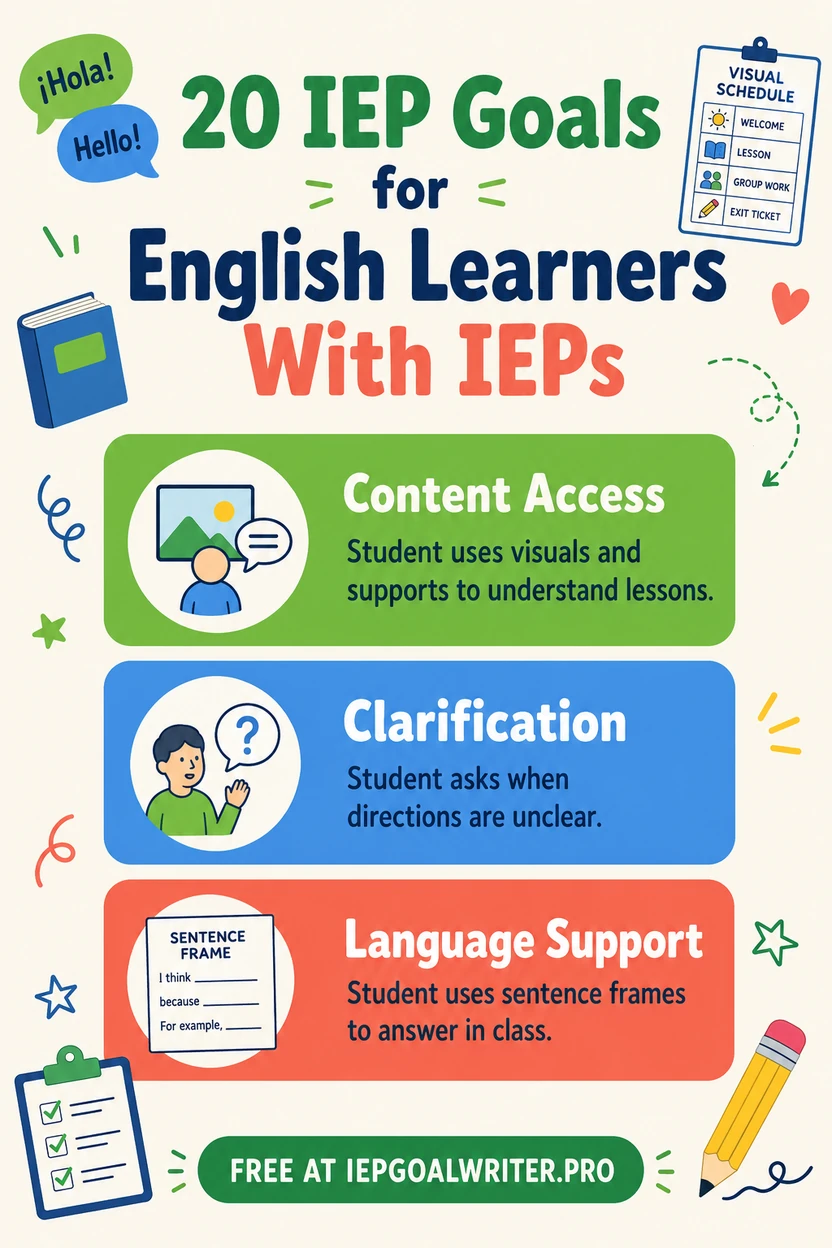
IEP goals for an English learner with an IEP must address a disability-related need, not normal second-language development. For example: By [date], [student] will use a visual organizer and home-language/English glossary to identify two key details in grade-level science text in 4 of 5 probes, as measured by curriculum-based data.
An English learner can receive both English language development and special education. Federal IDEA regulations require teams to consider language needs, and limited English proficiency cannot by itself be the determining factor for disability eligibility. These goals separate language acquisition from documented disability-related needs by naming the content task, the language-access supports, and the data source. Plan with educators who understand the student’s language development, family context, and instructional history—not with English-only data alone.
Separating Language Acquisition From Disability
- 1.By [date], [student] will demonstrate the target disability-related skill on a task presented with the language-access supports listed in the IEP with at least 80% accuracy across 3 consecutive probes, as measured by curriculum-based measures using documented language supports.
- 2.By [date], [student] will complete parallel versions of the same skill task with familiar vocabulary and new academic vocabulary with no more than a 10-percentage-point difference across 3 probe pairs, as measured by paired work-sample analysis.
- 3.By [date], [student] will use a taught strategy for the identified disability-related skill during both English-language development and content instruction in 4 of 5 observed opportunities across 2 settings, as measured by cross-setting strategy-use tally data.
- 4.By [date], [student] will respond to a skill probe using the student’s permitted language or communication supports without an adult simplifying the target skill itself in 4 of 5 trials, as measured by special-education progress-monitoring records.
- 5.By [date], [student] will identify whether a breakdown is caused by an unfamiliar English word or by the target academic strategy and select the matching help option with 80% accuracy across 10 structured examples, as measured by student problem-identification probe data.
Comprehension and Content Access
- 1.By [date], [student] will identify the main idea of a grade-level content paragraph after using the assigned visuals, previewed vocabulary, or bilingual support in 4 of 5 passages, as measured by reading-comprehension work samples.
- 2.By [date], [student] will follow a 3-step classroom direction supported by pictures, gestures, or written cues with all 3 steps completed in 4 of 5 opportunities, as measured by direction-following task-analysis data.
- 3.By [date], [student] will use a graphic organizer to record at least 3 key details from teacher-presented content in 4 of 5 lessons, as measured by completed organizer rubric data.
- 4.By [date], [student] will match 8 of 10 targeted academic vocabulary words to pictures, examples, definitions, or cognates as appropriate across 3 consecutive probes, as measured by teacher vocabulary probe data.
- 5.By [date], [student] will answer a content question with the required idea and use the student’s current English proficiency supports for wording with the content idea correct in 4 of 5 opportunities, as measured by content-response rubric data.
Self-Advocacy Across Languages
- 1.By [date], [student] will ask whether an unfamiliar word, direction, or task expectation can be clarified using the student’s established communication mode in 4 of 5 breakdowns, as measured by clarification-request tally data.
- 2.By [date], [student] will request a visual, model, repetition, or bilingual resource when one of those supports is listed for access in 4 of 5 appropriate opportunities, as measured by self-advocacy checklist data.
- 3.By [date], [student] will tell a teacher whether the student understands the academic concept but needs language support to express the answer in 4 of 5 structured conference opportunities, as measured by student self-report rubric data.
- 4.By [date], [student] will use an approved bilingual glossary, translation support, or vocabulary tool to locate meaning before asking an adult for the answer in 4 of 5 opportunities, as measured by resource-use checklist data.
- 5.By [date], [student] will participate in a progress check by naming one helpful language support and one special-education strategy that improved the task with both elements in 4 of 5 reviews, as measured by student conference notes.
Participation With Visual Supports
- 1.By [date], [student] will use a visual sequence to complete a 4-step grade-level classroom task with at least 3 of 4 steps independent in 4 of 5 opportunities, as measured by task-analysis data.
- 2.By [date], [student] will use a sentence frame, word bank, or model to produce a response containing the required academic idea in 4 of 5 work samples, as measured by teacher rubric data.
- 3.By [date], [student] will locate and use one visual cue from the page, board, or digital lesson to answer a content question in 4 of 5 opportunities, as measured by visual-support use tally data.
- 4.By [date], [student] will participate in a partner or small-group task by contributing at least 2 relevant messages using speech, writing, AAC, or the student’s permitted language supports in 4 of 5 group sessions, as measured by participation event recording.
- 5.By [date], [student] will transition from a modeled example to an independent parallel example using the same visual support with 80% accuracy across 10 paired trials, as measured by guided-to-independent work samples.
A Worked Example: One Student, PLAAFP to Data Plan
Present levels: Diego is developing English and reads connected Spanish text more fluently than comparable English text. In science, with a bilingual glossary and picture organizer, he identified a key detail in 8 of 10 tasks using Spanish, English, or both; without the visual organizer he identified a key detail in 4 of 10 and often copied a peer. Evaluation data show a disability-related difficulty organizing information across both languages, while English-development data show expected growth in vocabulary. His strength is explaining concepts orally in Spanish when the task structure is clear. The educational impact is difficulty extracting and organizing content information even when language access is provided.
Annual goal derived from that baseline: By [date], given grade-level content, a visual organizer, and the language-access supports documented in the IEP, Diego will identify the main idea or task focus and record at least 2 relevant supporting details in the response mode and language(s) permitted by the team in 4 of 5 work samples, as measured by a content-organization rubric. Specially designed instruction should explicitly teach how to use the organizer, identify task language, locate evidence, and transfer the routine across subjects; English-language development instruction remains a separate but coordinated service.
Goal versus accommodation: Bilingual glossaries, visuals, clarified directions, interpreter/translation supports for family participation, and appropriate language scaffolds can be access supports. The annual goal targets the disability-related skill under those conditions. The team should not write an IEP goal simply to accelerate ordinary second-language acquisition or measure English exposure as if it were a disability.
Data plan: Record which language-access supports were available and keep the academic skill rubric stable. Where valid and feasible, compare performance across languages or use bilingual assessment information so the team can see whether the difficulty is cross-linguistic. Review progress with both special education and multilingual-learner staff; a change in English proficiency level should not silently change the goal’s scoring conditions.
How These Goals Change by Grade Band
For young multilingual learners, use routines, objects, pictures, gestures, home-language information, and family input to establish what the student understands before attributing a difficulty to disability. IEP goals should target a skill that is demonstrably affected beyond ordinary language acquisition, such as following a visual task sequence, phonological processing documented across languages, or using a communication support.
In grades 3–5, goals can target content comprehension, written organization, clarification/self-advocacy, or a disability-related literacy skill while language supports remain explicit. The progression should increase independence with the academic routine, not remove bilingual or visual access simply because scores improve.
In middle and high school, connect goals to grade-level courses, graduation requirements, self-advocacy, and transition. Students may need to interpret complex task language, use glossaries strategically, request clarification, organize content responses, or manage assistive technology across classes. Always separate the English-development target from the IEP target in the data system so teams can tell which instructional program is producing which change.
Collecting Data Without Adding a Full-Time Job
Progress-monitor the disability-related skill under documented language-access conditions. Note the language of instruction and response, visuals, sentence frames, bilingual glossary, repeated/clarified directions, and other supports that materially affect the task. Without that context, a lower English-only score can be misread as disability-related regression.
Use measures that reduce unnecessary language load when the target is not language itself. For example, a math problem-solving goal can be scored with visuals and clarified vocabulary if the goal is selecting a representation, while a vocabulary goal obviously needs a defined language target. When possible, include work samples or assessment information across languages and consult staff qualified to interpret multilingual development.
Add a decision rule that protects against over-identification and under-identification. If the student improves rapidly when language access is added, investigate whether the original barrier was linguistic. If a specific difficulty persists across languages and tasks despite appropriate instruction, that pattern may support the existing disability-related instructional target—but the IEP team, not a goal bank, makes that determination.
Personalization warning: Being an English learner is not a disability and is not an IDEA eligibility category. Do not use IEP goals to remediate normal language acquisition. The team must distinguish language development, opportunity to learn, cultural/linguistic factors, and disability using appropriate evaluation data, then write goals only for the identified special-education needs.
FAQ
Paste your assessment data and generate an IDEA-compliant, individualized goal in seconds.
Try it free →