20 IEP Goals for Fetal Alcohol Spectrum Disorder
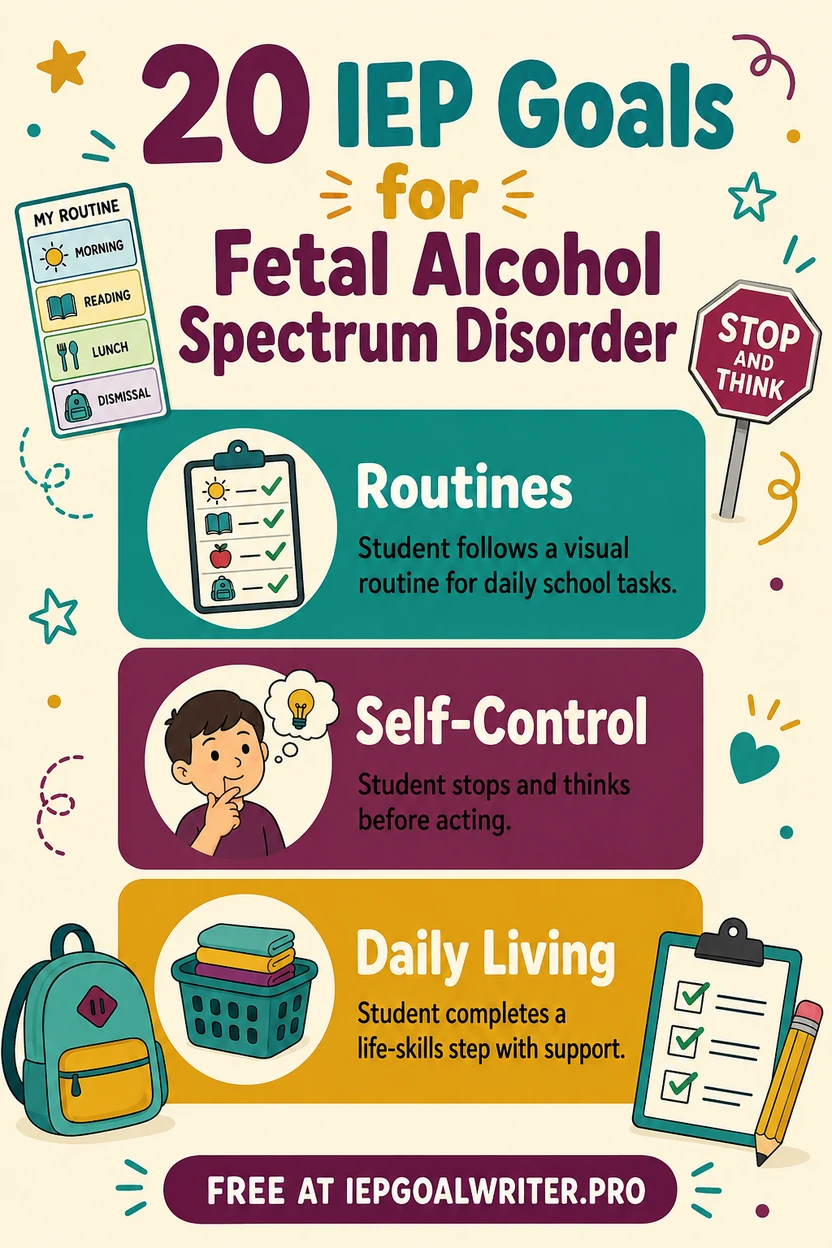
IEP goals for fetal alcohol spectrum disorder should target the specific school skill shown in baseline data, such as using a routine or applying a concrete math strategy. For example: By [date], [student] will use a visual three-step checklist to begin and complete the assigned routine in 4 of 5 opportunities, as measured by task-analysis data.
Fetal alcohol spectrum disorder is a medical or developmental term, not an IDEA eligibility category. A student’s eligibility and services depend on the evaluation, educational impact, and need for specialized instruction; teams may consider categories such as Other Health Impairment, Specific Learning Disability, Intellectual Disability, or another applicable category. These goals focus on teachable school outcomes: memory supports, self-control, adaptive routines, and concrete reasoning. Make the goal match the student’s functional baseline, not assumptions about a diagnosis.
Working Memory and Routines
- 1.By [date], [student] will use a visual 3-step routine card to complete the targeted classroom routine in the correct order with all 3 steps completed in 4 of 5 opportunities, as measured by task-analysis data.
- 2.By [date], [student] will repeat or show back a 2-step oral direction before beginning the task in 4 of 5 opportunities across 3 sessions, as measured by teacher direction-check data.
- 3.By [date], [student] will use an external memory support to locate the next required material or task step in 4 of 5 class periods with no more than 1 prompt, as measured by memory-support checklist data.
- 4.By [date], [student] will record one assignment, location, and due point in the established planner or digital system before leaving class in 80% of classes across 3 consecutive weeks, as measured by planner audit data.
- 5.By [date], [student] will complete a familiar routine after a 20-minute delay using the visual support without an adult reteaching the sequence in 4 of 5 opportunities, as measured by delayed-routine performance data.
Impulse Control and Decision-Making
- 1.By [date], [student] will pause for the taught 5-second check before acting in a teacher-selected high-risk classroom routine in 4 of 5 observed opportunities, as measured by impulse-control event recording.
- 2.By [date], [student] will state or indicate the expected outcome of 2 choices before selecting one during a structured school problem in 4 of 5 opportunities, as measured by decision-making rubric data.
- 3.By [date], [student] will use the agreed “stop-check-ask” routine before leaving the assigned area or changing tasks in 80% of relevant opportunities across 2 settings, as measured by routine-use tally data.
- 4.By [date], [student] will request adult help when a choice involves an unfamiliar rule, money, safety, or schedule change in 4 of 5 role-play or natural opportunities, as measured by help-seeking checklist data.
- 5.By [date], [student] will identify whether a classroom choice is safe/allowed, ask first, or stop-and-get-help from 3 options with 80% accuracy across 15 scenario trials, as measured by structured decision probe data.
Adaptive and Daily Living Skills
- 1.By [date], [student] will complete the individualized arrival or dismissal routine using a visual checklist with at least 80% of steps independent across 5 school days, as measured by daily-living task-analysis data.
- 2.By [date], [student] will organize the materials needed for the next class using a picture or written packing list in 4 of 5 transitions, as measured by materials checklist data.
- 3.By [date], [student] will follow a 4-step snack, meal, hygiene, or classroom-care routine identified by the team with at least 3 of 4 steps independent in 4 of 5 opportunities, as measured by adaptive-skill task analysis.
- 4.By [date], [student] will use the established schedule to arrive at the correct school location within the individualized time window in 4 of 5 transitions across 2 weeks, as measured by schedule-following data.
- 5.By [date], [student] will ask for a repeat, model, or visual reminder when the student cannot recall the next routine step in 4 of 5 breakdowns, as measured by self-advocacy tally data.
Concrete Math and Reasoning
- 1.By [date], [student] will represent a one-step practical math situation using objects, a drawing, or an equation before calculating in 4 of 5 problems, as measured by work-sample rubric data.
- 2.By [date], [student] will identify the relevant numbers and cross out one irrelevant number in a supported word-problem set with 80% accuracy across 10 problems, as measured by curriculum-based probe data.
- 3.By [date], [student] will use a calculator or number line after selecting the correct operation for a functional math task in 4 of 5 trials, as measured by teacher-scored task data.
- 4.By [date], [student] will compare 2 concrete quantities, prices, or time amounts and choose the larger/smaller or more/less option as asked with 80% accuracy across 15 trials, as measured by functional math probe data.
- 5.By [date], [student] will check a completed practical math answer against a visual estimate or reference chart and correct an unreasonable answer in 4 of 5 opportunities, as measured by error-analysis work samples.
A Worked Example: One Student, PLAAFP to Data Plan
Present levels: Carlos is friendly, participates well in hands-on lessons, and remembers routines that are visually posted and practiced in the same setting. Across 10 morning-routine observations, he independently completed an average of 2 of 4 steps; he required 3–5 adult reminders on 8 mornings and independently checked the pictured routine in only 1 observation. When a teacher pointed to the checklist, he completed the remaining steps in 7 of 9 opportunities. The educational impact is dependence on repeated adult prompting and lost transition time, not a generalized claim that Carlos “has poor memory.”
Annual goal derived from that baseline: By [date], given the student’s established visual routine, Carlos will independently check the support and complete all 4 morning steps with no more than 1 adult prompt in 4 of 5 school days across 3 consecutive weeks, as measured by task-analysis and prompt-level data. Specially designed instruction should teach the checklist as an external memory tool: orient to it, mark the current step, complete the action, return to the list, and practice the same sequence until use becomes efficient.
Goal versus accommodation: A pictured checklist, repeated language, reduced verbal load, extra processing time, or a consistent storage location may be accommodations. The goal is Carlos’s independent use of an external support and completion of a defined routine. The team should not remove the support to see whether he can “remember on his own” if the support is part of his access plan.
Data plan: Score each routine step and prompt level separately. Note whether Carlos independently consulted the external support before an adult supplied information. When the routine becomes stable, probe a related routine with the same support format rather than immediately adding more verbal directions. If errors cluster at one step, teach that step directly instead of treating the whole routine as equally weak.
How These Goals Change by Grade Band
For young students, use short, repeated routines with real objects, pictures, and immediate practice in the setting where the skill is needed. Goals should teach how to use external supports rather than expecting verbal memory to carry the routine. Concrete safety, transition, and communication skills often have more educational value than abstract self-monitoring language.
In grades 3–5, add independence with materials, one-step planning, simple time and money concepts, impulse-control routines, and explicit generalization from one familiar routine to another. Keep language concise and teach the support system itself—planner, checklist, model, calculator, or visual sequence—as part of the skill.
For older students, focus on portable systems that support secondary classes and transition: digital reminders, task chunking, safe community routines, budgeting with real tools, workplace checklists, and self-advocacy about instructions. The progression should increase independence with supports, not remove supports because the student is older. Abstract reasoning demands should be made concrete when that is what evaluation and classroom data show the student needs.
Collecting Data Without Adding a Full-Time Job
For memory and routine goals, score the external support the student is actually expected to use. Record which step broke down, whether the student independently checked the support, and the least prompt needed. A total “routine complete” score can hide that one step is consistently responsible for the difficulty.
For impulse-control or adaptive goals, define the observable routine and context. Count use of a taught stop/check routine, safe choice, or request for help instead of rating the student as “responsible.” For math or money goals, use concrete materials and authentic tools such as calculators or visual models when those are part of instruction, and keep the support conditions consistent across probes.
Build generalization deliberately. When a checklist routine reaches criterion in one setting, introduce a second routine with the same visual structure and compare how much teaching is needed. If performance drops after directions become longer or less concrete, that is useful instructional information—not proof that the student “was not trying.” Use graphs that distinguish independent support use from adult prompting.
Personalization warning: Fetal alcohol spectrum disorder is a clinical umbrella term, not an IDEA eligibility category. Students have highly variable profiles, and school teams should not assume a fixed set of deficits from the label. Choose goals from evaluation, present levels, safety/functional priorities, and the student’s demonstrated response to explicit instruction and external supports.
FAQ
Paste your assessment data and generate an IDEA-compliant, individualized goal in seconds.
Try it free →