20 IEP Goals for Auditory Processing Disorder
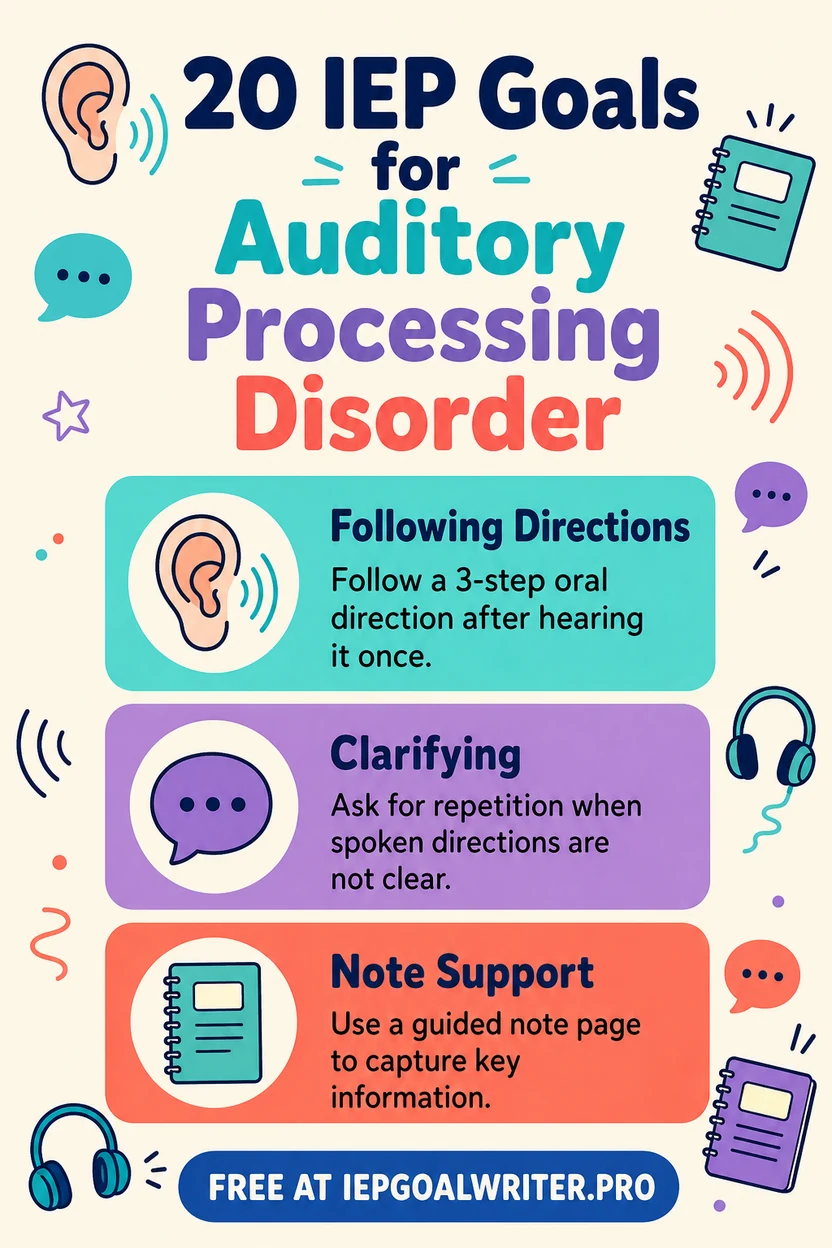
IEP goals for auditory processing needs should teach a documented listening or communication skill while preserving access supports. For example: By [date], [student] will repeat back and complete two-step oral directions with access to a visual cue in 4 of 5 trials, as measured by teacher direction-following data.
Auditory processing disorder, APD, or CAPD is not an IDEA eligibility category. Eligibility and services depend on the school evaluation, educational impact, and need for special education; a team may consider categories such as Speech or Language Impairment, Specific Learning Disability, Other Health Impairment, or another applicable category. The goals below target observable listening-related learning skills, while accommodations such as written directions, preferential seating, and assistive listening access may remain essential. Do not set a goal to “fix hearing” or replace audiology and related-service guidance.
Following Multi-Step Oral Directions
- 1.By [date], [student] will repeat or paraphrase a 2-step oral direction before starting the task with both steps stated correctly in 4 of 5 opportunities, as measured by teacher direction-check data.
- 2.By [date], [student] will complete a 3-step oral direction after using the visual cue or written key words listed in the IEP with all 3 steps completed in 4 of 5 trials, as measured by task-analysis data.
- 3.By [date], [student] will identify the first required action from a teacher’s oral direction presented at the agreed pace in 8 of 10 opportunities across 3 sessions, as measured by listening-response probe data.
- 4.By [date], [student] will follow an oral direction containing one temporal or spatial concept, such as before/after or first/last with 80% accuracy across 15 trials, as measured by SLP/teacher listening probes.
- 5.By [date], [student] will carry out a multi-step classroom direction in a typical group setting after using the assigned listening support in 4 of 5 opportunities across 2 classes, as measured by classroom observation data.
Clarification and Repetition Requests
- 1.By [date], [student] will ask for repetition when a key part of an oral direction was missed rather than guessing in 4 of 5 observed breakdowns, as measured by clarification-request tally data.
- 2.By [date], [student] will request that a speaker repeat only the missed step or key word using the taught clarification phrase in 4 of 5 opportunities, as measured by SLP/teacher communication data.
- 3.By [date], [student] will ask the speaker to slow down, chunk the direction, or provide a visual when the student identifies that support as needed in 4 of 5 relevant situations, as measured by self-advocacy checklist data.
- 4.By [date], [student] will confirm understanding by restating the direction and asking whether the restatement is correct in 4 of 5 complex-direction opportunities, as measured by teacher observation data.
- 5.By [date], [student] will use an agreed nonverbal signal to indicate “I missed that” during whole-group instruction without waiting until the task has started in 80% of documented opportunities across 3 weeks, as measured by signal-use tally data.
Note-Taking and Listening Supports
- 1.By [date], [student] will record at least 3 teacher-identified key words from a short oral explanation using the assigned note-taking template in 4 of 5 lessons, as measured by completed-note rubric data.
- 2.By [date], [student] will match a spoken main idea with the correct heading on a visual organizer with 80% accuracy across 10 short passages, as measured by listening-comprehension probe data.
- 3.By [date], [student] will use teacher-provided slides or written key words to complete missing information in notes after listening to a short explanation with at least 80% of required fields correct across 5 samples, as measured by note-taking work samples.
- 4.By [date], [student] will compare notes with a model and add one missed key detail after instruction in 4 of 5 lessons, as measured by note-revision checklist data.
- 5.By [date], [student] will use the assigned listening technology or classroom audio support and complete the setup/check routine before instruction begins in 4 of 5 class periods, as measured by technology-use checklist data.
Phonological Listening Skills
- 1.By [date], [student] will identify whether 2 spoken words are the same or different when they differ by one target speech sound with 80% accuracy across 20 trials, as measured by SLP phonological listening probes.
- 2.By [date], [student] will segment a spoken one-syllable word into its individual phonemes using counters or another assigned support with 80% accuracy across 10 words, as measured by phonemic-awareness probe data.
- 3.By [date], [student] will blend 3 to 4 orally presented phonemes into a word with 80% accuracy across 10 trials, as measured by SLP or reading intervention probes.
- 4.By [date], [student] will identify the first, middle, or final sound in a spoken word as asked with 80% accuracy across 15 items, as measured by phonological processing probes.
- 5.By [date], [student] will repeat a short sequence of 3 to 4 orally presented items using the student’s rehearsal or visualization strategy with 80% sequence accuracy across 10 trials, as measured by auditory-memory probe data.
A Worked Example: One Student, PLAAFP to Data Plan
Present levels: Renee follows single oral directions reliably and understands science concepts when she can see the procedure. Across 12 three-step lab directions delivered orally, she completed all steps in 3 trials; in the remaining trials she usually completed the first step and missed one of the later steps. When the teacher provided a written key-word list, she completed all three steps in 9 of 10 trials. Renee can repeat directions after an adult asks her to do so, but independently requested repetition or clarification in 1 of 12 observed breakdowns. The educational impact is missed procedural information and reduced independence during orally dense instruction.
Annual goal derived from that baseline: By [date], when given a multi-step oral direction during an academic routine, Renee will use the documented listening support, repeat or record the key steps, and request clarification for any missing step before beginning, completing all required steps in 4 of 5 opportunities, as measured by direction-following and self-advocacy data. Specially designed instruction should teach a repeat-back/keyword routine, how to identify the missing piece, and specific clarification language.
Goal versus accommodation: Written directions, reduced background noise, preferential access to the speaker, visual supports, or assistive listening technology may be accommodations. The annual goal is Renee’s strategic use of information and clarification—not listening without supports.
Data plan: Score each direction step, support used, clarification request, prompt level, and task outcome. Keep the length and complexity of probe directions comparable. When Renee meets criterion in science, sample another routine such as PE, art, or a general-education class to see whether the strategy generalizes.
How These Goals Change by Grade Band
For younger students, use one- and two-step directions, concrete visuals, repeat-back routines, and a simple help signal. Instruction should teach the child what to do when part of a message is missed, rather than repeatedly telling the child to “listen carefully.”
In grades 3–5, add recording key words, asking for a specific repetition, following longer oral directions with written support, note-taking from short teacher explanations, and phonological targets when evaluation data identify them. Progression comes from more complex information and greater strategic independence, not from removing the visual support that makes the information accessible.
In middle and high school, prioritize lecture/lab access, concise note-taking, self-advocacy with multiple teachers, managing assistive listening tools if used, and clarifying technical vocabulary or missed procedural steps. The student should learn to select the most efficient support for the context. Because APD is not an IDEA category, goals should reflect the evaluated school skill, not the diagnostic label.
Collecting Data Without Adding a Full-Time Job
Match the measure to the listening skill. For directions, score each required step and whether the student used the planned written/visual support. For clarification goals, tally real breakdowns and whether the student requested repetition, slower rate, the missing step, or another specific repair. For note-taking, compare the student’s notes with a short set of essential ideas rather than rating neatness.
Keep auditory conditions documented. Background noise, distance, speaker rate, visual access, and assistive technology can change performance substantially. If the goal is strategy use with a written support, removing that support for the probe makes the data invalid for that goal.
Add generalization checks without creating constant testing. Use a short structured probe plus one natural observation from another class every few weeks. If the student follows directions accurately but never independently asks for clarification, teach the self-advocacy component rather than increasing direction length. If performance drops only in one acoustically difficult setting, investigate environmental access before rewriting the goal.
Personalization warning: Auditory processing disorder/CAPD is a clinical diagnosis and not a standalone IDEA eligibility category. Do not infer APD from inattentiveness or difficulty following directions. School goals should come from appropriate evaluation data and target the specific educational skill—such as following oral information, phonological processing, note-taking, or self-advocacy—under the supports the team has identified.
FAQ
Paste your assessment data and generate an IDEA-compliant, individualized goal in seconds.
Try it free →