20 IEP Goals for Sensory Processing Difficulties
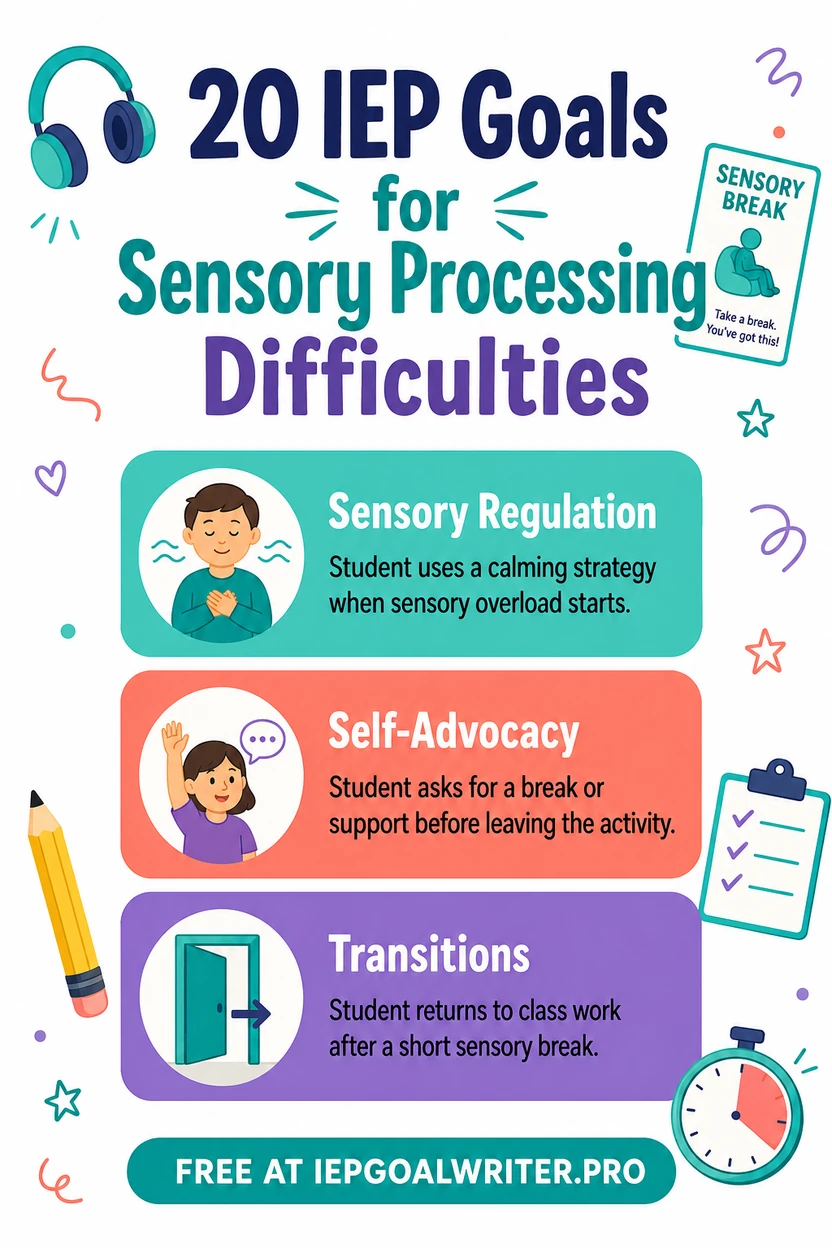
IEP goals for sensory processing difficulties should describe the school-access skill that needs instruction, such as noticing a trigger, requesting a break, or returning to work. For example: By [date], [student] will use a taught sensory regulation strategy after identifying an early trigger in 4 of 5 observed opportunities, as measured by a behavior log.
Sensory processing difficulty is not an IDEA eligibility category by itself. A student may be eligible under Autism, Other Health Impairment, Specific Learning Disability, or another category only when the evaluation and team decision show a need for special education. These 20 goals target observable school access: regulation, communication of sensory needs, participation, and transitions. Each is a starting structure to align with the student’s actual baseline, sensory profile, and service plan.
Sensory Regulation
- 1.By [date], [student] will name or indicate one early body or environmental signal that a sensory load is becoming difficult before leaving the activity in 4 of 5 observed opportunities across 3 school days, as measured by teacher event-log data.
- 2.By [date], [student] will choose an appropriate regulation option from a visual menu of at least 3 taught choices after identifying a sensory trigger in 80% of documented opportunities across 2 settings, as measured by strategy-choice tally data.
- 3.By [date], [student] will use the selected regulation strategy for the agreed duration and then signal readiness to return to instruction in 4 of 5 opportunities with no more than 1 adult prompt, as measured by behavior-log duration and prompt data.
- 4.By [date], [student] will return to the assigned task within 3 minutes after a planned sensory break ends in 4 of 5 documented breaks across 3 consecutive weeks, as measured by break-and-return timing data.
- 5.By [date], [student] will rate regulation on a 3-point self-monitoring scale before and after using a taught strategy and select the next step that matches the rating with 80% agreement with staff scoring across 10 observations, as measured by student self-monitoring forms and staff comparison data.
Self-Advocacy for Sensory Needs
- 1.By [date], [student] will request a sensory break or environmental adjustment using speech, AAC, a card, or the established communication system before leaving the activity in 4 of 5 opportunities across 3 settings, as measured by communication tally data.
- 2.By [date], [student] will state or indicate the specific support needed, such as quieter seating, movement, reduced visual clutter, or headphones in 8 of 10 naturally occurring opportunities, as measured by teacher communication checklist data.
- 3.By [date], [student] will tell an unfamiliar school adult what support is needed using the student’s established communication mode in 4 of 5 role-play or real-school opportunities, as measured by self-advocacy rubric scores.
- 4.By [date], [student] will decline an offered sensory support that is not helpful and choose a different taught option in 4 of 5 structured choice opportunities, as measured by OT or teacher observation data.
- 5.By [date], [student] will use a discreet class-specific signal to request support without stopping instruction for peers in 80% of relevant opportunities across 3 consecutive weeks, as measured by classroom signal-use tally data.
Participation and Access
- 1.By [date], [student] will remain engaged in a teacher-selected group activity for 10 consecutive minutes while using an agreed sensory support in 4 of 5 sessions, as measured by momentary time-sampling data.
- 2.By [date], [student] will complete a 3-step classroom task after setting up the sensory support listed in the IEP with all 3 steps completed in 4 of 5 trials, as measured by task-analysis data.
- 3.By [date], [student] will participate in a previously difficult school routine, such as assembly, cafeteria, art, or PE, for the individually defined interval in 4 of 5 opportunities with no more than 1 adult prompt, as measured by participation-duration data.
- 4.By [date], [student] will shift from a sensory support back to the same academic task and complete at least 80% of the assigned portion across 4 of 5 class periods, as measured by work-completion records.
- 5.By [date], [student] will identify one environmental change that would improve access and use it before beginning an independent task in 4 of 5 opportunities across 2 classrooms, as measured by access-preparation checklist data.
Transitions and Recovery
- 1.By [date], [student] will follow a 3-step visual transition routine from one classroom activity to the next in 4 of 5 transitions across 3 consecutive days, as measured by transition checklist data.
- 2.By [date], [student] will begin a planned transition within 2 minutes of the transition cue while using the assigned sensory support in 80% of opportunities across 2 settings, as measured by latency data.
- 3.By [date], [student] will recover from an unexpected schedule or sensory change by selecting one taught coping action and rejoining the next activity in 4 of 5 observed incidents, as measured by ABC/event-log data.
- 4.By [date], [student] will carry or independently retrieve the needed sensory support before moving to a predictable high-demand setting in 4 of 5 scheduled transitions, as measured by materials-readiness checklist data.
- 5.By [date], [student] will complete the return-to-learning routine after a difficult transition, including settling, checking the schedule, and starting the first task step in 4 of 5 opportunities with no more than 1 prompt, as measured by 3-step routine checklist data.
A Worked Example: One Student, PLAAFP to Data Plan
Present levels: Maya participates successfully in quiet small-group work and can name two supports she likes. During 10 noisy whole-group observations across two weeks, she showed an early signal—covering her ears or leaving her chair—in 8 observations and left the activity or cried in 6. When an adult pointed to her break card, she requested a break in 5 of 6 opportunities; she independently requested support before escalation in 1 of 8 opportunities. The educational impact is lost instructional time and difficulty re-entering the same task after the sensory load increases.
Annual goal derived from that baseline: By [date], Maya will independently identify or indicate an early sensory signal, request one agreed support, and return to the original activity within 5 minutes in 4 of 5 observed opportunities across 2 school settings, as measured by event-log and return-to-task data. Specially designed instruction should teach the sequence when Maya is regulated: notice the signal, choose from a small menu, communicate the choice, use the support, and rehearse the return routine. Staff should fade prompts rather than simply increasing access to breaks.
Goal versus accommodation: Noise-reducing headphones, predictable seating, previewing a loud event, or access to a movement break can be accommodations because they change access conditions. The annual goal is the skill Maya is learning—recognizing a need, communicating it, using the agreed plan, and resuming participation. The team should not withhold an accommodation in order to “test” the goal.
Data plan: Use one line per relevant event: setting, trigger, early signal, support requested, prompt level, minutes away, and whether Maya returned to the original task. Graph independent requests separately from prompted requests. Review the last 5–10 events every two weeks; if independence rises in one setting but not another, teach and probe generalization rather than raising the criterion prematurely.
How These Goals Change by Grade Band
In PreK–2, the progression usually starts with recognizing one or two concrete body/environment signals, choosing between two visual supports, and completing a very short return routine with adult co-regulation. The instructional target is not “tolerating noise”; it is learning a predictable communication-and-recovery sequence that preserves access to play and early academics.
In grades 3–5, move toward comparing support options, using a discreet signal, preparing for predictable high-load settings, and returning to multi-step academic work. The student can begin rating whether a strategy helped and choosing a different strategy when the first one does not.
In middle and high school, prioritize portable self-advocacy across teachers and environments: planning ahead for assemblies, labs, cafeterias, vocational settings, or transportation; explaining needed supports to unfamiliar adults; and managing the smallest effective interruption to instruction. The grade-band shift should increase independence and generalization, not simply increase the amount of sensory input the student is expected to endure.
Collecting Data Without Adding a Full-Time Job
Use event-based data for sensory-regulation goals rather than rating the entire day. Record only the moments in which the target skill could reasonably occur: setting, likely trigger, the student’s first observable signal, support requested or selected, prompt level, time away, and whether the student returned to the original task. This produces instructional information instead of a vague “regulated/not regulated” score.
For self-advocacy goals, separate independent requests from gestural, verbal, or modeled prompts. Also score whether the requested support matched the student’s identified need. For participation goals, use a defined duration or brief momentary time sampling. For transitions, time a specific interval such as cue-to-movement or end-of-break-to-first-task-step.
Build a simple decision rule into the progress-monitoring plan. If independent use is increasing but return-to-task is flat, teach the recovery routine rather than changing the request goal. If performance meets criterion in one predictable setting across several data points, probe a second setting before calling the skill generalized. If data remain flat, review antecedents, instruction, prompt fading, and whether the goal is measuring the correct skill.
Personalization warning: Do not write a sensory goal simply because a student seeks movement, dislikes noise, or uses sensory equipment. A goal is appropriate only when baseline data identify a school-access skill requiring specialized instruction. Environmental changes, headphones, seating, movement opportunities, and other access supports may belong as accommodations instead of annual goals.
FAQ
Paste your assessment data and generate an IDEA-compliant, individualized goal in seconds.
Try it free →