20 IEP Goals for Slow Processing Speed
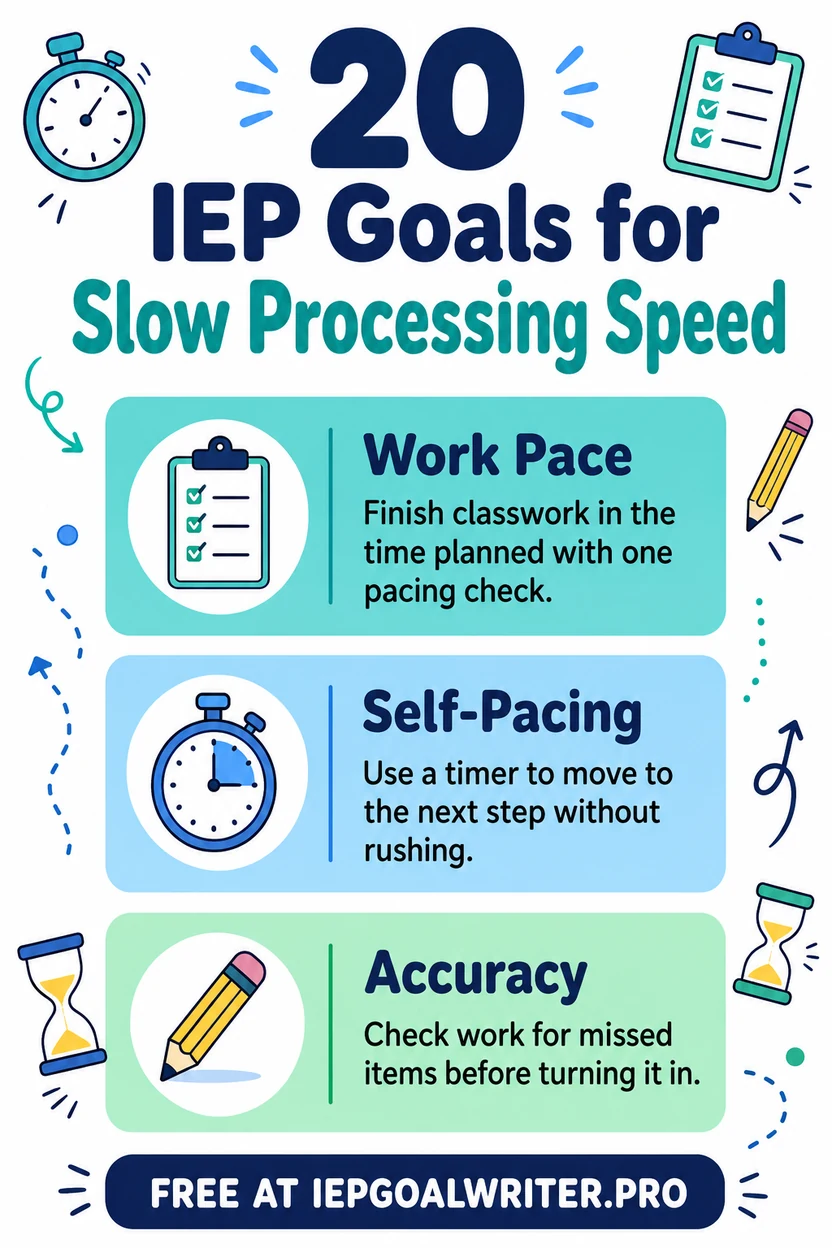
IEP goals for slow processing speed should target a specific learnable work skill and distinguish it from the need for extended time. For example: By [date], [student] will use a two-step pacing plan to complete 12 mixed math facts at 90% accuracy in 4 of 5 probes, as measured by curriculum-based measurement.
Slow processing speed is not an IDEA eligibility category or a diagnosis by itself. A student may be eligible under an IDEA category when evaluation data show an educational impact and need for specialized instruction. Some students need accommodations such as extended time, reduced copying, or a quieter setting; others also need direct instruction in automaticity, pacing, organization, or self-monitoring. These goals help the team separate the support from the teachable skill and avoid treating faster work as the only outcome that matters.
Work Completion Within a Defined Routine
- 1.By [date], [student] will begin a familiar independent assignment within 3 minutes after directions and materials are provided in 4 of 5 opportunities across 3 weeks, as measured by task-initiation latency data.
- 2.By [date], [student] will complete the teacher-defined essential portion of a routine assignment within the individualized work interval in 4 of 5 class periods, as measured by work-completion timing data.
- 3.By [date], [student] will move from one completed task step to the next without waiting for an additional adult cue in 80% of scored transitions within tasks, as measured by task-analysis data.
- 4.By [date], [student] will use a visual checklist to complete a 4-step classroom routine within the allotted routine period with all 4 steps completed in 4 of 5 opportunities, as measured by routine checklist and timing data.
- 5.By [date], [student] will finish and submit a short class assignment by the agreed deadline after using the support plan named in the IEP in at least 80% of opportunities across 3 consecutive weeks, as measured by submission records.
Automaticity and Fluency
- 1.By [date], [student] will read a practiced word or phrase list at the individualized target rate while maintaining at least 95% accuracy across 3 consecutive one-minute probes, as measured by curriculum-based reading fluency measures.
- 2.By [date], [student] will retrieve 20 previously mastered math facts within the individualized timing window with at least 90% accuracy across 3 probes, as measured by math fluency probes.
- 3.By [date], [student] will write or type a practiced sentence frame response at the individualized target rate without omitting required content in 4 of 5 timed samples, as measured by writing-rate work samples.
- 4.By [date], [student] will name or categorize familiar academic items from a practiced set within the individualized response interval with 80% accuracy across 20 items, as measured by automaticity probe data.
- 5.By [date], [student] will complete a repeated routine task using fewer total seconds than baseline while maintaining the baseline accuracy criterion in 4 of 5 weekly probes, as measured by rate-and-accuracy progress-monitoring data.
Self-Pacing Strategies
- 1.By [date], [student] will estimate whether a task will take less than 5, 10–20, or more than 20 minutes and choose the matching work plan with 80% accuracy across 10 planning opportunities, as measured by time-estimation records.
- 2.By [date], [student] will use a timer or visual time cue to check progress at the halfway point of a work period in 4 of 5 class periods, as measured by self-pacing checklist data.
- 3.By [date], [student] will divide a multi-part assignment into at least 3 work chunks and record a completion point for each in 4 of 5 assignments, as measured by student work-plan review data.
- 4.By [date], [student] will request the specific extended-time or reduced-copying support listed in the IEP before the standard work period expires in 4 of 5 relevant opportunities, as measured by self-advocacy tally data.
- 5.By [date], [student] will compare completed work with the planned halfway target and adjust pace or request help using the taught routine in 4 of 5 work periods, as measured by mid-task self-monitoring forms.
Accuracy Without Rushing
- 1.By [date], [student] will complete the first pass of an assignment at the student’s planned pace and reserve the final 3 minutes for checking in 4 of 5 assignments, as measured by work-timing and self-check data.
- 2.By [date], [student] will use a 3-item accuracy checklist before submitting timed or high-volume work with all 3 checks completed in 4 of 5 opportunities, as measured by completed checklist data.
- 3.By [date], [student] will identify and correct at least 80% of careless errors marked by the student’s own checking routine before submission across 5 work samples, as measured by error-analysis work samples.
- 4.By [date], [student] will maintain the individualized accuracy criterion when the task rate increases by the next instructional step across 3 consecutive probes, as measured by rate-and-accuracy curriculum-based measures.
- 5.By [date], [student] will choose to slow down and rework an item after detecting a mismatch between the answer and a model, estimate, or rubric in 4 of 5 detected-error opportunities, as measured by self-correction tally data.
A Worked Example: One Student, PLAAFP to Data Plan
Present levels: Marcus explains algebra concepts accurately in discussion and earns 85–90% on untimed computation checks. Across five 25-minute independent practice periods, he completed 5, 6, 5, 7, and 5 of 12 problems. In the final five minutes, his error rate increased sharply when he tried to finish everything at once. With a visual work plan that identifies six essential problems first, he completed an average of 5.5 essential problems at 88% accuracy and used the remaining time for review. The educational impact is incomplete demonstration of known skills and rushing-related errors under classroom time demands.
Annual goal derived from that baseline: By [date], given a teacher-defined priority set and the student’s approved timing supports, Marcus will begin within 2 minutes, complete at least 80% of the priority items, and maintain at least 85% accuracy in 4 of 5 class work periods, as measured by start-latency, completion, and accuracy data. Specially designed instruction should teach prioritizing, estimating time, using a midway check, and recognizing when to request clarification or an approved extension.
Goal versus accommodation: Extended time, reduced copying, access to notes, or a smaller representative practice set may be accommodations when documented by the team. The annual goal targets a teachable pacing or productivity routine; it should not require the student to “process faster” as a neurological trait.
Data plan: Track start latency, amount attempted, amount correct, essential items completed, and whether the pacing strategy was used. Compare similar task types over time. If Marcus becomes faster only by sacrificing accuracy, the strategy needs revision. If accuracy and completion improve with a priority-set routine, probe whether he can apply the same routine in another subject before increasing workload.
How These Goals Change by Grade Band
For early learners, focus on predictable start routines, very short work sets, visual first/next cues, and automaticity only for skills that truly benefit from fluent retrieval. The goal should teach how to enter and complete a task, not make speed itself the universal measure of competence.
In grades 3–5, add efficient use of known strategies, brief fluency practice where instructionally appropriate, pacing a defined work chunk, checking one error type, and using a timer as information rather than pressure. Keep rate and accuracy paired so rushing is not rewarded.
In middle and high school, connect goals to authentic class demands: prioritizing essential items, planning multi-part assignments, estimating time, using approved extended time effectively, and communicating when processing demands exceed the available window. The progression should increase strategic independence while preserving accommodations that provide access. A student who needs more time can still learn to use that time productively.
Collecting Data Without Adding a Full-Time Job
Collect rate and accuracy together. A faster worksheet score is not progress if errors rise, and perfect accuracy can still mask that the student cannot finish the essential classroom task in a functional window. For routine work, record start latency, amount attempted, amount correct, amount completed, and support used. For fluency targets, use equivalent probes and a consistent timing interval.
Separate the skill bottleneck from the access condition. If the student knows the content but loses time copying, reading dense directions, navigating a platform, or organizing materials, those may require different goals or accommodations. Do not combine all delay into one “processing speed” number.
Use a decision rule that protects accuracy. If completion rises while accuracy remains within the team’s target range across several comparable probes, consider increasing independence or generalizing the pacing routine. If speed rises and accuracy falls, restore the prior strategy and teach checking. If performance is stable only with extended time, that does not mean the accommodation should be removed; the annual target can still measure effective use of the accessible time.
Personalization warning: Slow processing speed is a test/functional description, not an IDEA eligibility category. Do not write a goal to make a student globally “faster.” Choose the specific school task that breaks down—initiation, automaticity, pacing, written output, note taking, or another skill—and measure it under valid access conditions.
FAQ
Paste your assessment data and generate an IDEA-compliant, individualized goal in seconds.
Try it free →