20 IEP Goals for Telling Time and Time Concepts
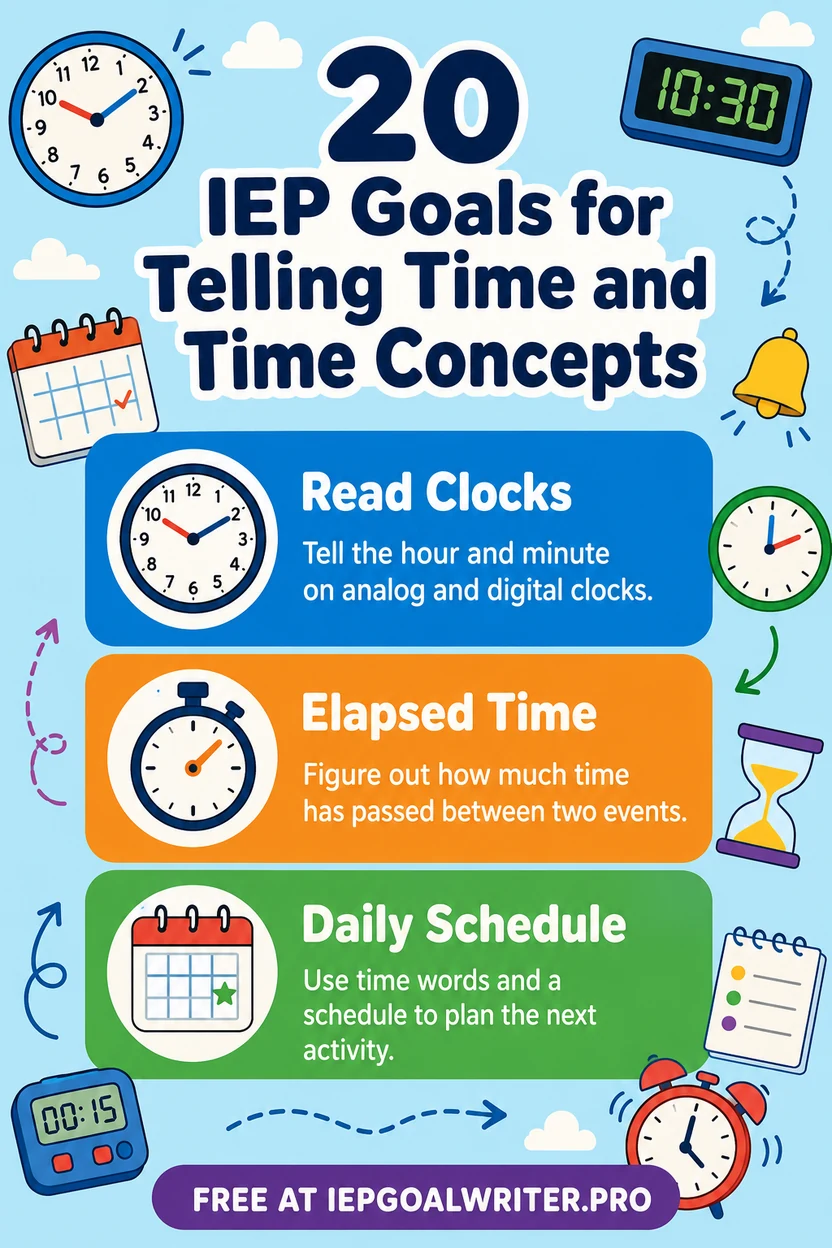
Telling-time IEP goals should identify the exact time concept that needs instruction, such as reading quarter-hour time or calculating elapsed time. For example: By [date], [student] will read analog time to the nearest five minutes with 85% accuracy across 3 probes, as measured by curriculum-based time-concept data.
Time concepts are not one skill. A student may recognize a digital clock but not connect it to a schedule, read an analog clock but not calculate elapsed time, or know time vocabulary but not start work independently. These 20 goals separate those steps and link them to everyday school participation. Begin with an error analysis and real routines: arrival, transitions, work periods, appointments, or community access. Keep visual timers and schedule supports as accommodations when the student needs them; the goal should measure the teachable skill.
Reading Analog and Digital Time
- 1.By [date], [student] will read digital times to the nearest 5 minutes with 90% accuracy across 20 mixed items for 3 consecutive probes, as measured by teacher time-reading probes.
- 2.By [date], [student] will read analog clock times to the nearest 5 minutes using the taught hour-hand/minute-hand routine with 80% accuracy across 20 items, as measured by curriculum-based time probes.
- 3.By [date], [student] will match an analog clock to the corresponding digital time from 3 choices with 80% accuracy across 15 trials, as measured by clock-matching probe data.
- 4.By [date], [student] will set an analog or instructional clock to a stated time to the nearest 5 minutes with 80% accuracy across 15 trials, as measured by performance-based time tasks.
- 5.By [date], [student] will identify whether a displayed time is a.m. or p.m. when given a familiar school or daily-life activity with 80% accuracy across 10 scenarios, as measured by time-concept scenario probes.
Elapsed Time
- 1.By [date], [student] will determine elapsed time in whole hours between a start and end time with 80% accuracy across 10 problems, as measured by curriculum-based elapsed-time probes.
- 2.By [date], [student] will determine elapsed time to the nearest 5 minutes using a number line, timeline, or clock model with 80% accuracy across 10 problems, as measured by work-sample analysis.
- 3.By [date], [student] will find the end time when given a start time and duration within the individualized range with 80% accuracy across 10 problems, as measured by teacher-scored time problems.
- 4.By [date], [student] will compare the durations of 2 scheduled activities and state how many minutes longer or shorter one activity is with 80% accuracy across 10 timetable items, as measured by functional elapsed-time work samples.
- 5.By [date], [student] will use a digital timer or schedule to verify whether a planned activity finished within the stated duration in 4 of 5 functional opportunities, as measured by functional time-use checklist data.
Sequencing Daily Schedules
- 1.By [date], [student] will place 5 familiar daily activities in chronological order using picture, written, or digital schedule cards with 80% accuracy across 5 schedule sets, as measured by schedule-sequencing task data.
- 2.By [date], [student] will identify the activity that comes before and after a named event on the student’s school schedule with 80% accuracy across 10 trials, as measured by schedule comprehension probes.
- 3.By [date], [student] will use a daily schedule to locate the start time of the next required class or activity in 4 of 5 opportunities across 2 weeks, as measured by schedule-use tally data.
- 4.By [date], [student] will calculate how many minutes remain before a scheduled transition when given the current time with 80% accuracy across 10 functional trials, as measured by functional elapsed-time data.
- 5.By [date], [student] will update the student’s schedule after one announced change and identify the new next activity in 4 of 5 planned change opportunities, as measured by schedule-adaptation checklist data.
Using Time for Self-Management
- 1.By [date], [student] will set a timer for the agreed work interval before beginning an independent task in 4 of 5 opportunities, as measured by self-management checklist data.
- 2.By [date], [student] will check the remaining time at the planned midpoint and identify whether the task is on pace, ahead, or behind in 4 of 5 work periods, as measured by time-monitoring forms.
- 3.By [date], [student] will use the class or personal schedule to arrive at a designated school location within the individualized time window in 4 of 5 transitions across 3 weeks, as measured by transition timing data.
- 4.By [date], [student] will estimate whether a familiar task will take less than 5, 10–20, or more than 20 minutes and compare the estimate with actual time with 80% correct range estimates across 10 tasks, as measured by time-estimation logs.
- 5.By [date], [student] will request a time-related clarification, such as start time, end time, or remaining minutes, before missing a deadline or transition in 4 of 5 relevant opportunities, as measured by self-advocacy tally data.
A Worked Example: One Student, PLAAFP to Data Plan
Present levels: Harper reads digital time to the hour with 9/10 accuracy and matches common daily activities to morning/afternoon routines. On two analog-clock probes she read time to the nearest five minutes correctly on 3/10 and 4/10 items. During centers, she transitioned when an adult verbally redirected her in 8 of 10 opportunities but independently checked the posted end time or timer in 1 of 10. Her strength is reading a visual schedule once prompted. The educational impact is difficulty using time information independently to start, stop, or prepare for classroom routines.
Annual goal derived from that baseline: By [date], given the classroom schedule and an analog or digital time display used in that setting, Harper will identify the current/end time, determine whether the transition is due within the taught interval, and begin the transition routine within 2 minutes in 4 of 5 opportunities, as measured by schedule-use and transition-latency data. A separate academic target may address reading analog time to five-minute intervals if that prerequisite is documented. Specially designed instruction should connect clock concepts to real schedule decisions rather than teaching clock worksheets in isolation.
Goal versus accommodation: Visual schedules, timers, alarms, color-coded clocks, or extra transition warnings can be accommodations. The annual goal is using time information or the support system with increasing independence. The team does not need to remove alarms to prove the student “knows time” if the authentic goal is self-management.
Data plan: Keep academic clock-reading probes separate from functional schedule data. For clock reading, record the exact interval type and error pattern. For self-management, record cue available, whether Harper checked it independently, correct interpretation, and latency to action. If worksheet accuracy improves but transitions do not, teach the bridge from reading time to acting on time.
How These Goals Change by Grade Band
For early learners, begin with before/after, first/next, parts of the day, predictable routines, and concrete timer use before expecting formal clock reading. Students can learn that a visual or sound cue signals a routine change even while clock concepts are still developing.
In grades 3–5, connect analog/digital reading, five-minute intervals, elapsed time, schedules, and deadlines to authentic classroom routines. The IEP target may address a prerequisite time concept while grade-level instruction continues; visual schedules and timers can remain access supports.
In middle and high school, prioritize functional time management: reading class/work schedules, calculating when to leave, estimating task duration, using calendar alerts, planning travel time, and recognizing conflicts. An older student who uses a phone timer successfully may need a planning goal more than an analog-clock worksheet goal. Progression should move from reading a representation of time to using time information to make independent school and transition decisions.
Collecting Data Without Adding a Full-Time Job
Separate clock-reading from functional time use. A student can read 2:35 correctly and still be unable to determine when to leave for class; another may use alarms successfully despite weak analog-clock skills. Use short probes for analog/digital accuracy, work samples for elapsed-time calculation, and natural routine data for schedule/self-management goals.
For analog-clock targets, code the error pattern: hour hand, minute hand, five-minute counting, crossing the hour, or reading intervals such as quarter-hour. For elapsed time, note whether the student chose a number line, clock model, equation, or another taught strategy. For functional goals, tally independent cue checking, correct interpretation, and action latency.
Use generalization deliberately. When the student independently follows one class schedule, probe a second routine with a different display or timing demand. If clock-reading accuracy rises but real transitions remain prompt-dependent, the instructional decision is to teach cue monitoring and action initiation—not simply harder clock problems.
Personalization warning: Do not assume telling time must mean analog-clock mastery for every student. Choose the time skill that affects current educational access or transition needs. For some students that is reading a clock; for others it is elapsed time, following a schedule, setting an alarm, estimating duration, or using time to start and stop work.
FAQ
Paste your assessment data and generate an IDEA-compliant, individualized goal in seconds.
Try it free →