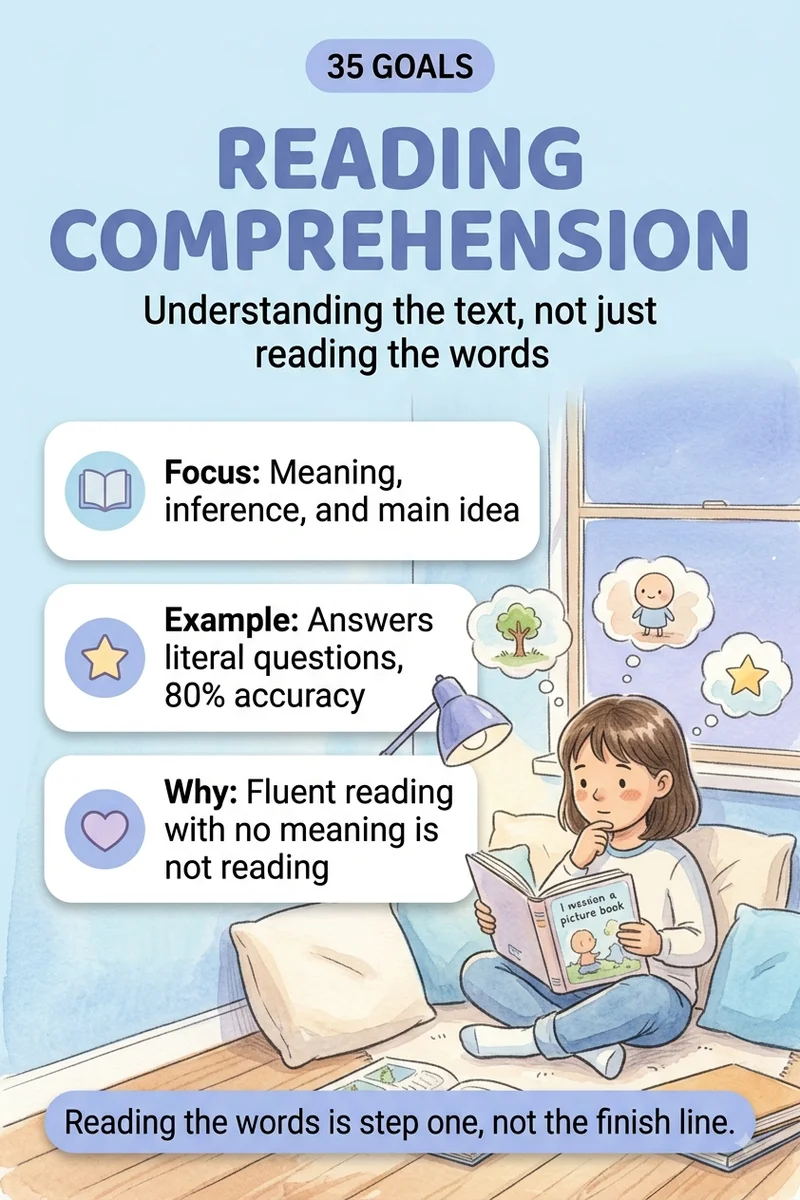
35 Reading Comprehension IEP Goals, Preschool Through High School
Comprehension goals go wrong when they are written for a student who cannot yet decode. A fluent-sounding reader who cannot answer questions needs a comprehension goal; a student who is still sounding out words needs a decoding goal first, because a comprehension score for them is really a decoding score in disguise.
Free · no email required · opens your browser's print dialog
Preschool & Pre-K
- 1By [date], [student] will answer a literal "who" or "what" question about a story read aloud, using words, signs, or an AAC device, in 4 of 5 opportunities.
- 2By [date], [student] will retell one event from a familiar story with picture support in 3 of 4 opportunities.
- 3By [date], [student] will point to a named object from a field of three with 85% accuracy across 4 of 5 trials.
- 4By [date], [student] will use 10 new vocabulary words from shared reading spontaneously during play, as measured by teacher observation over 2 weeks.
- 5By [date], [student] will attend to a shared reading activity for 5 consecutive minutes with no more than 1 redirect in 4 of 5 sessions.
- 6By [date], [student] will predict what happens next in a familiar story with 75% accuracy in 3 of 4 opportunities.
Kindergarten – 2nd
- 7By [date], [student] will answer literal who/what/where questions about a grade-level passage with 80% accuracy across 4 of 5 trials.
- 8By [date], [student] will retell a story including character, setting, problem, and solution in 4 of 5 opportunities.
- 9By [date], [student] will identify the main topic of a short informational text with 75% accuracy in 4 of 5 trials.
- 10By [date], [student] will use picture and context clues to determine the meaning of an unfamiliar word with 75% accuracy across 4 of 5 trials.
- 11By [date], [student] will make a prediction about a text and confirm or revise it after reading in 3 of 4 opportunities.
3rd – 5th Grade
- 12[student] will retell a 3-paragraph narrative including character, setting, problem, and resolution, with 80% accuracy in 3 of 4 retell attempts.
- 13[student] will answer inferential and predictive questions about a story or passage, with 75% accuracy across 4 of 5 trials.
- 14[student] will summarize the main idea of a short passage or conversation in 1-2 sentences, with 80% accuracy across 4 of 5 trials.
- 15By [date], [student] will identify the main idea and 3 supporting details from a grade-level informational text with 80% accuracy in 4 of 5 trials.
- 16By [date], [student] will make an inference and cite the specific text evidence supporting it with 75% accuracy across 4 of 5 probes.
- 17By [date], [student] will summarise a grade-level passage in 3-4 sentences without copying text verbatim, scoring 3/4 on a rubric in 4 of 5 opportunities.
- 18By [date], [student] will identify the author's purpose (inform, persuade, entertain) with 80% accuracy across 4 of 5 trials.
- 19By [date], [student] will compare and contrast two texts on the same topic using a graphic organiser with 80% accuracy in 4 of 5 trials.
- 20By [date], [student] will identify cause and effect relationships in a grade-level text with 80% accuracy across 4 of 5 trials.
6th – 8th Grade
- 21[student] will answer higher-order comprehension questions (compare/contrast, cause/effect) about grade-level text, with 75% accuracy across 4 of 5 trials.
- 22[student] will identify the main idea and supporting details of a lecture or reading passage, with 80% accuracy across 4 of 5 trials.
- 23By [date], [student] will determine a central idea of a grade-level text and trace how it develops across the passage with 75% accuracy in 4 of 5 trials.
- 24By [date], [student] will cite textual evidence to support an analysis of what the text says explicitly and inferentially with 80% accuracy across 4 of 5 assignments.
- 25By [date], [student] will analyse how a specific paragraph fits into the overall structure of a text with 75% accuracy in 4 of 5 trials.
- 26By [date], [student] will compare how two authors present the same topic differently with 75% accuracy across 4 of 5 opportunities.
- 27By [date], [student] will distinguish fact from opinion and identify bias in an informational text with 80% accuracy in 4 of 5 trials.
- 28By [date], [student] will summarise a grade-level text objectively, without personal opinion, scoring 3/4 on a rubric in 4 of 5 opportunities.
9th – 12th Grade
- 29[student] will identify bias, persuasion, or unstated assumptions in spoken or written communication, with 75% accuracy across 4 of 5 trials.
- 30[student] will follow and summarize a multi-step verbal instruction set (a recipe, a work order, an assembly guide), with 80% accuracy across 4 of 5 trials.
- 31By [date], [student] will cite strong textual evidence to support an analysis of a grade-level text with 80% accuracy across 4 of 5 assignments.
- 32By [date], [student] will evaluate an author's argument, distinguishing claims supported by evidence from those that are not, with 75% accuracy in 4 of 5 trials.
- 33By [date], [student] will analyse two texts presenting conflicting information on the same topic and explain the discrepancy with 75% accuracy in 4 of 5 opportunities.
- 34By [date], [student] will determine the meaning of domain-specific vocabulary in a content-area text with 80% accuracy across 4 of 5 trials.
- 35By [date], [student] will annotate a grade-level text to identify claim, evidence, and reasoning with 75% accuracy in 4 of 5 assignments.
How to teach reading comprehension in the classroom
Comprehension is built by teaching a few strategies deeply, not many strategies briefly. Choose two or three that carry weight — predicting, questioning, summarizing, monitoring for confusion — and teach each one explicitly: name it, model it aloud on a real passage, then practice it with feedback before expecting independent use. Talk about the text before, during, and after reading, and keep the text at the student's instructional level so decoding effort does not eat the working memory comprehension needs. Use graphic organizers (story maps, cause-effect frames) to make the structure of the text visible, then fade them. Teach the student to stop and notice when meaning breaks down and to have a fix-up move ready — reread, read on, check a word. Vocabulary and background knowledge matter as much as strategy, so pre-teach the handful of words or ideas that would otherwise block the passage. Retelling in their own words is both practice and assessment.
How to measure it
Name the text and the question type in the goal. "Answers comprehension questions with 80% accuracy" is unscoreable until you say whether the passage is read independently or read aloud to the student, and whether the questions are literal or inferential — those are four different skills.
Where these goals come from
Each goal above is drawn from a grade-band goal bank, where you can see it alongside the other targets it is usually paired with: Communication goals, 3rd – 5th Grade; Communication goals, 6th – 8th Grade; Communication goals, 9th – 12th Grade; Reading goals, 3rd – 5th Grade; Reading goals, 6th – 8th Grade; Reading goals, 9th – 12th Grade; Reading goals, Kindergarten – 2nd Grade; Reading goals, Preschool & Pre-K.
Related skills
A flat following-directions goal is often really a breakdown in one of these skills. If the data does not move, check whether the real target is here instead:
- Reading Fluency IEP goals — reading connected text accurately, at a workable rate, with expression
- Decoding & Phonics IEP goals — turning print into sound reliably enough to stop thinking about it
- Working Memory IEP goals — holding information in mind long enough to act on it
Common questions
Should a comprehension goal come before decoding is solid?
Usually the priority is decoding first, because a student spending all their effort sounding out words has nothing left for meaning. But comprehension work can happen in parallel through read-alouds and listening comprehension, so the student keeps building strategy and vocabulary while decoding catches up.
How do you measure comprehension objectively?
Common measures include correct answers to literal and inferential questions on an instructional-level passage, accuracy of a written or oral retell scored against a rubric, or maze/cloze scores. Pick one, use it consistently, and note the passage level so gains are not just the text getting easier.
Is retelling the same as comprehension?
Retelling is one window into it. A strong retell shows the student grasped the sequence and main ideas, but some students comprehend well and retell poorly, or retell fluently without inference. Pair a retell with a few inferential questions for a fuller picture.
Further reading
Need a goal built from your student's baseline? Generate one for your student →