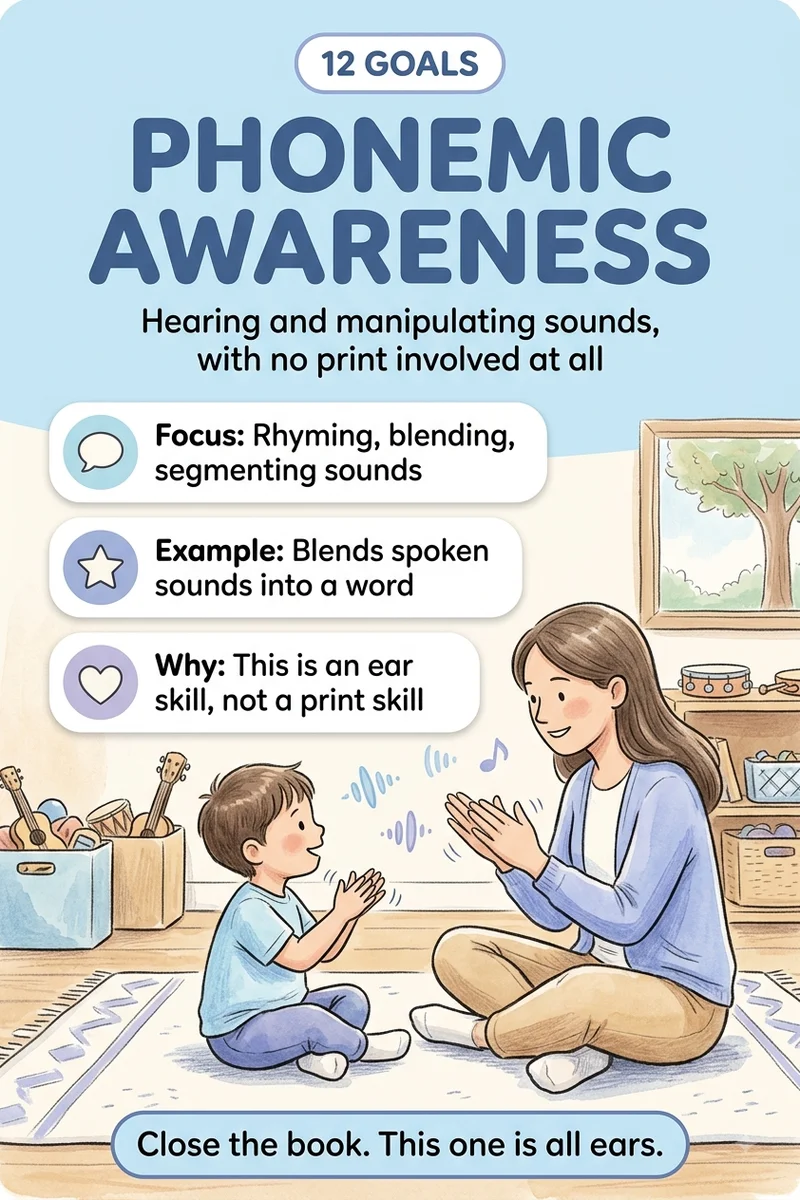
12 Phonemic Awareness IEP Goals, Preschool Through High School
Phonemic awareness is entirely an ear skill — blending, segmenting, and manipulating sounds with the book closed. It is also the single best early predictor of later reading, and the skill most often skipped over once a student can name letters, because naming letters looks like reading readiness and isn't.
Free · no email required · opens your browser's print dialog
Preschool & Pre-K
- 1By [date], [student] will identify whether two spoken words rhyme with 80% accuracy across 4 of 5 trials.
- 2By [date], [student] will produce a rhyming word for a given spoken word in 3 of 4 opportunities.
- 3By [date], [student] will clap the syllables in a 2-syllable spoken word with 80% accuracy across 4 of 5 trials.
- 4By [date], [student] will identify the beginning sound of a spoken word with 75% accuracy across 4 of 5 trials.
- 5By [date], [student] will blend two spoken syllables into a whole word with 80% accuracy in 4 of 5 opportunities.
Kindergarten – 2nd
- 6By [date], [student] will segment a 3-phoneme word into individual sounds with 80% accuracy across 4 of 5 trials.
- 7By [date], [student] will blend 3 spoken phonemes into a whole word with 85% accuracy across 4 of 5 trials.
- 8By [date], [student] will delete the initial phoneme from a single-syllable word with 75% accuracy in 4 of 5 trials.
- 9By [date], [student] will substitute the initial or final phoneme in a single-syllable word with 75% accuracy across 4 of 5 trials.
3rd – 5th Grade
- 10[student] will blend 4-5 phonemes presented orally into a whole word (e.g., /s/-/t/-/r/-/i/-/p/ → "strip"), with 80% accuracy across 4 of 5 trials.
- 11[student] will segment a multisyllabic word into its individual phonemes orally, with 80% accuracy across 4 of 5 trials.
- 12[student] will delete or substitute a phoneme in a spoken word when asked (e.g., "say plant without the /p/"), with 75% accuracy across 4 of 5 trials.
How to teach phonemic awareness in the classroom
Phonemic awareness is an oral skill, so most of the teaching happens with no print in front of the student. Work in short, daily bursts through a rough sequence: rhyme and syllables first, then blending sounds into words, then segmenting words into sounds, and finally manipulating sounds (change the /m/ in mat to /s/). Keep it multisensory — push a token for each sound, tap it on the arm, stretch a rubber band — so an invisible skill becomes something the student can feel. Once a student can blend and segment reliably by ear, connect the sounds to letters immediately; phonemic awareness pays off only when it feeds decoding. Use tiny sets (two or three sounds) and lots of repetition, and target the specific operation the data shows is weak rather than running a general program. Five focused minutes a day beats one long weekly session.
How to measure it
Test it with no print in sight. A student who can blend /s/-/t/-/r/-/i/-/p/ into "strip" when you say it aloud, but freezes when shown the printed word, has a phonemic awareness skill that hasn't transferred to decoding yet — mixing the two into one goal hides which piece is actually missing.
Where these goals come from
Each goal above is drawn from a grade-band goal bank, where you can see it alongside the other targets it is usually paired with: Reading goals, 3rd – 5th Grade; Reading goals, Kindergarten – 2nd Grade; Reading goals, Preschool & Pre-K.
Related skills
A flat following-directions goal is often really a breakdown in one of these skills. If the data does not move, check whether the real target is here instead:
- Decoding & Phonics IEP goals — turning print into sound reliably enough to stop thinking about it
- Reading Fluency IEP goals — reading connected text accurately, at a workable rate, with expression
- Reading Comprehension IEP goals — understanding the text, not just reading the words
Common questions
What is the difference between phonemic awareness and phonics?
Phonemic awareness is purely oral — blending, segmenting and manipulating sounds with no print in front of the student. Phonics connects those sounds to letters. Mixing both into one goal hides which of the two is actually missing.
Do older students still need phonemic awareness goals?
Sometimes. A struggling reader in 3rd grade or above who cannot segment a multisyllabic word orally will not be fixed by more decoding practice alone. Test it with the book closed before assuming the problem is print-based.
Need a goal built from your student's baseline? Generate one for your student →